

Which families belong? Rethinking Canada’s Family Class Program

 |
Canada’s Changing Immigration Landscape |
| Immigration policy is central to the future of the federation. This series explores recent challenges and opportunities, turning complex issues into clear, actionable insights. |
Family members make up roughly one-quarter of Canada’s annual permanent resident admissions, and governments regularly celebrate family reunification as a pillar of Canadian immigration policy. Yet, the Family Class Program still reflects a narrow, outdated understanding of what constitutes a family and continues to impose inconsistent, sometimes opaque barriers that prevent many migrant families from reuniting.
These limitations are increasingly at odds with evolving family structures in Canada and with the realities of transnational caregiving, multigenerational households and diverse intimate partnerships. They also interact with growing pressures on Canada’s migration system, including political concerns about system integrity, long processing times and fluctuating admission targets.
This brief argues that a more inclusive, coherent and consistent family reunification program is needed. Canada’s current legislative and administrative frameworks continue to privilege the economically self-sufficient, heterosexual, nuclear family model rooted in the 1976 Immigration Act. Meanwhile, migrants who depend on extended kin networks — for caregiving, emotional support and economic stability, among other things — often find no viable route to reunification. Program freezes, inconsistent intake levels and high evidentiary burdens further disrupt family life, especially for parents, grandparents and couples whose relationships do not fit bureaucratic expectations.
Canada’s historical approach to the Family Class has been shaped by three overlapping state agendas: nation-building, economic growth and border security. While these objectives remain politically influential, they also constrain policy-makers’ ability to adapt definitions and pathways to today’s social realities. Migrant families seeking reunification often face entrenched assumptions of a specific cultural model of intimacy and parenting that presumes fraud if the family structure doesn’t conform. This disproportionately impacts racialized, low-income families typically from the Global South. These limitations undermine the program’s stated purpose of enabling families to live together and thrive in Canada.
To modernize family reunification and better align it with contemporary family life, this brief makes four recommendations:
- Expand the definition of the Family Class to include non-nuclear family members.
- Revisit Immigration, Refugees and Citizenship Canada’s (IRCC’s) current manual OP2: Processing Members of the Family Class and develop a more realistic list of evidence and criteria for spousal sponsorship.
- Implement a consistent parent and grandparent stream with guaranteed annual intake.
- Move away from political and bureaucratic discourses about fraud in the program.
Canada’s demographic trends, including declining fertility and slower population growth, underscore the importance of migrant families to the country’s long-term social and economic health. Reforms that centre lived family dynamics and reduce unnecessary barriers would not only strengthen Canada’s humanitarian commitments but also better support the economic, emotional and social well-being of newcomers and their Canadian sponsors. A modernized family reunification program should reflect the simple principle that guides this brief: families, in their many forms, have a right to be together.
Introduction
Which families belong? This question sits at the centre of family migration politics. Family members make up the second-largest immigration class, comprising approximately 25 per cent of total permanent resident admissions most years (figure 1). This number does not include families reunited through other permanent pathways such as refugee resettlement, accompanying family members through the economic class or humanitarian and compassionate grounds, and temporary pathways including specific temporary work permits and the super visa.
The value of family migration is widely recognized. As John McCallum, a former Liberal immigration minister, stated, “If we want top people to come here, we want to let their families come too” (Bhuyan et al., 2020, p. 571). However, at the same time, Family Class migration has been, and continues to be, viewed as a “problematic area of migration management” for Canadian governments (Hawkins, 1989, p. 85). Limitations placed on family reunification rights — even for those with a legal claim to it — is an ongoing trend in immigrant-receiving countries (Gaucher, 2018). Particularly challenging is the definition of what counts as family, who qualifies as a family member and who can sponsor relatives.
While the Family Class program is celebrated by all Canadian political parties, current definitions of family that inform the program fail to reflect broader societal shifts with respect to family dynamics and composition. Moreover, not all streams within the program are consistently accessible to migrant families seeking reunification. These details matter as the Family Class program makes it clear which families matter to the state and are therefore considered deserving of Canadian citizenship.
Which Families Belong Today?
Family Class migration is touted as a “fundamental pillar of Canadian society” (IRCC, 2023). In 2025, it comprised around 27 per cent of annual permanent resident admissions (IRCC, 2025a). Its high demand is a “reflection of its role in attracting and retaining newcomers to Canada” (IRCC, 2024). Governments continuously claim it is one of the “most generous programs in the world” (IRCC, 2025a, p. 14), even though family migration makes up the majority of annual intake in many other immigrant-receiving countries.

When it comes to the Family Class pathway, there is a lot to celebrate, considering the number of migrant families successfully reunited within Canada. Moreover, the Canadian public has generally been supportive of family reunification. However, public opinion polls have found support for the idea that it is less important than economic migration (Environics Institute, 2024). It is worth noting that more recent polling has found an increased concern about the impact of Family Class migration (and migration more generally) on housing, crime rates and access to health care and social services (Broadbent Institute, 2025; Goldstein, 2025; Tasker, 2024).
The Family Class program has four permanent streams — spousal, parents and grandparents, dependent children, and other relatives — that involve various degrees of financial commitment on the part of the sponsor. Family members who come to Canada through any of these four streams acquire permanent residence upon arrival.
As outlined in the 2001 Immigration and Refugee Protection Act (IRPA), family members not disclosed at the time of the sponsor’s original application for permanent residence are ineligible for future sponsorship. This regulation ignores the administrative (e.g., application confusion, language barrier, failure to update application, unawareness of child at time of application, presumed death of family members, etc.) and culturally stigmatized (e.g., children born out of wedlock, successive marriages, etc.) reasons that migrants do not declare all potential sponsorable dependants at the time of initial application. Family members can also be deemed ineligible if they have a criminal record or financial issues, are medically inadmissible or have previously been found guilty of misrepresentation.
Processing times vary across the four streams and depend on whether family members seeking reunification are already living in Canada and whether they are seeking reunification in Quebec or elsewhere (table 1).
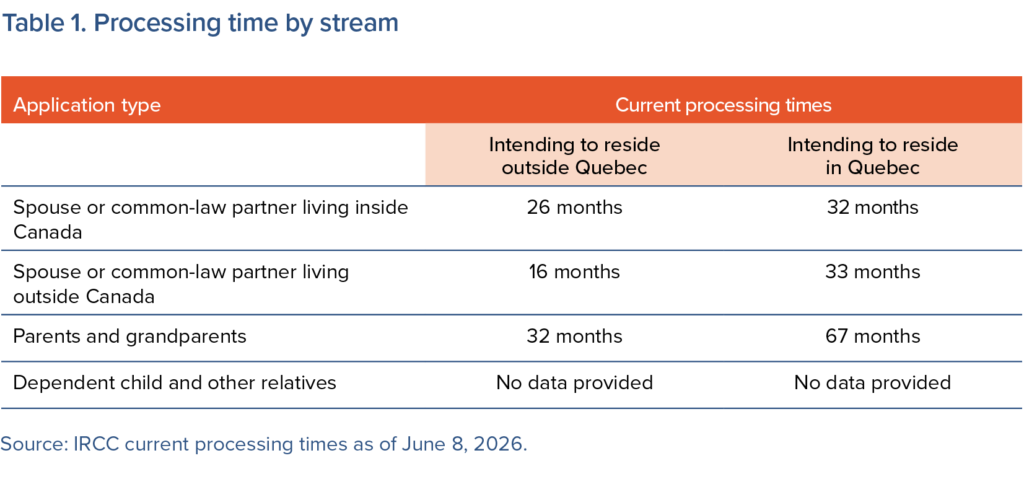
In addition, to reduce the application backlog and improve processing times in the parents and grandparents stream, governments have sometimes paused application intake, ultimately keeping some families separated for longer periods.
Spousal stream (spouses, common-law and conjugal partners)
The spousal stream has consistently been the largest pathway to family reunification, ranging from 70 to 80 per cent of total Family Class admissions in any given year. In 2024, the leading source countries were India, the Philippines and China (IRCC, 2025a). This stream permits Canadian citizens and permanent residents to sponsor a spouse, common-law or conjugal partner of any gender (and dependent children) from within Canada or overseas (table 2). With respect to processing times, the spousal stream remains the quickest way to acquire permanent residence.

Statistically, most sponsored spouses are married, between the ages of 18 and 34 and are female (IRCC, 2024). There is no minimum necessary income requirement for the spousal stream. However, the sponsor must agree to a three-year financial commitment and neither the sponsor nor sponsored spouse can be on social assistance. Recent reviews of the program draw attention to the economic success of the spousal stream, with many sponsored spouses reporting employment income within their first year of arrival (IRCC, 2024).
The IRCC manual OP2: Processing Members of the Family Class outlines how spousal relationships should be assessed for the purposes of sponsorship. A couple must prove that their relationship is genuinely economically and emotionally interdependent and was not entered into primarily for the purpose of immigration — what is referred to as a “relationship of convenience.”1
While IRCC recognizes that immigration always plays some type of role in cross-border marriage, the role of immigration officers is to assess whether the “marriage took place primarily for immigration” (Satzewich, 2016, p. 143). This assessment typically requires documentary evidence including, but not limited to, proof of cohabitation, proof of continuous communication when separated, joint bank accounts and insurance policies, testimonies from friends and family members, proof of couple compatibility (e.g., age, culture, religion, education, etc.) and photographic evidence of trips and major events (e.g., wedding ceremony, honeymoon, etc.).
Eligibility criteria for spousal sponsorship therefore rest not solely on the sponsoring spouse, but on a government evaluation of their relationship with their sponsored spouse or partner (Gaucher, 2018).
While, historically, the presence of children has been a positive indicator of a genuine relationship, the Immigration and Refugee Board has more recently taken the position that the existence of a child should be taken into consideration but is not in itself determinative of the genuineness of the marriage (Mansro v. Canada, 2008).
Parents and grandparents stream (PGP)
A Canadian citizen or permanent resident can sponsor their parents or grandparents (biological or adopted). In addition to providing basic needs (e.g., food, clothing, shelter, health, etc.), sponsors are required to financially support their parents and grandparents for 20 years (10 years in Quebec). To demonstrate financial capacity, sponsors must meet the minimum necessary income requirement, plus 30 per cent, for three consecutive years preceding the date of application.
Unlike the spousal stream, there is a cap on PGP applications that is predetermined by the immigration minister and is not annually consistent. The cap has ranged from 5,000 to 30,000 a year between 2014 and 2020 (IRCC, 2024). The program has undergone a series of pauses to deal with application backlogs — the most recent having been announced in January 2025. Most sponsored parents and grandparents are over the age of 65 and are female (IRCC, 2024).
As permanent parent and grandparent sponsorship spaces are limited, either through caps or program freezes, governments recommend the super visa — a multi-entry temporary visa — as an alternative to permanent reunification. With the super visa, parents and grandparents can live with their family in Canada for five years at a time for a period of up to 10 years. Applicants must meet IRCC’s medical admissibility rules every five years and hold health insurance from an authorized private provider. Applicants must also prove that they are a “genuine visitor to Canada” who will leave by choice once their visa has expired (IRCC, 2025b).
Super visas strip recipients of all options to work, study or access government health and social services. Migrant parents and grandparents, however, regularly do unpaid work, such as taking care of grandchildren, helping with housework and other family tasks, and providing emotional and cultural support. This unpaid labour often allows their adult children to participate in the paid workforce.
Initially presented as a way for parents and grandparents to visit and care for their grandchildren but not live in Canada, the super visa has been the more consistent pathway for parent and grandparent reunification since its inception in 2011 (Gaucher et al., 2025).
Dependent children stream
The IRPA defines an eligible dependent child as a biological or legally adopted child aged 21 or younger with the sole exception of an older adult child who is dependent due to mental or physical conditions. There is no cap on applications and sponsors do not have to meet the minimum income requirement. However, sponsors are financially responsible for the child for 10 years or until the child is 25 (18 in Quebec).
Like the spousal stream, the sponsoring parent’s bond with their dependent child(ren) often undergoes evaluation before IRCC decides whether to grant entry. The presence or absence of a strong family bond is typically evaluated through a series of factors, including regular telecommunication, time spent apart, the sending of remittances/gifts, and physical proximity/duration between visits.
Canada now uses DNA testing in their immigration programs to confirm biological relationships. This has been championed by some politicians trying to curb what they call migration fraud, but critics of DNA testing take issue with its reinforcing a restrictive version of family (Joly et al., 2017; Moreno et al., 2017). While IRCC claims DNA testing is used only as a last resort when there are doubts about the parent-child relationship, studies have shown that more frequent tests are “made for applicants from certain countries irrespective of documentary evidence” (Kelley et al., 2025, p. 173).
Other relatives stream
Individuals can sponsor two types of relatives through this stream, albeit only under specific conditions (table 3).
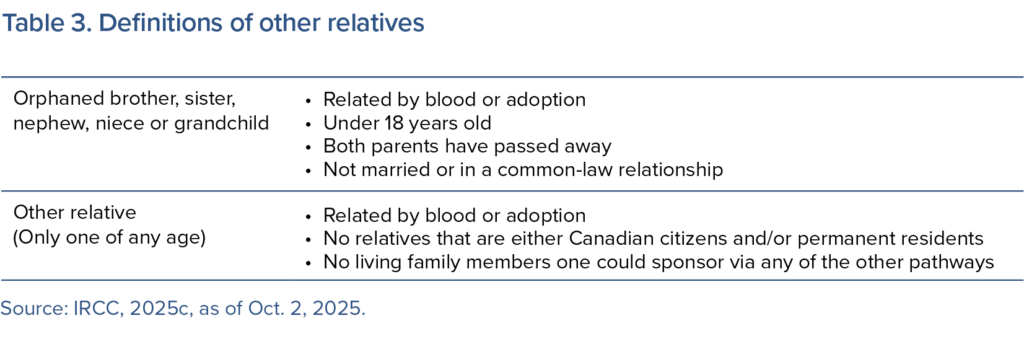
Sponsors must meet the minimum income requirement for a year. Arrivals under this stream typically constitute less than one per cent of annual arrivals overall (IRCC, 2024).
Contextualizing the Family Class
The current family reunification program is arguably fairer and more accessible than previous versions. However, its operating definition of family fails to reflect the full range of lived realities within Canada or abroad. This is largely attributed to the Canadian state’s ongoing framing of who belongs against a backdrop of distinct, competing and overlapping agendas of nation-building, economic prosperity and border security. While this backdrop is not unique to Canada, it has clouded Ottawa’s abilities to reconceptualize the program in any manner that substantively accounts for lived family dynamics beyond the traditional nuclear family (Gaucher, 2018).
Family Class migration as a source of national membership
Early family migration of white European immigrants pre-1976 advanced the state’s agenda of displacing, and at times eradicating, Indigenous Peoples, as well as privileging the demographic expansion of certain groups. White Europeans were encouraged to come to Canada with their family members and “establish roots,” which would include having children (Thobani, 2007).
In contrast, prior to the passing of the 1976 Immigration Act, immigration officers were authorized to refuse entry to non-European family members based on factors such as nationality, citizenship, ethnicity, country of origin, “peculiar” customs and suitability for integration. “Non-preferred” male migrants were granted entry for their labour while female migrants from those same ethnic groups were refused admission out of concern that these migrant workers would become “too Canadian” (Sharma, 2006, p. 76). Single women recruited from the Caribbean as live-in domestics underwent pregnancy tests to ensure no future sponsorship of spouses and children. Family became one, if not the, primary indicator of a migrant’s permanency within Canadian borders. This established the European nuclear family as the Canadian family.
The 1976 Immigration Act formally established three migrant categories, one of them being the Family Class. Included in the act was the point system (informally established in 1967), an evaluation scale that assigns a score to potential migrants based on their skills and formal education/work experience. However, Family Class migrants — individuals sponsored by a family member who was either a Canadian citizen or a permanent resident — were exempt from the point system.
Under the act, Family Class sponsors were now obligated to financially support their sponsored relatives for 10 years. Under the previous system, sponsors had to declare only that their sponsored family members would not be a burden on the state — a measure that had proven ineffective. Even today, there are few mechanisms to ensure sponsors’ financial responsibility because it is difficult to keep track of migrant families administratively once they have arrived.
Amendments were also added to the act to include the sponsoring of parents and grandparents, dependent children and adopted children under the age of 19. However, siblings and other extended family members remained excluded.
The point system is technically gender- and race-neutral, but its ongoing reliance on formal education and paid work experience typically favours male migrants from the Global North. As such, female migrants of colour are more likely to come to Canada either as dependent spouses through the economic class or through temporary migrant work programs in hopes of securing permanent residence, then sponsoring family members later. The act therefore maintains gendered and racialized dynamics of dependency and precariousness in many cases, even if this is not formally written into law.
Family Class migration as a source of economic growth
In the 1980s, Brian Mulroney’s Progressive Conservative government took the position that immigration promoted economic growth and that the Family Class was a way to attract economic migration to Canada. As such, Family Class admission rates during this government’s tenure increased to 50 per cent of total annual admissions (Kelley et al., 2025). This intertwining of state objectives to both grow the Canadian population and be economically competitive globally meant that the ideal family was now also the economically self-sufficient family. “Changes in the family class are often in response to prevailing economic conditions” (Kelley et al., 2025, p. 161).
Treatment of the Family Class thus highlighted an ongoing commitment to then-global discourses of economic competitiveness, privatization and cost recovery. While the Jean Chrétien Liberal government that was elected in 1993 agreed with its predecessor that migration boosts economic growth, it thought the best immigrants were those with “labour market skills that would enhance Canada’s competitive position in a world economy” (Abu-Laban & Gabriel, 2002, p. 62). The Family Class was thus the cost of a strong economic migration pathway rather than a valuable stream on its own.
Under the Chrétien government, admissions decreased to around 25 per cent (Kelley et al., 2025, p. 8), as framings of migrant women, children and aging parents as potential drains on the Canadian welfare state were reinvigorated. With a continued favouring of economic migrants, successive Conservative and Liberal governments have prioritized sponsored family members with the capacities to obtain a job upon arrival and support themselves.
The passing of the IRPA in 2001 identified family reunification as one of the primary objectives of Canadian immigration policy and expanded the category of Family Class to include homosexual and heterosexual common-law partners. It also reduced the sponsor’s financial obligations from 10 to three years. Changes to the IRPA post-2001 continue to reinforce family reunification as secondary to economic progress, even though elected officials often recognize how the unpaid care undertaken by sponsored family members can positively impact the sponsor’s earning potential.
Family Class migration as a security threat
At the same time, immigration policy was identified in the IRPA as a “key site at which threats to the state must be addressed” (Harder, 2010, p. 204). Restrictive measures to the Family Class are thus justified as protecting not only Canadian borders, but also Canadian families from external threats. Discourses or allegations of fraud have become increasingly popular, used by Liberals and Conservatives alike.
For example, IRCC launched an anti-marriage fraud campaign in 2011, aimed at relationships for the sole purpose of immigrating to Canada (Gaucher, 2018). The campaign involved a series of commercials in the mainstream media about the risks of marriage fraud, a national survey open to concerned stakeholders and citizens, and several town halls facilitated by Jason Kenney, immigration minister in Stephen Harper’s Conservative government at that time. Despite a lack of empirical data on marriage fraud in Canada, the Harper government used this campaign to justify further restrictions to the spousal stream, including a residency requirement for sponsored spouses,2 enhanced scrutiny of applications from certain countries and the deportation of individuals found guilty of misrepresentation post-arrival (Gaucher, 2018).
Restrictions to family reunification and the ongoing criminalization of certain migrant families as demonstrated in the anti-marriage fraud campaign and anti-migration fraud campaigns more generally have thus been framed to protect Canada from queue jumpers, bogus families and security threats, while maintaining a specific version of family to help grow the Canadian nation.
The Future of the Family Class
While the definition of family has undergone minor tweaks since the 1976 Immigration Act, the federal government’s objectives remain largely the same and are not specific to the political party in power. Answers to the question, “Which families belong?” have changed over time. However, the family reunification program is forever intertwined with a deep-rooted attachment to the white, economically self-sufficient, nuclear family.
This immigration story is not unique to Canada. Globally, family migration is one of the largest migration categories, with most countries recognizing family ties as grounds for entry, though to varying degrees and under different legal, social, economic and temporal contexts. With the ongoing displacement of global populations due to war, unemployment, environmental degradation and political upheaval, among other factors, people will continue to move to safer countries and seek family reunification.
At the same time, immigrant-receiving states regularly cite the challenge of admitting migrants responsibly both to realize their humanitarian commitments and to ease strains on their health and social services.
Citing an overburdened migration management system, the Justin Trudeau Liberal government announced a three-year reduction in Family Class admissions in 2024. Marc Miller, then IRCC minister, said at the time that, while Canada was still an open country, “Not everyone can come here or can have the privilege of becoming a permanent resident” (Major, 2024).
Prime Minister Mark Carney echoed that sentiment at a Liberal caucus retreat in September 2025, promising a more “sustainable” and “focused” approach to overall immigration — an initiative supported by most Canadians in recent polls (Tasker, 2025). While the government’s focus has been primarily on international students and temporary foreign workers, plans for reform have implications for the Family Class as well. A continued commitment to border security was solidified in the 2025 federal budget, with $198.3 million promised to the Canada Border Services Agency in addition to the $1.3-billion border protection plan announced in late 2024 (Government of Canada, 2025).
Statistics Canada reported in early 2025 that Canada’s population experienced the smallest quarterly growth since the border closure in 2020 to slow the spread of the COVID-19 pandemic, and the country’s overall fertility rate continues to decline (Statistics Canada, 2025). Indeed, this long-standing tension between Canada needing migrant families to grow the nation and wanting only specific families remains.
The federal 2025-27 immigration plan promises a target of 118,000 permanent residents through the Family Class per year, maintaining the average rate of 22 per cent of overall permanent resident admissions (IRCC, 2024). At the same time, today’s Family Class looks almost the same as its original legislative conceptualization in the 1976 Immigration Act. Migrant families seeking reunification often encounter the same barriers that centre around their incompatibility with the program’s definition of family, inconsistent permanent pathways for extended family members and ongoing unfair expectations that families prove their bonds are genuine.
Recommendations
What could a more robust conceptualization of family look like? These are four recommendations that could help modernize family reunification and remedy the current situation:
1. Expand the definitions in the Family Class
The current definition of family reinforces the assumption that the nuclear family has a monopoly over economic and emotional interdependence. Moreover, it assumes that this interdependence is primarily concentrated within the traditional family (i.e., parents and children) and that relationships of interdependence with extended family members remain secondary. As such, families that fail to demonstrate this structure or a particular set of dynamics are often refused entry. The Family Class Program is not the issue so long as we interpret family to be “deeply rooted relationships of interdependence” (Law Commission of Canada, 2001, p. 43). Simply put, a more robust conceptualization of family must prioritize family function over family form.
A broader definition of family could include space for kinship through marital and offspring ties, extended kinship and self-defined kinship. While the first two already exist, the third would allow Canadian citizens and permanent residents to determine “who is most important to them, and who is part of what they consider family” (Law Commission of Canada, 2001, p. 45).
What changes here is permitting self-selection. Individuals would have the capacity to say who composes their family. Canadian law recognizes that people have the right to define their familial networks as they see fit. While the traditional nuclear family remains the preferred adult familial relationship in Canadian law and policy (Gaucher 2018), citizens are permitted to live and/or be economically and emotionally interdependent on parents, extended family members, other care providers and friends. It is therefore important that Canadian citizens and permanent residents be permitted to reunite with similar support networks whose members are living abroad.
2. Revisit OP2: Processing Members of the Family Class
The burden placed on sponsors and their sponsored family members to prove the genuineness of their relationships according to specific evidence and criteria also warrants further consideration. This current IRCC manual relies on a list that either glosses over or ignores cultural, religious, class and gendered differences across married and common-law couples (Gaucher, 2018). Evaluations of familial bonds between parents and children assume a specific parent-child relationship that is often not the reality for migrant parents and their children living elsewhere. A broader definition of family could thus also allow sponsors and their sponsored family members to demonstrate the genuineness of their bond according to their own terms, rather than being obligated to align with a predetermined checklist.
3. Implement a consistent parent and grandparent stream (PGP)
After the most recent program freeze in early 2025, IRCC announced in August that it would accept 10,000 applications from those who submitted an interest-to-sponsor application in 2020. This means yet another cycle of uncertainty for those families wanting to submit an interest-to-sponsor application now.
Given that parent and grandparent sponsorship is often motivated by care needs, reunification is time-sensitive. But because of current program freezes and long processing times, families are often left to rely on the super visa program that keeps migrant grandparents in a state of legal, political and economic precarity (Gaucher et al., 2025). As such, while caps might be necessary for the responsible admittance of extended family members, intake through the parent and grandparent stream should be annually consistent and without pause.
4. Stop using the rhetoric of family fraud
Use of this language has unfortunately become commonplace. In addition to the past marriage fraud campaign, governments have used the language of queue jumpers and bogus families when inaccurately describing the live-in caregiver program, the privileging of Syrian women and families over single men during the 2015 refugee intake, and critiques about non-residents giving birth on Canadian soil and their children claiming birthright citizenship.
Bill C-12, the Strengthening Canada’s Immigration System and Borders Act, passed by the Carney government in 2025, amended the IRPA to expand “legal authority over immigration documents and by extension, migration to Canada” in an effort to combat fraud (Parliament of Canada, 2026). While the bill does not discuss Family Class migration fraud specifically, fraud rhetoric is widely used when governments implement further restrictions to the family reunification program in the name of system integrity and citizen protection (Gaucher, 2018). Moreover, fraud rhetoric ignores the very reasons families often seek reunification.
This is not to suggest that fraud does not happen. However, this language is used by Canadian governments to target certain couples, relationships and families as different, ultimately reproducing long-standing gendered and racialized narratives that certain families deserve to belong more than others.
Moving Forward
When it comes to family reunification, there is a public interest that extends beyond economic productivity and membership definition. The right to family reunification is a moral good, essential to one’s well-being. Families have a right to be together. Keeping this in mind and considering internal and external pressures that continue to drive changes to the Family Class Program, the federal government needs to find solutions that allow a responsible admissions policy while also addressing the needs and interests of families seeking permanent reunification.
Notes
1 IRCC identifies three types of relationship fraud: marrying/sponsoring an individual in exchange for money; marrying in good faith and being abandoned upon the sponsored spouse’s arrival in Canada; and purchasing relationships through an external organization.
2 From 2012-17, all sponsored spouses were required to live in Canada for two years prior to obtaining permanent residence. That policy was reversed by the Justin Trudeau government.
References
Abu-Laban, Y., & Gabriel, C. (2002). Selling diversity: Immigration, multiculturalism, employment equity and globalization. Broadview Press.
Bhuyan, R., Yoon, K., & Valmadrid, L. (2020). Family reunification as an earned right: A framing analysis of (im)migrant workers’ pathways to neoliberal multicultural citizenship in Canada.
New Political Science, 42(4), 558-577.
Broadbent Institute. (2025). Shifting borders: Canadian attitudes towards immigration.
https://broadbentinstitute.ca/research/shifting-borders/
Environics Institute. (2024, October 17). Canadian public opinion about immigration and refugees — Fall 2024. https://environicsinstitute.org/canadian-public-opinion-about-immigration-and-refugees-2024/
Gaucher, M. (2018). A family matter: Citizenship, conjugal relationships, and Canadian immigration policy. UBC Press.
Gaucher, M., Atique, A., Tungohan, E., & Yalamarty, H. (2025, August 20). Here’s why Canada’s parents and grandparents reunification program is problematic. The Conversation.
https://theconversation.com/heres-why-canadas-parents-and-grandparents-reunification-program-is-problematic-262263
Goldstein, L. (2025, April 15). Liberal government’s high immigration policy created housing crisis: Report. Toronto Sun. https://torontosun.com/news/national/liberal-governments-high-immigration-policy-created-housing-crisis-report
Government of Canada. (2025). Canada strong budget 2025. https://budget.canada.ca/2025/report-rapport/pdf/budget-2025.pdf
Harder, L. (2010). In Canada of all places: National belonging and the lost Canadians. Citizenship Studies, 14(2), 203-220.
Hawkins, F. (1989). Critical years in immigration: Canada and Australia compared. McGill-Queen’s University Press.
Immigration, Refugees and Citizenship Canada (IRCC). (2023). 2023 annual report to parliament on immigration. Government of Canada. https://www.canada.ca/en/immigration-refugees-citizenship/corporate/publications-manuals/annual-report-parliament-immigration-2023.html
Immigration, Refugees and Citizenship Canada (IRCC). (2024). Evaluation of the Family Reunification Program. Government of Canada. https://www.canada.ca/en/immigration-refugees-citizenship/corporate/reports-statistics/evaluations/evaluation-family-reunification-program.html
Immigration, Refugees and Citizenship Canada (IRCC). (2025a). 2024 annual report to parliament on immigration. Government of Canada. https://www.canada.ca/en/immigration-refugees-citizenship/corporate/publications-manuals/annual-report-parliament-immigration-2024.html
Immigration, Refugees and Citizenship Canada (IRCC). (2025b, March 7). Update on 2025 Parents and Grandparents Program. Government of Canada. https://www.canada.ca/en/immigration-refugees-citizenship/news/notices/update-2025-parents-grandparents-program.html
Immigration, Refugees and Citizenship Canada (IRCC). (2025c). Sponsor your relatives: Who you can sponsor. Government of Canada. https://www.canada.ca/en/immigration-refugees-citizenship/services/immigrate-canada/family-sponsorship/other-relatives/who-you-can-sponsor.html
Joly, Y., Salman, S., Ngueng Feze, I., Granados Moreno, P., Stanton-Jean, M., Lacey, J., Labelle, M., Dench, J., Dove, E. S., Atak, I., Bellefleur, C., Heinemann, T., Langlais, H., & Love, R. (2017). DNA testing for family reunification in Canada: Points to consider. Journal of International Migration and Integration, 19(2), 391-404.
Kelley, N., Reitz, J. R., & Trebilcock, M. (2025). Reshaping the mosaic: Canadian immigration policy in the twenty-first century. University of Toronto Press.
Law Commission of Canada. (2001). Beyond conjugality: Recognizing and supporting close personal adult relationships. https://publications.gc.ca/collections/collection_2023/jus/JL2-18-2001-eng.pdf
Major, D. (2024, October 24). New immigration plan aims to stabilize population growth, housing market: Minister. CBC News. https://www.cbc.ca/news/politics/new-immigration-levels-plan-1.7361972
Mansro v. Canada (Citizenship and Immigration), VA6-01540. (2008).
https://www.canlii.org/en/ca/irb/doc/2008/2008canlii77291/2008canlii77291.html
Moreno, P. G., Ngueng Feze, I., & Joly, Y. (2017). Does the end justify the means? A comparative study of the use of DNA testing in the context of family reunification. Journal of Law and the Biosciences, 4(2), 250-281.
Parliament of Canada. (2026). Bill C-12, An Act respecting certain measures relating to the security of Canada’s borders and the integrity of the Canadian immigration system and respecting other related security measures. https://www.parl.ca/documentviewer/en/45-1/bill/C-12/royal-assent
Satzewich, V. (2016). Points of entry: How Canada’s immigration officers decide who gets in. UBC Press.
Sharma, N. (2006). Home economics: Nationalism and the making of “migrant workers” in Canada. University of Toronto Press.
Statistics Canada. (2025, June 18). Canada’s population estimates, first quarter 2025.
https://www150.statcan.gc.ca/n1/daily-quotidien/250618/dq250618a-eng.htm
Tasker, J. P. (2024, November 22). Feds want $411 million to cover refugee health care as the number of new arrivals soars. CBC News. https://www.cbc.ca/news/politics/refugee-health-care-costs-sevenfold-increase-1.7389847
Tasker, J. P. (2025, September 12). Popular support for more immigration has cratered. Politicians are taking note. CBC News. https://www.cbc.ca/news/politics/popular-support-immigration-plummets-1.7631767
Thobani, S. (2007). Exalted subjects: Studies in the making of race and nation in Canada. University of Toronto Press.
This Policy Brief was published as part of the Canada’s Changing Immigration Landscape series from the Centre of Excellence on the Canadian Federation. The manuscript was copy-edited by Jim Sheppard, proofread by Zofia Laubitz, editorial co-ordination was by Étienne Tremblay, production was by Chantal Létourneau, publication management was by Prasanthi Vasanthakumar and art direction was by Anne Tremblay.
Canada’s Changing Immigration Landscape is a partnership between the Centre of Excellence on the Canadian Federation at the IRPP, the Institute for Research on Migration and Society at Concordia University (IRMS) and the Centre for Migration Studies at the University of British Columbia (CMS). All publications are under the direction of Charles Breton, Executive Director of the Centre of Excellence on the Canadian Federation, Mireille Paquet, Director of IRMS, and Irene Bloemraad, Co-director of CMS.
Megan Gaucher is an associate professor in the Department of Law and Legal Studies at Carleton University. Her research focuses on the intersections between citizenship, family and belonging in Canadian immigration and refugee law, policy and politics.
A French translation of this text is available under the title Quelles familles ont leur place ici ? Revoir le regroupement familial au Canada.
To cite this document:
Gaucher, M. (2026). Which families belong? Rethinking Canada’s Family Class Program. Institute for Research on Public Policy. https://doi.org/10.26070/z051-gz24