

Migrant Integration Services in Canada: Adapting to the Changing Landscape

 |
Canada’s Changing Immigration Landscape |
| Immigration policy is central to the future of the federation. This series explores recent challenges and opportunities, turning complex issues into clear, actionable insights. |
Context
Canada has an extensive network of migrant integration programs, most funded by governments but delivered by community organizations. After years of rapid growth, the federal government began significantly reducing permanent and temporary resident admissions in 2025 — a shift with major implications for the agencies and programs that support newcomers (often referred to as the settlement sector).
This report examines the evolution, objectives and current challenges of integration services delivered by the federal government (Immigration, Refugees and Citizenship Canada [IRCC]), the provinces of Ontario and British Columbia, and the cities of Toronto and Vancouver. The case studies draw on original interviews with senior government officials and settlement sector leaders in each jurisdiction.
Key findings
Federal spending: The budget of the IRCC Settlement Program, which funds integration services almost exclusively for permanent residents, grew by 70 per cent between 2016-17 and 2023-24, approaching $1.2 billion in 2024-25. A government-wide expenditure review will reduce the Settlement and Resettlement Program budget to $935.7 million in 2026-27.
Admission reductions: The federal government reduced annual permanent resident targets to 395,000 for 2025, down from 500,000 in 2024. Following the introduction of Canada’s first-ever limits on temporary resident admissions, the number of temporary foreign workers fell 48 per cent, and new international students dropped 60 per cent in the first nine months of 2025 compared to the same period in 2024.
Language training cut: IRCC will discontinue funding for language instruction above Canadian Language Benchmark (CLB) level 4 as of September 2026. In Ontario, one-third of language learners study at the intermediate and higher levels (CLB 5+).
Settlement sector strain: A survey of 48 service provider organizations in the Toronto region conducted before the further cuts from the expenditure review were announced found that 69 per cent anticipated laying off staff due to federal funding reductions.
Refugee claimants left out: Despite 295,819 pending refugee claims as of September 2025 and an 80 per cent acceptance rate, refugee claimants remain ineligible for IRCC Settlement Program services.
Provincial variation: Ontario and British Columbia fund integration services beyond the scope of the federal program. Ontario’s well-established programs served 185,600 clients in 2023-24. Following a significant budget increase, B.C.’s redesigned Newcomer Services Program and new Safe Haven program served over 64,000 clients in 2024-25.
Cities diverge: Toronto has a proactive newcomer strategy and kiosks providing services regardless of immigration status. Vancouver has no formal policy by design, relying instead on an equity and accessibility lens applied across city services.
Recommendations
The author presents four recommendations:
Engage the settlement sector
- To inform the program review that is part of the expenditure review, give a mandate to one of IRCC’s sectoral committees to hold targeted consultations and propose specific changes, making fuller use of sector expertise in policy development.
Reverse the language training cut
- IRCC should restore funding for language instruction above CLB 4 and signal that, as of April 2029, service providers will be eligible to deliver instruction up to CLB 8 under the Settlement Program.
Expand eligibility to refugee claimants
- IRCC should allow service providers to support refugee claimants under the Settlement Program, potentially requiring organizations to co-finance part of costs from non-federal sources.
Hold a national forum
- Convene governments, practitioners and experts to assess the effectiveness of Canada’s migrant integration model, explore improvements and raise public awareness about the need for renewal.
Introduction
Canada has an extensive and well-established network of programs and services to support migrants1 after their arrival and to foster their subsequent integration. A distinctive feature is that most of the services are funded by governments but delivered under contract by community organizations.
Although jurisdiction over immigration is shared by the federal and provincial governments, Ottawa has long been the leading funder of integration services, except in Quebec, where the provincial government is responsible for these services, using an annual grant from the federal government. The other provinces and some large cities are also active in this domain.
After almost a decade of significant growth in the admission of permanent residents (immigrants) and temporary residents, the federal government announced in late 2024 that the numbers for both categories would be reduced significantly, starting in 2025.
These reductions and the pending future cuts in spending resulting from the Carney government’s Comprehensive Expenditure Review — which has a government-wide goal of $13 billion in annual savings by 2028-29 through restructuring operations, consolidating services and reducing departmental budgets — have major implications for the nature and extent of federally funded integration services and for the agencies that deliver them.
This report2 opens with a discussion of the meaning and dimensions of migrant integration, which is defined here as the process through which newcomers are enabled to participate equitably in the economic, social and civic/political life of the receiving society.
This is followed by an overview of recent developments, notably the reductions in admission levels. The central section analyzes the objectives and evolution of the main initiatives of the federal government, the governments of Ontario and British Columbia, and the administrations of the cities of Toronto and Vancouver.
This review addresses these questions: How has the nature of, and eligibility for, migrant integration programs changed (or not) during the past five to 10 years? Have governments increased their spending and the number of clients served during this period? What challenges do they currently face?
Drawing on the case studies, I then present four recommendations for policy changes and public discussion:
- Engage with the service sector to find solutions.
- Reverse the federal government’s decision to end funding for language instruction beyond the basic level.
- Modify the criteria of the Settlement Program of Immigration, Refugees and Citizenship Canada (IRCC) to focus on the most vulnerable, particularly refugee claimants.
- Hold a national forum to take stock of Canada’s migrant integration programs.
I conclude that governments, stakeholders and experts will need to collaborate on revising the country’s migrant integration framework. Concrete steps to diversify funding should be part of this renewal. The foundations of the Canadian model remain strong, and with sufficient political will, governments and stakeholders can renew the Canadian model while preserving its core objectives.
The Fundamentals of Migrant Integration
The meaning of migrant integration is a subject of ongoing debate (Spencer & Charsley, 2021). Based on earlier work (Seidle & Joppke, 2012) and a recent literature review, I define migrant integration as the process through which newcomers are enabled to participate equitably in the economic, social and civil/political life of the receiving society.
In this context, settlement services target migrants’ needs during the initial period after arrival. In this report, migrant integration refers to both the early and subsequent phases of newcomers’ adaptation. It has a number of fundamental, largely complementary facets:
- Economic integration refers to migrants’ participation in the labour force, ideally within the field for which they were educated and/or had experience before arrival. Such matching does not always occur within the first few years of migrants’ lives in a new country. Obstacles include insufficient language competence, requirements for credential recognition and systemic discrimination.
- Social integration is facilitated by contacts with friends, neighbours, co-workers and others — what has been described as “the countless interactions that occur among the kaleidoscope of individuals, groups, and institutions within a city” (Frideres, 2008, p. 96). Social integration contributes to a sense of belonging to the local community and/or the country as a whole.
- Civic integration includes neighbourhood and community activities that help build social capital. Such activities are often political without being partisan — for example, involvement in advocacy organizations.
- Political integration entails involvement in the democratic life of the host society. A key element of this is voting, which in Canada is open to newcomers only after they become citizens. Irene Bloemraad draws a link with social and civic involvement. “Informal ties — usually fostered by an organized group or association — combine with more formalized activities to assist newcomers with the process of political integration” (Bloemraad, 2006, p. 93).
Integration is a two-way process
Migrant integration requires adaptation within the receiving society to support newcomers’ efforts and foster inclusion. As Joseph Carens, a Canadian political theorist, has written:
Immigrants bring change with them. That is inevitable. It is not grounds for constructing the immigrants as a threat or a problem. What is needed instead is some sort of mutual adaptation between citizens of immigrant origin and the majority in the state where the immigrants have settled. (Carens, 2014, p. 545)
This perspective is echoed in the latest European Union Action Plan on Integration and Inclusion: “Integration and inclusion of people with a migrant background is a two-way process. We need a whole of society approach that includes migrant and local communities, employers, civil society and all levels of government” (European Commission, 2020, p. 1).
Government action encourages effective integration
Although migrant integration is facilitated by supports provided without charge by employers, schools and community organizations, progress is encouraged by dedicated, publicly funded programs and services. As the authors of a study based on European data sources concluded:
As a general rule, when countries adopt comprehensive and inclusive integration policies that focus on social, economic and cultural aspects, migrants are more likely to experience better outcomes, lower vulnerability, and have a greater self-perception of state protection. (Moldes-Anaya & Sommarribas, 2023, p. 100)
Publicly sponsored integration programs are most often provided by national governments. In federal countries such as Canada, the provincial or state governments also need to be involved — not least because they are responsible for matters that contribute to migrant integration, such as education and health care.
Cities are a major locus of migrant integration (Seidle, 2019). In Canada, municipal governments are a constitutional responsibility of provincial governments, and their revenue comes almost entirely from property taxes and transfers from the provincial government. Thus, “municipalities’ formal autonomy [is] highly circumscribed” (Good, 2009, p. 217). They are nevertheless active in domains that are relevant to migrant integration, such as housing, recreational facilities and referrals.
Policies on immigration levels and categories are a key part of migration dynamics and changes to them have an impact on integration programs and services. This has been demonstrated in Canada following significant changes to permanent and temporary migration levels since 2024.
Canada’s Changing Migration Landscape
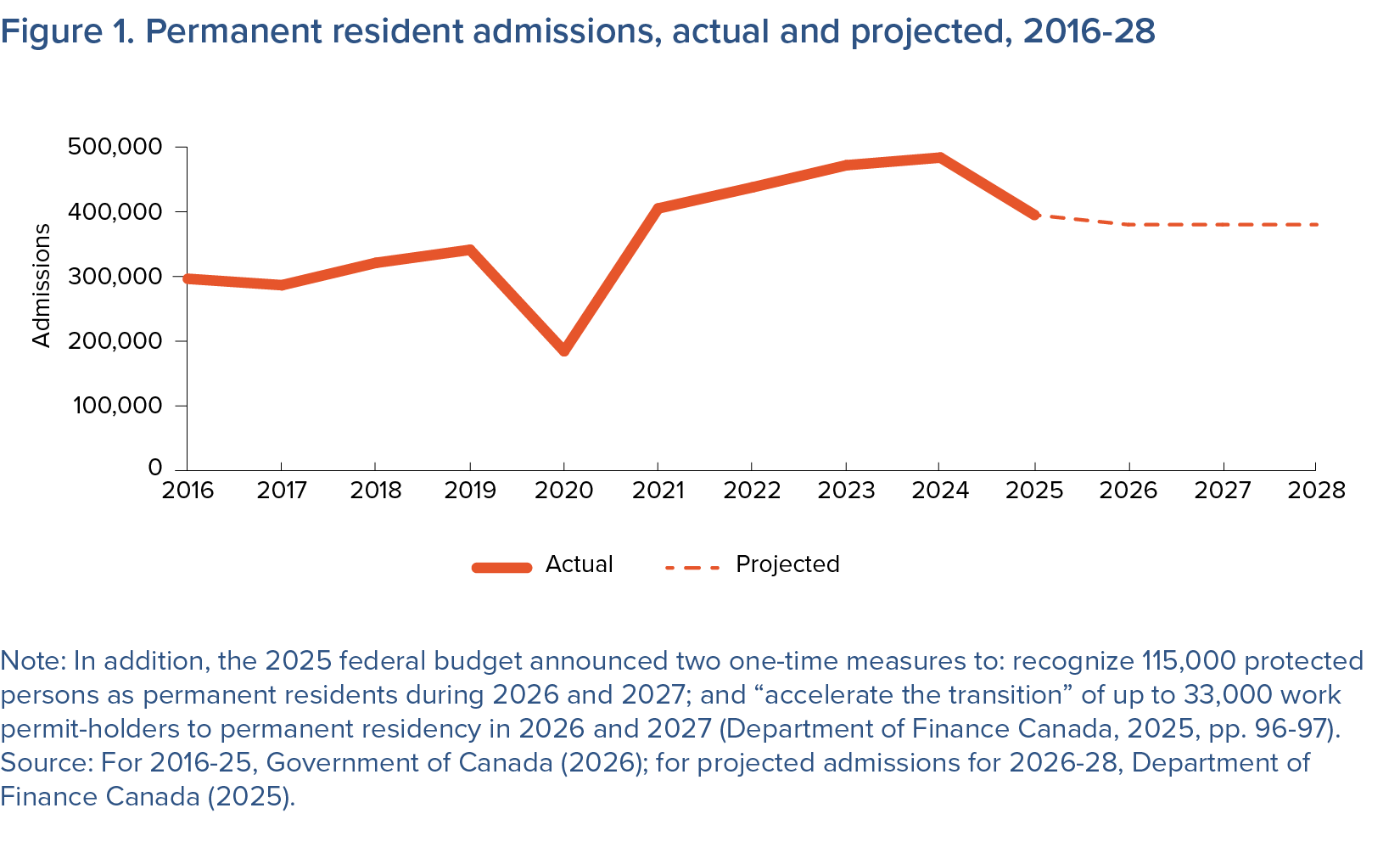
Following the election of a federal Liberal government in 2015 with Justin Trudeau as prime minister, the number of permanent residents admitted to Canada increased by 63 per cent between 2016 and 2024 (see figure 1).
During the same period, temporary migration rose even more significantly. The principal groups were international students, temporary foreign workers3 and refugee claimants (or asylum-seekers — the term more often used internationally).
The growth in temporary migration was encouraged by pathways to permanent residence, notably the Canadian Experience Class, that are open to higher-skilled temporary foreign workers and foreign students who graduate from a Canadian post-secondary institution. In 2023, 46 per cent of all new permanent residents were admitted through such a two-step process (Hou, 2025).
Partly because of policy changes introduced following the COVID-19 pandemic, the number of documented temporary residents in Canada rose to a high of 3,049,277 on Oct. 1, 2024, from 1,909,005 on Jan. 1, 2023, an increase of 60 per cent.
By 2024, it became evident that population growth from migration was one of the factors behind rising housing prices and low rental vacancies (Hou et al., 2025), for which immigrants were sometimes scapegoated (Song, 2025). In this context, surveys showed a significant drop in public support for the current immigration level (Besco & Goel, 2025; Seidle, 2024).
In November 2024, the Trudeau government announced a major reduction in the annual level of permanent resident admissions to 395,000 in 2025, 380,000 in 2026 and 365,000 in 2027 from 500,000 in 2024 (Immigration, Refugees and Citizenship Canada [IRCC], 2024a). The November 2025 federal budget provided for:
- 380,000 permanent resident admissions a year for 2026, 2027 and 2028.
- A one-time initiative to recognize 115,000 protected persons (refugees accepted in Canada) as permanent residents during 2026 and 2027.
- A one-time measure “to accelerate the transition” of up to 33,000 work permit-holders to permanent residency in 2026 and 2027 (Department of Finance Canada, 2025, pp. 96-97).
It is unclear why the numbers for the two one-time measures were not included in the overall targets for 2026 and 2027. This risks muddling public understanding of the federal government’s decisions about the numbers and categories of permanent resident admissions.
As for temporary residents, the November 2024 announcement specified for the first time a limit on temporary residents along with a commitment to reduce their share of the population to five per cent by the end of 2026, compared to 7.3 per cent in mid-2024.4
The largest group of them, temporary foreign workers, has since dropped considerably: 48 per cent fewer new workers arrived between January and September 2025 compared to the same period in 2024 (IRCC, 2025a). Further reductions will likely result from the 2025 budget’s targets for new work permits: 385,000 in 2026 and 370,000 in each of 2027 and 2028 (Department of Finance, 2025).
International students accounted for 32 per cent of total temporary admissions in 2024 (Coderre et al., 2025). Valued as a revenue source for post-secondary institutions (Goudreault, 2025), the number of student permit-holders had increased exponentially to a peak of 1.03 million in 2023 from 120,000 in 2000 (Brunner, 2025).
In January 2024, the federal government introduced a limit on the number of international student permits for 2024 and 2025 (IRCC, 2024b). Between January and September 2025, 60 per cent fewer new students arrived than during the same period in 2024 (IRCC, 2025a). It is projected that 155,000 new permits for foreign nationals studying in Canada for six months or more will be issued for 2026, along with 150,000 for each of 2027 and 2028 (Department of Finance, 2025).
As for refugee claimants, there was a considerable influx of people crossing into Quebec outside regular border posts (notably Roxham Road) between 2017 and 2022. This ended almost completely following amendments to the Safe Third Country Agreement between Canada and the United States (Paquet & Schertzer, 2025). From Jan. 1 to July 31, 2025, 34 per cent fewer people claimed refugee status nationally than during the same period in 2024 (IRCC, 2025b). Despite these declines, 295,819 refugee claims were pending as of Sept. 30, 2025 (Immigration and Refugee Board of Canada, 2025).
Along with other changes (such as the reduction of the annual targets for economic immigration to Quebec), there has been a major shift in Canada’s migration landscape. There are significant implications for integration policies and programs in the five jurisdictions examined in the following section.
Migrant Integration Services in Five Jurisdictions
Under the Constitution Act, 1867, the federal and provincial governments share authority over immigration, although in case of conflict, federal law is paramount. Until the 1970s, no province sought to use its authority in this domain.
The dynamics changed through “federalization,” which is defined as “an increase of the agency of provincial governments, without a diminishing of the role of the federal government” (Paquet, 2019, p. 8). The Quebec government was the leader in this regard — part of a broader process of province-building. In 1991, the Canada-Quebec immigration accord gave the province the power to select all economic immigrants planning to settle there.
Since 1998, provincial nominee programs (PNPs) have been established across the country.5 Through these programs, provincial governments nominate candidates to the federal government while Ottawa makes the final decision on granting permanent residence. PNPs allow the provinces some flexibility, including the ability to choose candidates in lower-skilled occupations (Seidle, 2013). The programs are nevertheless fairly similar in important ways. For example, a detailed study of 68 PNP streams and of nominations made in 2021 and 2022 found that the requirement to have prearranged work was prevalent (Xhardez & Tanguay, 2024).
As for migrant integration programs, the federal government is the main player. Provincial governments play less significant roles, with one exception. Under the 1991 accord, the federal government withdrew from managing integration services in Quebec. Instead, it provides the provincial government with an annual grant for linguistic, cultural and economic integration services.
For fiscal year 2024-25, the grant to Quebec was $867.3 million (IRCC, 2025c). Some 100 community organizations provide a range of reception and integration services to permanent and temporary residents, including international students and temporary foreign workers (Gouvernement du Québec, 2025). French-language education is a particular focus.
In the late 1990s, the federal government offered to devolve the delivery of integration services to the other provinces. Only Manitoba and British Columbia took up the offer, and agreements between them and the federal government were signed in 2003 and 2004, respectively.
These ended in 2013 in Manitoba and 2014 in B.C., following the federal government’s decision to resume management for those provinces, apparently to harmonize services across the country (Braun & Clément 2023, p. 271). Although there are references to integration in some of the current agreements between the federal and provincial governments respecting PNPs, none concern actual delivery or a transfer of federal funding.
Three types of policies and services are relevant to migrant integration across the Canadian federation:
- Formal agreements between the federal government and other jurisdictions, principally the provinces.
- Stand-alone federal, provincial and municipal programs that directly target immigrants.
- Regular public services offered to residents, including newcomers and their families, that contribute to migrant integration, including primary and secondary education, social services, housing programs, health and mental health services, and recreational facilities.
This section focuses on the first two categories and provides overviews of the main migrant integration programs and services of the federal government, Ontario, British Columbia, Toronto and Vancouver. Among the provinces, Ontario and British Columbia have the highest and second-highest percentages of immigrants. Toronto and Vancouver have the highest and second-highest percentages of immigrants among Canadian cities.
For each jurisdiction, I conducted semi-structured interviews with one or more senior officials (see list in the Appendix). Interviewees subsequently provided additional information and responded to questions.
Immigration, Refugees and Citizenship Canada
One of the objectives of federal immigration law is “to promote the successful integration of permanent residents into Canada, while recognizing that integration involves mutual obligations for new immigrants and Canadian society.”6 Although integration is not defined, the wording of the section references the two-way process discussed earlier.
Integration services funded by the federal government have historically been delivered by community organizations — often referred to as service provider organizations (SPOs). This arrangement was formalized in 1974 through the establishment of the Immigrant Settlement and Adaptation Program (Vineberg, 2012). Language training was added as a core element of the program in 1992 (Biles, 2008).
At present, IRCC, formerly Citizenship and Immigration Canada, funds the following services in all provinces and territories, except Quebec, through its Settlement Program (IRCC, 2023, p. 6):
- Needs and assets assessments and referrals to determine what services clients need and to offer referrals to receive them.
- Information and orientation services about various elements of life in Canada.
- Language assessment and training to help clients of school-leaving age develop their official language skills.
- Employment-related services to help clients prepare for the labour market.
- Community connections services to help clients learn about and integrate into their local communities.
The Refugee Assistance Program provides resettled government-assisted refugees with reception and related services (e.g., referrals to relevant government programs) and income support for one year. Privately sponsored refugees receive financial support (also for one year) from their sponsors, along with in-kind support. All refugees, who become permanent residents on arrival, have access to language training and other Settlement Program services.
The services funded by IRCC are primarily for migrants already in Canada (except those in Quebec), including all permanent residents, resettled refugees, people who are already approved to become permanent residents and protected persons who have received a positive decision from the Immigration and Refugee Board. A notable recent exception was the Canada-Ukraine Authorization for Emergency Travel (CUAET). From its launch in March 2022 until March 2024, those who qualified for CUAET visas were eligible for settlement services funded by the federal government (IRCC, 2024c).7 There are some other exceptions to IRCC’s eligibility rules.8
Delivery of the services described above is governed by multi-year agreements between IRCC and SPOs. Proposals for the latest funding period (starting April 2025) were assessed in relation to a number of IRCC policies, including the department’s CORE principles — client-centred, outcomes-driven, responsive-to-need, and effective-use-of-resources. Applicants for funding are expected to incorporate these principles in the design, implementation and evaluation of their proposed project(s), and to articulate how they have done so in their application (IRCC, 2024d).9
These agreements were intended to last five years (as was the case for the previous round). However, the term was reduced to three years following the November 2024 announcement of reduced permanent resident admissions. In January 2026, IRCC informed SPOs that the agreements would be extended for a fourth year (until March 31, 2029). Another change, which takes effect in September 2026, was IRCC’s decision to discontinue funding language education beyond the Canadian language benchmark (CLB) level 4, which is classified as “fluent basic” (CLB-OSA, n.d.).
Funding allocations by province (except Quebec) and territory under IRCC’s Settlement Program are based on the national settlement funding formula, which was developed in consultation with provincial and territorial governments, and approved by the federal cabinet. Under it, the funding in each province/territory reflects the five-year average proportion of permanent resident authorizations. The 2025-26 funding allocations were based on the number of permanent residents admitted from 2021-25 inclusive. Additional weight was given to refugees to account for their unique needs.
Along with admissions, the number of unique clients10 served through the Settlement Program between 2016-17 (the first full fiscal year following the election of the first Trudeau government) and 2023-24 rose 66 per cent. In part, this reflected services to Ukrainians under CUAET. Figure 2 shows the breakdown of clients in 2023-24, according to the program’s five categories of services.
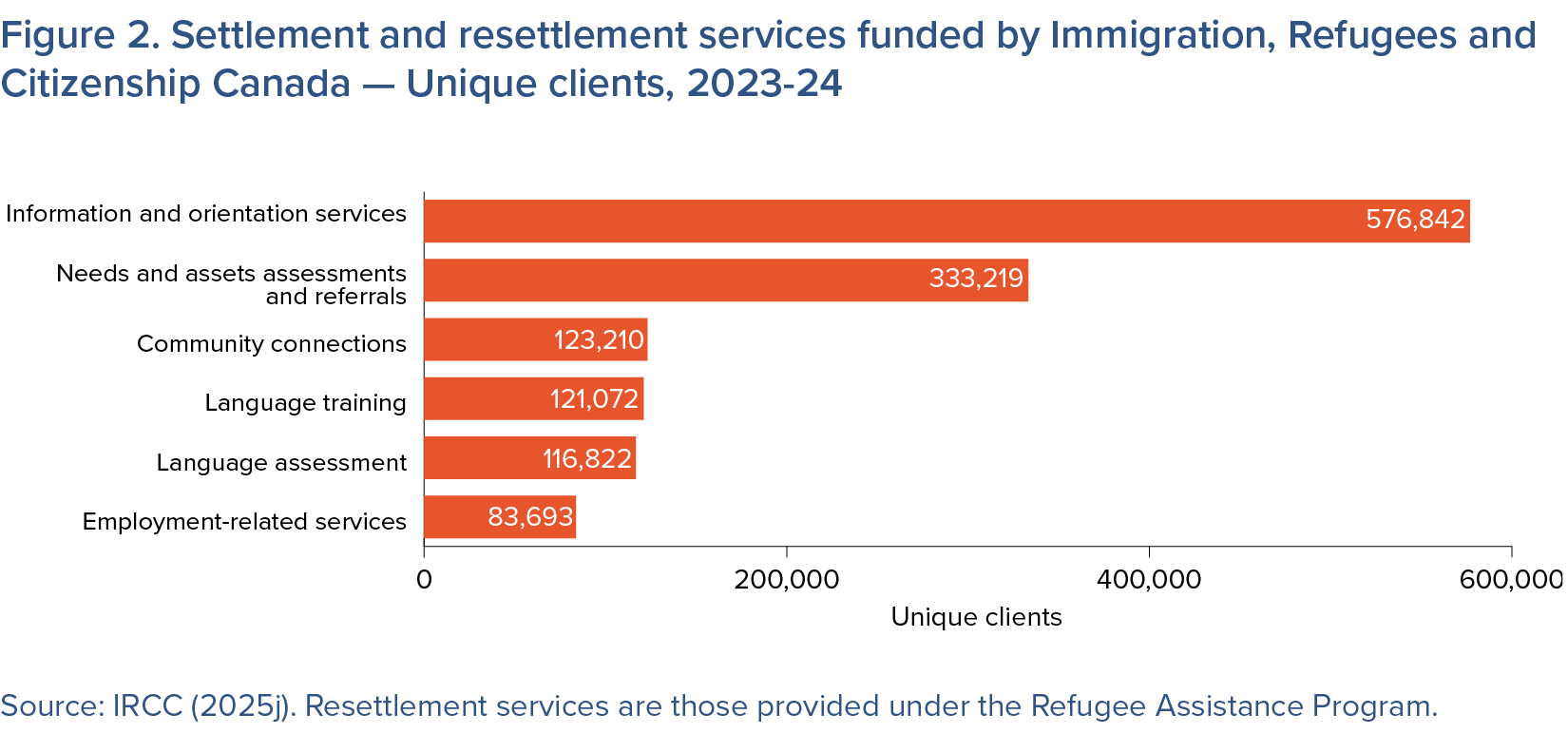
Funding for the Settlement Program rose by 70 per cent between 2016-17 and 2023-24. By 2022-23, spending had surpassed $1 billion (see figure 3). For the five years starting April 2020, 824 projects were funded (IRCC, 2019). IRCC anticipated investing approximately $1.13 billion to support newcomers outside Quebec in 2025-26, a decrease of four per cent compared to 2024-25. This reduction was largely due to the lower immigration levels announced in November 2024.

A major development during the past decade was the launch of an annual survey of newcomers, both clients and non-clients of IRCC’s Settlement Program. In 2020 and 2021, the newcomer outcomes survey (NOS) was sent to about 2.2 million newcomers who had become permanent residents between 2013 and 2020; 183,257 responses were received, 42 per cent from clients.
The results suggest that in many respects the Settlement Program has been meeting its objectives. In IRCC’s 2025-26 departmental plan (see figures 4 and 5), two “departmental result indicators” concern the integration of immigrants and refugees. For the indicator “immigrants and refugees have a strong sense of belonging” (see figure 5), results slightly exceed the targets (IRCC, 2025e). However, for “settlement clients who improved their official language skills” (see figure 5), there is a considerable gap between the indicator and the responses. In 2023-24, 35 per cent of respondents said they had improved their official language skills, compared to the 50 per cent target.
IRCC is concerned about the reach of its settlement services. Thirty-two per cent of respondents to the surveys had not accessed IRCC-funded services and reported not being aware of them (IRCC, 2023). In this regard, IRCC’s strategic plan for 2025-27 included the following as one of seven key strategic actions: (IRCC, 2025f, italics added)
Work with provinces, territories, federal partners, and other stakeholders to ensure newcomers and refugees are aware of, and have access to, the support they need, including settlement services: right service to the right client at the right time.
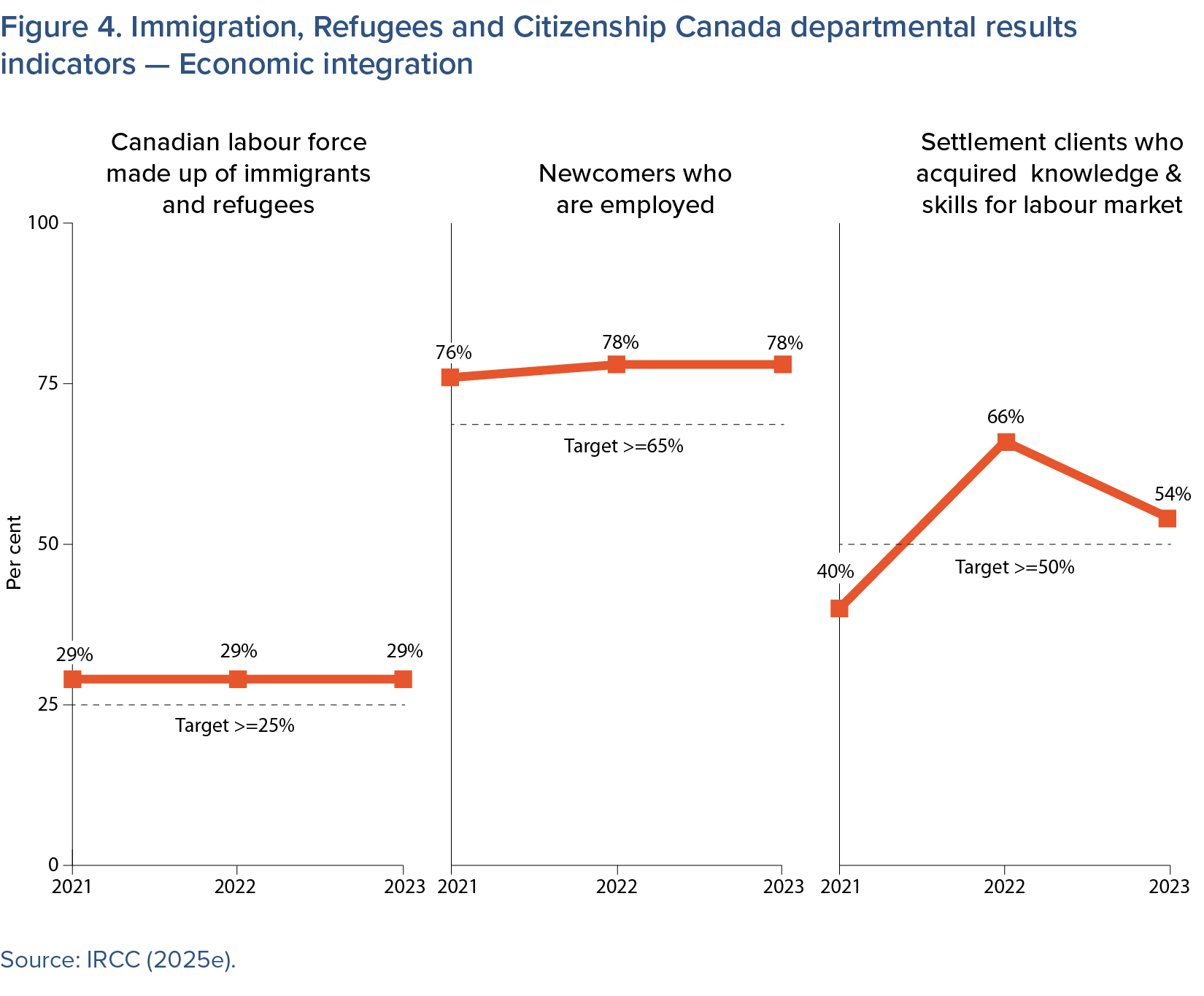
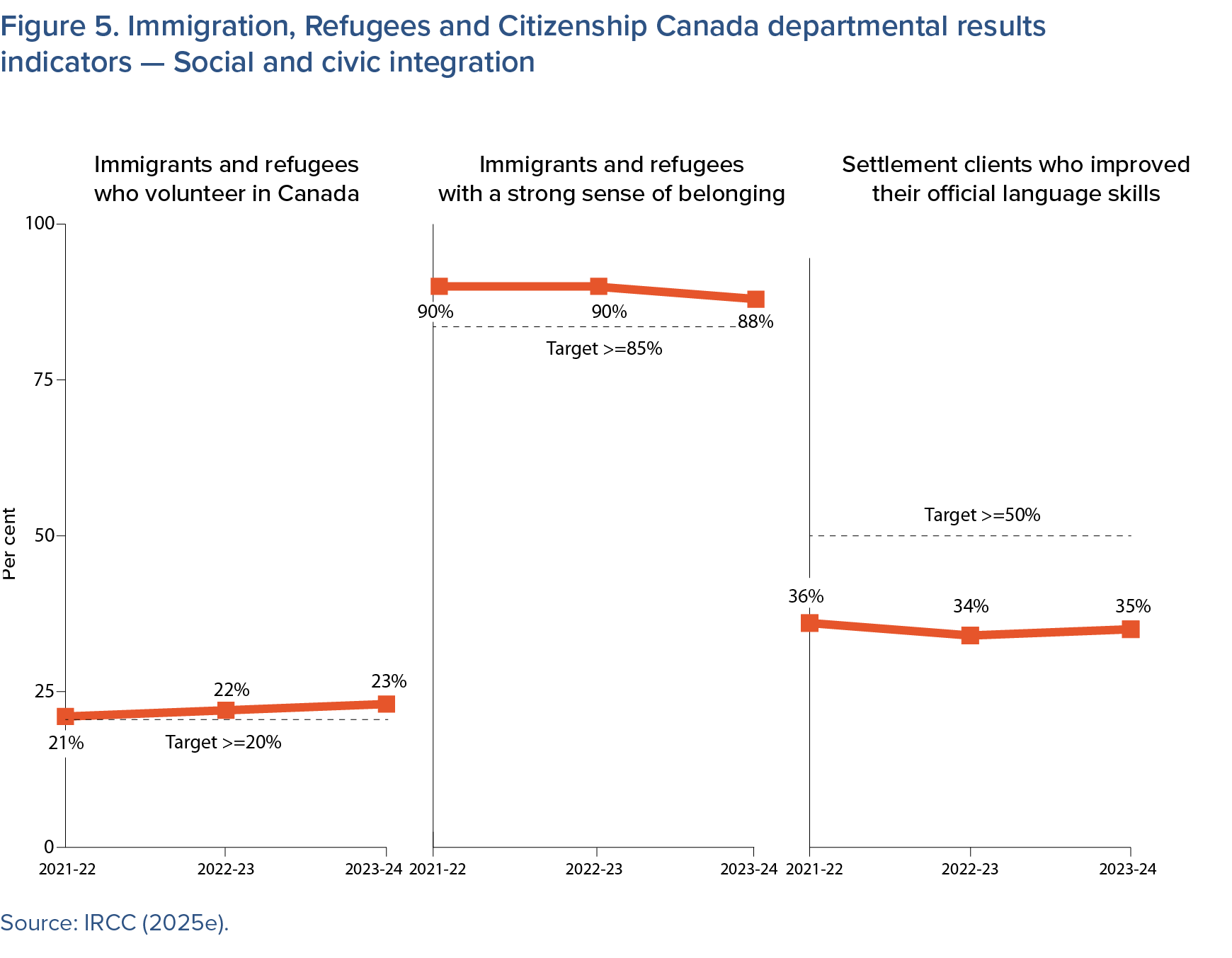
Asked to identify the most significant developments in the Settlement Program during the past decade, IRCC officials began with the NOS, which one described as “huge.” They identified the following additional developments: more structured, data-driven engagement with provincial and territorial governments on “service matching”; greater dispersion of integration services due to more newcomers settling outside Toronto, Vancouver and Montreal; and a pivot to online service delivery encouraged by greater reliance on remote delivery during the COVID-19 epidemic (see also Monteiro et al., 2023).
IRCC officials pointed out that the issue of temporary residents’ potential access to federally funded integration services has been a “discussion over decades with partners.” The availability of funding is key, they added.
A more immediate issue is the expenditure review now in progress. It requires departments to identify the following reductions in program spending: five per cent in fiscal year 2026-27, seven per cent in 2027-28 and 15 per cent in 2028-29. For IRCC, the projected reduction in spending for 2029-30 is $613.5 million.
In a presentation to sector representatives at the time of the 2025 budget, IRCC officials stated that evolving circumstances present “a real opportunity for program renewal and renewed collaboration” (IRCC, 2025g). In that regard, the presenters asked: “How do we consider client vulnerability in implementing a new framework?” The presentation covered a range of additional issues, including stronger collaboration with provincial/territorial counterparts “to align co-planning and service delivery” as well as potential improvements “to foster broad partnerships in communities and diversify sources of funding.”
In February 2026, IRCC informed service provider agencies of the following decisions resulting from the expenditure review:
- The Settlement and Resettlement Program budget for 2026-27 will be $935.7 million, a decrease of 9.5 per cent (approximately $98.1 million) compared to the notional budget for that year which, to reflect the decline in admissions levels, was lower than the 2025-26 budget.
- The total amount allocated to organizations in Ontario in 2026-27 will be reduced by seven per cent compared to the notional budget for that year (17 per cent lower than in 2025-26). In British Columbia, the corresponding reductions are 11 and 25 per cent.
- As of April 1, 2026, economic class clients, as well as their spouses and children, will be eligible for services for six years from the date their permanent residence is confirmed. This will be reduced to five years on April 1, 2027.
- Services to resettled refugees will not be affected by the spending reductions (IRCC, 2026).
These decisions will require changes to many of the agreements with SPOs that came into effect in April 2025. In that regard, another February 2026 IRCC message stated: “Funding decisions do not affect all [SPOs] in the same way, as impacts depend on each organization’s unique situation” (Keung, 2026). IRCC must also take account of the two one-time measures announced in the 2025 budget and the planned increase in francophone immigration outside Quebec.11 The department has a heavy agenda for the near term. Considerable additional effort and vision will be required to advance the program renewal and renewed collaboration referenced in its November 2025 presentation.
Government of Ontario
With 38 per cent of the country’s population in 2021 (Statistics Canada, 2022), Ontario is Canada’s most populous province. It also has the highest proportion of immigrants. In 2021, 30 per cent of its population was born outside Canada (Statistics Canada, 2025). Despite efforts to encourage a greater dispersion of newcomers, Ontario remains a powerful magnet. In 2025, 169,550 immigrants arrived in the province, 43 per cent of the Canadian total (Government of Canada, 2026). Ontario also receives a high proportion of temporary residents. For the fourth quarter of 2025, Statistics Canada estimated that 45 per cent of the country’s non-permanent residents (temporary workers, international students and refugee claimants) resided in Ontario (Statistics Canada, 2026).
From 2003-18, Ontario had a Ministry of Citizenship and Immigration. Following the election of a Progressive Conservative government in 2018, administrative support for immigration and integration was divided between the Ministry of Children, Community and Social Services (settlement and adult language training programs) and the former Ministry of Training, Colleges and Universities (Ontario Bridge Training Program). The Ontario Immigrant Nominee Program and the Settlement and Integration Program are now situated within the global talent and settlement services division of the Ministry of Labour, Immigration, Training and Skills Development.
There have been three immigration agreements between the Ontario and federal governments. The first was signed in 2005 when the Liberals held power federally and in Ontario. It committed Ottawa to a massive increase in spending on settlement services and language training in the province. Between 2004-05 and 2009-10, that spending increased fourfold, to $430 million from $110 million (Vineberg, 2012, p. 49). However, spending this huge amount proved a challenge (Seidle, 2010). As the agreement neared its term, the Ontario government asked for the devolution of immigrant selection and integration services in a renewed agreement (Biles et al., 2011, p. 206). The Conservative federal government (elected in 2006) rejected the request and after a one-year extension, the agreement expired in 2011.
The second agreement, signed in 2017, focused mostly on Ontario’s Provincial Nominee Program. The brief section on settlement and integration simply stated that “[t]he Parties will coordinate their efforts to support the successful settlement and integration of Refugees” (IRCC, 2017). The agreement was extended three times.
A new agreement, with a five-year term, was signed in November 2025. The section on settlement and integration is somewhat more robust. For example: “Canada and Ontario agree to consult one another on investment planning for the successful settlement and economic integration of immigrants in Ontario” (IRCC, 2025h).
Ontario’s Settlement and Integration Program is intended to “[help] newcomers integrate and contribute to the economy through services designed to help overcome integration barriers and equip them with the tools they need to succeed” (Ministry of Labour, Immigration, Training and Skills Development, 2025). There are three long-established programs within it:
- Newcomer settlement helps newcomers build a strong foundation, gain knowledge and skills that are key to integration, access social supports and develop connections to the labour market. Services include needs assessment and referrals, information and orientation, case management for clients with higher needs and labour market orientation.
- Language training helps newcomers gain communication skills for effective community and labour market integration. Services include language proficiency assessments, training in English or French as a second language, as well as workplace and occupation-specific language training.
- Bridge training helps skilled immigrants overcome foreign qualification recognition barriers and find employment commensurate with their international qualifications. Services include occupation-specific and technical training to address skill and knowledge gaps in high-demand occupations, as well as training focused on obtaining licensure/certification in regulated occupations.12
Services under these programs are delivered by community organizations, school boards and post-secondary institutions. The base budgets of the three programs have remained relatively stable since 2019-20 (see table 1). The first two programs have nevertheless received increases due to time-limited investments to support migrant populations with unique needs — for example, Syrian refugees and asylum claimants. Between 2022-25, Ontario provided $20.2 million in additional funding for Ukrainians who arrived on CUAET visas.13

Total spending for 2024-25 under the three programs was $6.82 per Ontario resident — somewhat higher than the corresponding amount in British Columbia ($6.34). Spending on federally funded services in Ontario for 2024-25 equalled $36.52 per Ontario resident (using 2021 census results)14 — 5.4 times the Ontario government’s spending on the programs.
Table 2 provides a breakdown by category of clients served by the three programs in 2023-24. The client eligibility criteria, particularly for newcomer settlement, are broader than those of IRCC’s Settlement Program. For newcomer settlement and language training, refugee claimants and protected persons represented 28 per cent of settlement clients and 44 per cent of language learners in the school year 2023-24. About 65 per cent of learners are studying at the lower levels, CLB 1-4, and 33 per cent at the intermediate and higher levels, CLB 5+ (Y. Ferrer, interview, June 6, 2025). In 2023-24, 185,600 clients were served under the three programs.
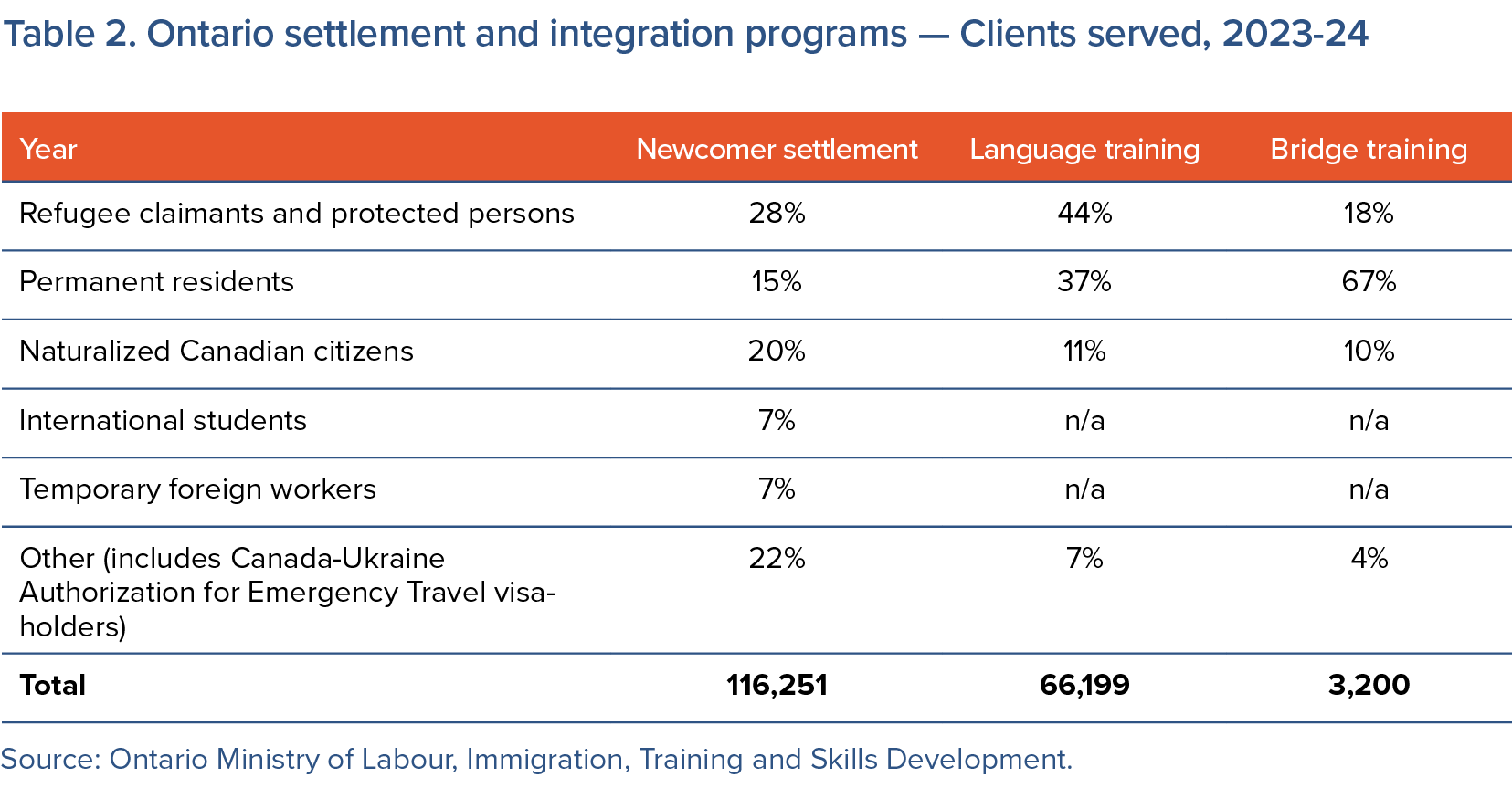
The wider client eligibility criteria of Ontario’s programs reflect an economic perspective. Processing times for refugee claims often stretch to several years. During that period, claimants can help fill labour market gaps. Integration services for claimants are thus seen as a worthwhile investment.
The Ontario government has responded proactively to immigration shifts by modernizing service models — for example, the introduction of occupation-specific language training courses, the 2024 redesign of the bridge training program and the launch of the international student connect program (COSTI Immigrant Services, n.d.). Ontario’s Fair Access to Regulated Professions Act has been amended several times since 2021 to streamline and expedite recognition processes for internationally trained skilled workers.
Funding increases have enabled community organizations to expand and adapt service models to meet emerging needs, but their time-limited nature has often meant that new initiatives with positive outcomes cannot be sustained.
Government of British Columbia
British Columbia is Canada’s third-most populous province, with 14 per cent of the country’s population in 2021 (Statistics Canada, 2022). It also has the second-highest proportion of immigrants. In 2021, 29 per cent of B.C.’s population was born outside Canada (Statistics Canada, 2025). In 2025, 50,640 immigrants arrived in British Columbia — more than any other province except Ontario and 13 per cent of the Canadian total (Government of Canada, 2026).
The B.C. government launched a settlement program in 1992 “to provide for the needs of immigrants at risk of criminality, social exclusion and poverty” (Paquet, 2019, p. 81). The program remained relatively modest until the signing of the Agreement for Canada-British Columbia Co-operation on Immigration in 2007. The federal offer “coincided with the province’s desire to intervene more robustly in integration, in line with principles of social justice” (Paquet, 2019, p. 84).
The agreement, which lasted until 2014, led to expansion and innovation. The annual transfer from the federal to the B.C. government reached a high of $120,729,982 in 2009-10 (Seidle, 2010, p. 4). In particular, there was a large increase in spending under the B.C. Settlement and Adaptation program (Hiebert & Sherrell, 2011).
B.C.’s migrant integration initiatives are now administered by the immigration policy and integration branch in the Ministry of Post-Secondary Education and Future Skills. The largest program is the B.C. Newcomer Services Program (BCNSP), formerly the B.C. Settlement and Integration Services (BCSIS). Its purpose is “to empower temporary residents and naturalized citizens to successfully integrate into their new communities, find meaningful employment, access education and health care, and contribute to the social fabric of their new community” (Government of British Columbia, 2023). Temporary foreign workers, international students and refugee claimants are eligible.
In recent years, spending that targeted temporary residents was fairly modest: $6 million for BCSIS in 2018-19, and $12 million for BCSIS in 2022-23. For 2024-25, the NDP government increased its funding to $13.4 million for the redesigned BCNSP. Services were provided by 55 organizations, with 47,968 clients served.
A new program, Safe Haven, was launched in 2024, with $12.2 million in funding for 2024-25 for 31 organizations that provided specialized services to 13,985 refugee claimants and “other humanitarian newcomers.” These included language education for refugee claimants, counselling to provide urgent support to clients through an emergency, and clinical counselling for those who have experienced trauma (WelcomeBC, 2025a).
A notable economic integration initiative is Career Paths for Skilled Immigrants. It dates from 2017, when Skills Connect (established in 2006) was redesigned. Career Paths “helps professionals use their skills, training, and foreign qualifications for work in B.C. It can help [them] get jobs that match [their] experience and background” (WelcomeBC, 2025b). The program has three streams: priority occupations, regulated jobs and unregulated jobs. It is co-funded with IRCC, which contracts with the same service providers as B.C. for part of the services (the federal funding is thus not an intergovernmental transfer). In 2024-25, total funding for Career Paths was $9.2 million. B.C. provided $6.1 million and IRCC $3.1 million. Eleven organizations provided services to 2,161 clients.15
A related initiative that should promote economic integration is the adoption of the International Credential Recognitions Act (Government of British Columbia, 2025). This statute makes B.C. a leader among the provinces in this area.
A competitive procurement process was used in 2024-25 prior to the launch of Safe Haven and for BCNSP. For 2024-25, total B.C. government funding of the three programs was $31.7 million, with more than 64,000 clients served. Using 2021 census results, the B.C. government’s spending was $6.34 per provincial resident — slightly below the corresponding figure for Ontario ($6.82). Spending on federally funded services in B.C. for 2024-25 equalled $27.97 per resident (based on 2021 census results)16 — 4.8 times B.C.’s spending on its programs.
Asked about the most significant developments of the past several years, Joni Rose, senior program adviser, Ministry of Post-Secondary Education and Future Skills, emphasized the substantial increase in provincial funding to support the rising number of temporary residents (J. Rose, interview, May 13, 2025). Rose added that decreased funding under IRCC’s Settlement Program will have ripple effects because B.C. funds some of the same service providers. “We are only at the beginning of the fallout,” she observed. Although adjustments lie ahead, the B.C. government has demonstrated a commitment to strengthening supports for vulnerable migrants.
City of Toronto
Toronto has the highest proportion of immigrant residents of any Canadian city. In 2021, 51.9 per cent of its residents were born outside Canada (46.6 per cent were immigrants and 5.3 per cent were non-permanent residents). In 2021, only two countries were the birthplace of more than 10 per cent of Toronto’s immigrant population: the Philippines at 10.3 per cent and China at 10.1 per cent (Statistics Canada, 2025).
The city’s deep diversity has meant that “[n]o municipal service field in Toronto has remained unchanged by the massive global migration that has settled in the city in recent decades” (Siemiatycki, 2012, p. 35). In the face of this, Toronto’s services for migrant reception and integration have long been based on a horizontal (cross-administration) approach. This was reflected in the initial version (2013) of the Toronto Newcomer Strategy, which included the following mission: “Advance the successful settlement and integration of all newcomers to Toronto through a seamless, responsive and accountable human services system” (City of Toronto, 2013).
The strategy was based on four interconnected pillars: advancing labour market outcomes; promoting and supporting good health; improving access to municipal support; and supporting civic engagement and community capacity.
A key component of the strategy was collaboration with Local Immigration Partnerships (LIPs) (National LIP Secretariat, n.d.). The LIPs began in 2009 as 17 neighbourhood-based local planning tables and transitioned to a quadrant model in 2012. Each of Toronto’s neighbourhoods belongs to one of the four quadrant-based LIPs. There is also a fifth LIP — the City of Toronto’s Newcomer Office. Leadership of the LIPs is provided by a partnership council of multi-sectoral leaders. The Newcomer Office LIP and two of the quadrant-based LIPs are funded by the IRCC Settlement Program.17
The 2013 Toronto Newcomer Strategy led to the creation of a secretariat, which was mandated to “work with City and external partners to promote the inclusion of a newcomer lens in the development and implementation of City programs and policies” (City of Toronto, 2013). The secretariat was subsequently renamed the Toronto Newcomer Office in 2013.
That office is within the City’s social development, finance and administration division. Alison Stanley, its manager, described the office as “an internal centre of expertise” (A. Khenti & A. Stanley, interview, May 9, 2025). As such, it “advise[s] and support[s] other City divisions and agencies … as well as having primary responsibility for coordinating the Toronto Newcomer Strategy” (City of Toronto, 2021). It also oversees implementation of the City’s Refugee Resettlement Program, Refugee Capacity Plan and the Access to City Services for Undocumented Torontonians policy. For 2025-28, the office will receive an average of $799,617 a year from the Newcomer Office LIP.18
In 2013, the City adopted the Access to City Services for Undocumented Torontonians policy, also called AccessTO. Under it, “all Torontonians, regardless of immigration status, have the right to access City services without fear” (City of Toronto, 2025a). In addition, all residents may access the newcomer services kiosks, located throughout the city, usually without being asked for proof of status. Under this initiative, residents not only obtain information virtually but may meet with a settlement worker and receive free, confidential services, such as: information on education, employment, health care, housing and other matters; referrals to community services and City programs; and access to language-specific supports across the city (City of Toronto, 2025b).
The latest version of the Toronto Newcomer Strategy, adopted by City Council in 2021, outlines five priorities for 2022-26 (City of Toronto, 2021):
- Improve newcomer access to the City of Toronto through employee training, outreach and communication.
- Rigorously implement the AccessTO (Access without Fear) Policy.
- Prepare and implement newcomer access plans for programs and services with a high impact on newcomer well-being.
- Convene, collaborate and advocate for system-wide issues affecting newcomers.
- Report on results.
A 2016 progress report included a positive assessment of the Toronto Newcomer Office: “[It] has been able to leverage its municipal positioning to develop a strong network of partners at the municipal, provincial, federal and community level, and increase their participation in planning and coordination” (City of Toronto, 2016, p. 7). However, the latest Toronto Newcomer Strategy states that AccessTO “is a case of a good policy that has not received the resources and attention it needs for implementation” (City of Toronto, 2021, p. 11).
The next report to City Council on the strategy will be in 2027. Perhaps its assessment of AccessTO will be more positive. In the meantime, it is fair to say that the City of Toronto has an ongoing commitment to advancing migrant integration through inclusive measures that reflect the demography of a large and highly diverse community.
City of Vancouver
The 2021 census found that 48.8 per cent of residents of the City of Vancouver were born outside Canada (42.2 per cent were immigrants and 6.6 per cent were non-permanent residents). Its population, then 662,248, is only a fraction of the population of the Vancouver census metropolitan area (CMA), which was 2,642,825 in 2021, with 41.8 per cent of them immigrants. In some of the cities in Metro Vancouver,19 immigrants are a higher proportion of the population. For example, in 2021, immigrants were 60.3 per cent of the population of Richmond and 44.6 per cent in Surrey (Statistics Canada, 2025). This section covers only the City of Vancouver.
The Vancouver area has a long history of community action with migrants (Hiebert & Sherrell, 2011; Kataoka & Magnusson, 2011). However, the City of Vancouver has been less proactive than Toronto in this area. As Lanny Libby, a social planner in the City’s arts, culture and community services division, said in an interview, the City does not have a policy in this area and does not provide services directly to migrants. Libby says this reflects explicit direction from City Council, which considers the provision of settlement and integration services to be the federal government’s jurisdiction. Libby added that the City’s approach is to incorporate “an equity and accessibility lens” into all its work (L. Libby & A. Huang, interview, June 10, 2025).
The City does have some initiatives that benefit migrants. One provides grants to organizations for settlement and integration-related services, offered without regard to status. In 2024, these grants totalled about $300,000. The Neighbourhood Houses program provides housing and other supports for marginalized residents. Spending on this program has risen in recent years and in the 2024 budget it was $1.2 million.
Another initiative is the 2016 Access Without Fear policy. It applied initially to street and homeless outreach; emergency operations; fire and rescue; garbage, recycling and green waste collection; permits; public hearings; and water, sewers and drainage (City of Vancouver, 2022). Parks and Recreation and the Vancouver Public Library later adopted policies in support of the City’s objectives. The Vancouver Police Department initially resisted the policy but subsequently developed a relatively general set of guidelines.
The City of Vancouver (2014) has a detailed (79 pages) newcomer’s guide. Although it was not intended only for immigrants, the guide includes a wealth of information about relevant services and resources. It was also an invitation to participation and civic engagement. Copies of the guide were distributed to schools, libraries and community centres across the city, but it is now available only online.
Libby underlined the City’s focus on the most vulnerable migrants and the explicit decision to stay away from areas funded by IRCC. As with the B.C. government’s Safe Haven program, the city’s Neighbourhood Houses initiative benefits some of the most precarious migrants. The latter program would no doubt benefit from an increased budget, as would the modest grants program for community organizations.
Overall
Taking the five cases together, no common pattern is evident. In two of the three jurisdictions that fund SPOs to deliver integration services — the federal and Ontario governments — the client groups remained essentially the same during the past decade. However, British Columbia innovated through Safe Haven, which provides a wider range of services to refugee claimants than the programs of those two governments. Spending under IRCC’s Settlement Program rose by 70 per cent between 2016-17 and 2023-24. In B.C., spending in 2024-25 was 2.6 times what it was in 2018-19. The base budgets of Ontario’s three ongoing programs have remained relatively stable since 2019-20.
The Toronto Newcomer Office advises and supports other divisions with implementing the city’s Newcomer Strategy. The city’s newcomer services kiosks provide information and referrals. The City of Vancouver has no policy in this area. It endeavours to include an “equity and accessibility lens” into all its work, but there is no mechanism to further this objective.
Looking Ahead
Taking account of Canada’s shifting migration landscape and drawing on discussions with interviewees and others, this section presents four recommendations on governance and policy: strengthened engagement between the federal government and the settlement sector; reversing IRCC’s decision to end funding for language instruction beyond the basic level; modifying the IRCC Settlement Program criteria to further the objective of focusing on the most vulnerable, particularly refugee claimants; and holding a national forum to take stock of Canada’s migrant integration programs.
Engage the settlement sector
According to Robert Vineberg, a former IRCC director general, “Canada’s decision to encourage non-governmental organizations to deliver settlement services was a brilliant way to involve communities and to stretch resources by means of community volunteer networks supporting settlement professionals” (Vineberg, 2012, p. 67).
These organizations, often referred to as the settlement sector, constitute a vast pan-Canadian network. Some are active across an entire province while others focus on a single immigrant community or big-city neighbourhood. As the data provided in this report demonstrate, their reach (clients served) is impressive.
To include perspectives from the settlement sector, I interviewed the head or senior staff of three organizations: the Ontario Council of Agencies Serving Immigrants (OCASI), composed of more than 250 community-based organizations; the Affiliation of Multicultural Societies and Service Agencies of B.C. (AMSSA), the umbrella association for newcomer-serving agencies in B.C.; and the Immigrant Services Society of BC (ISSofBC), which supports immigrants and temporary residents, including refugee claimants and international students. The interviewees were asked about developments during the past decade and current challenges.
Chris Friesen, chief operating officer of ISSofBC, said the national sector engagement framework has evolved since the early 2000s. There are currently several standing consultative bodies, the most important of which is the National Settlement and Integration Council (C. Friesen, interview, April 15, 2025).20
Debbie Douglas, OCASI’s longtime executive director, mentioned the increased support for initiatives on equity issues funded by the federal and certain provincial governments. These initiatives include a strengthened emphasis on women, especially on gender-based violence and economic empowerment. She also observed there is slightly more flexibility in contract budget management (D. Douglas, interview, April 22, 2025).
Friesen spoke favourably about the B.C. government’s increased funding to support temporary residents, including refugee claimants, through the Safe Haven and Newcomer Support programs.
The federal reduction in admission levels announced in 2024 led to considerable concern and uncertainty in the settlement sector. An interviewee from AMSSA pointed out that, even if annual admissions are dropping, newcomers who arrived in previous years still require support. She added that some organizations with 30 years’ experience were already laying off staff. There is now “an atmosphere of uncertainty and competition”
(S. Dumitra, S. Sehic, & H. Khan, interview, June 10, 2025).
The concern in the sector is understandable. As a rule, SPOs may apply 15 per cent of the value of the funding agreement with IRCC toward administrative costs. A reduction in annual funding thus affects not only SPOs’ client services but also their ongoing operations. According to a report based partly on a survey of 48 SPOs in the Toronto region, 69 per cent of the agencies anticipated laying off staff as a result of funding reductions. The research was conducted before the further cuts resulting from the expenditure review were made known (Shakya et al., 2026).
One of the AMSSA interviewees stated: “The sector needs to think about how we’re being funded and by whom, and consider how to diversify funding” (S. Dumitra, S. Sehic, & H. Khan, interview, June 10, 2025). In the study conducted by the United Way of Greater Toronto and partners, 77 per cent of the agencies indicated that in response to the IRCC funding reductions, they would apply for funding from other government bodies, while 69 per cent planned to seek alternative funding from community foundations. The study noted: “Key informants emphasized that these [approaches] reflect not just financial adaptation but also a profound commitment to maintaining service continuity under constrained conditions” (Shakya et al., 2026, p. 37).
As for relations between IRCC and the sector, Douglas observed that the relationship solidified during the arrival of Syrian and Ukrainian refugees but changed during the last couple of years, in part because of significant turnover in senior management at IRCC. In her view, the intelligence of the sector is not being used in policy development, “although we’re starting to see some movement there as we prepare for more cuts.” She added: “With all the changes in senior leadership, we need to build new trust between IRCC and the sector” (D. Douglas, interview, April 22, 2025).
The fallout from the expenditure review will remain a focus of IRCC’s relations with the sector for some time. IRCC is nevertheless committed to program review, and it would do well to engage the sector more fully than in the past — for example, by giving a mandate to one of the department’s sectoral committees to hold targeted consultations and propose specific changes.
Reverse the decision on federal funding for intermediate language instruction
SPOs and others have been critical of IRCC’s decision to end funding for language instruction beyond the basic level, CLB 4 (CLB-OSA, n.d.) as of September 2026. This surprise announcement came after applications for the latest round of funding had closed. Previously, some participants were taught at levels up to CLB 10. In Ontario, one-third of learners are studying at the intermediate and higher levels, CLB 5+.
A June 2025 briefing note for the IRCC minister addressed the language instruction policy change:
A core objective of the Settlement Program is to assist the most vulnerable clients and to ensure that they have the supports they need to participate in Canadian society. In the language training service sector, this means prioritizing basic language skills that allow clients to: access services; participate in their children’s education; and conduct daily activities. (IRCC, 2025i)
Since 2012, CLB 4 has been required for naturalization as a Canadian citizen. However, such basic competence is insufficient for newcomers seeking recognition of their professional credentials, which is often an onerous process. Greater fluency in one of Canada’s official languages can also contribute to newcomers’ social and civic integration.
Moreover, Canadians in general agree that language fluency is important for newcomers. Respondents to the 2023 Focus Canada survey conducted by Environics ranked fluency in English or French the highest among values they believed were most important for immigrants to adopt (Environics Institute for Survey Research, 2023).
IRCC should reverse its decision to end funding for language instruction beyond CLB 4. It should also indicate that, as of April 1, 2029 (when the next round of funding takes effect), SPOs with the capacity to provide language instruction up to CLB 8 will be eligible for funding under the Settlement Program.
Broaden eligibility for programs to refugee claimants
Revising public policies and programs entails making choices about who is to benefit. The eligibility criteria for integration services reflect decisions about which migrant categories have the greatest need.
In this regard, refugee claimants merit particular consideration. As the Canadian Council for Refugees stated in a submission to the federal immigration department: “Some groups of newcomers such as refugee claimants and migrant workers, particularly those in the ‛low-skilled’ categories, are made vulnerable by their lack of access to services, including … information and referral services” (Canadian Council for Refugees, 2013, p. 2).
Following the introduction of a file review policy in 2019, the acceptance rate by the Immigration and Refugee Board of Canada rose to 80 per cent in 2024 (Yousif, 2026). Even so, obtaining an initial decision can take several years. During that time, a considerable proportion of claimants have the right to work, and many are doing so. Supports such as language training can help them fit into the labour market. For those who transition to permanent residence, skill-building services at an early stage can facilitate their economic and social integration.
Refugee claimants are not eligible for services provided under IRCC’s Settlement Program. However, programs provided by Ontario and B.C. are open to many temporary residents. In Ontario, 44 per cent of the clients of the provincially funded language classes were refugee claimants or protected persons in 2023-24 (see table 2). B.C.’s Safe Haven program provides a range of services, including information and referrals for migrants who have not yet submitted a claim.
As for IRCC, in response to the war in Ukraine, the department funded services through CUAET (see footnote 7). An academic study concluded that “[t]he quick and effective response to Ukrainian newcomers showcased the adaptability and effectiveness of Canada’s settlement and integration services, setting a precedent for tailored approaches that would meet the specific needs of other migrant groups” (Ali et al., 2025, p. 6).
IRCC should consider adjusting its eligibility criteria to allow SPOs to support refugee claimants. One option would be to stipulate that an SPO must commit to financing part of the project’s cost (perhaps one-third) from sources other than IRCC.
Many businesses and professional organizations already help support migrant integration, both directly and indirectly (e.g., through LIPs). A recent example is the decision of the Canadian Medical Association to grant $645,000 to the Health English Language Pro (HELP) program, which pairs retired physicians with newcomer doctors to help the latter improve their English through about 10 virtual conversations (Grant, 2026).
In light of the humanitarian and economic considerations discussed above, some foundations and employers or employers’ associations could be willing to support IRCC-funded projects for refugee claimants. This potential change should be examined and ideally included in the call for proposals for the next round of funding under IRCC’s Settlement Program.
Hold a national forum to take stock of Canada’s migrant integration model
Migrant integration in Canada consists of a vast network that benefits from collaboration among governments and their partners in pursuit of shared objectives. Even if the model has several strengths, these should not be taken for granted, particularly in light of recent policy changes and pressures from fiscal restraint.
In part to inform the renewal process IRCC has undertaken, I propose that a national forum be held to assess Canada’s migrant integration model as a whole and to examine possible improvements. The agenda should address the following questions:
- How effective are the current migrant integration programs and services funded by Canada’s federal and provincial/territorial governments?
- Could large cities, other centres and francophone communities outside Quebec be more active in this area? If so, how?
- In what concrete ways can co-ordination between the federal and provincial/territorial governments be strengthened to improve their services?
- How can service provider and umbrella organizations play a larger role in planning and policy/program review?
The forum agenda could include presentations by experts and practitioners, including some from outside Canada, on broader questions about the fundamentals of migrant integration, such as:
- What are the best digital communication tools to help reduce costs and expand client reach?
- Should some or most integration services be provided by public service institutions, such as the adult education centres that provide more than one-third of the integration courses in Germany?
- Should participation in language training and/or some other integration programs be mandatory? If so, for which categories of migrants? In Germany and Sweden, such requirements apply mainly to migrants who have been granted international protection.
The national forum should be broadcast online and recorded for later posting. In addition to the knowledge that participants and viewers would gain from the presentations and discussions, the forum would help raise public awareness about Canada’s migrant integration services and possible changes to take account of the evolving migration context. In turn, this could encourage business, foundations and others to support joint initiatives.
Conclusion
The November 2024 announcement about the reduction to permanent and temporary migration drew a link with immigrant integration: “Immigration accounted for almost 98% of [population] growth in 2023. This growth affected Canada’s ability to effectively integrate newcomers, while negatively impacting public support for immigration” (IRCC, 2025e).
As the admission reductions and cuts in federal spending proceed, governments, stakeholders and experts will need to examine how to update and strengthen the country’s extensive migrant integration programs and services. The foundations are solid, the experience of governments and stakeholders is extensive, and the support of community organizations seems strong.
However, the path forward will not be easy. Migration issues have become a good deal more volatile. This is reflected in public opinion and in certain politicians’ efforts to exploit public concerns.
Financial restraint is an obstacle to the renewal of integration programs. The first priority of program managers and delivery organizations is to adapt to lower budgets. Funding cuts may nevertheless provide a stimulus for service providers and umbrella organizations to increase financial support for integration initiatives from non-government sources.
Another obstacle to renewal is a lack of political will. It may be convenient for certain provincial and big-city governments to claim that migrant integration is a federal responsibility. With its various dimensions, migrant integration concerns Canadian society and the economy, as a whole. All governments need to acknowledge this.
As they face the present unsettled climate, governments can benefit from the expertise of sector leaders who have worked extensively with a range of organizations and communities. Federal/provincial/territorial processes are another potential source of knowledge about how best to meet the needs of different client groups. Some lessons may also come from other countries with well-developed programs in this field. Ideally, such engagement and policy debate will inform program renewal that will bring results while sustaining the objectives of Canada’s unique migrant integration model.
Notes
1 In this report “migrants” is used as “[a]n umbrella term … reflecting the common lay understanding of a person who moves away from his or her place of usual residence, whether within a country or across an international border, temporarily or permanently, and for a variety of reasons” (International Organization for Migration, 2026). This usage is followed by other leading international organizations.
2 My sincere thanks to Nadya Zezyulina for the excellent research assistance she provided on this project. I am also grateful for the insightful and constructive comments on the initial version provided by Irene Bloemraad, Charles Breton, Lisa Brunner and Mireille Paquet.
3 For a detailed account of Canada’s migrant labour system, see the report of the Standing Senate Committee on Social Affairs, Science and Technology (2024).
4 This was modified in the 2025 budget. The target is now to “reduce the total number of temporary residents to less than five per cent of Canada’s population by the end of 2027” (Department of Finance, 2025, p. 97).
5 All the provinces and territories outside Quebec, except Nunavut, now have a nominee program.
6 Immigration and Refugee Protection Act, S.C. 2001, c. 27., s. 3 (1) (e).
7 This initiative provided Ukrainians and their family members with a pathway to enter and stay in Canada temporarily due to the Russian invasion. It offered a visitor visa, open work permit and study permit options for up to three years. Ukrainians who qualified did not become permanent residents but could apply to immigrate to Canada under a number of programs and streams (IRCC, 2022). Between March 17, 2022, and April 1, 2024, 298,128 Ukrainians arrived in Canada under CUAET (IRCC, 2024e).
8 For example, temporary residents and their dependants in employment programs such as the Atlantic Immigration Program and the Rural and Northern Immigration Program; Palestinians who left Gaza on or after Sept. 1, 2023, and their families (until March 31, 2027); and participants in the Francophone Minority Communities Student Pilot and their families (IRCC, 2025d).
9 The proposals also received an equity, diversity and inclusion score based on incorporation of gender-based analysis plus targeted programming for specific equity-deserving client populations, and Truth and Reconciliation programming that increases awareness of Indigenous-related topics among newcomers and facilitates meaningful connections and social cohesion between Indigenous Peoples, newcomers and Canadians.
10 Persons who accessed at least one settlement service or the Refugee Assistance Program.
11 Immigration to French-speaking communities outside Quebec is expected to rise to 35,175 by 2028 — almost twice the 19,600 permanent residents in this category in 2023.
12 Program profiles provided by the Ontario Ministry of Labour, Immigration, Training and Skills Development.
13 Ukrainians admitted under CUAET had greater access to key provincial programs than other temporary visa holders. In particular, they could join immediately the Ontario Health Insurance Program and were also eligible to apply for social assistance (Ali et al., 2025).
14 Spending data provided by IRCC.
15 The data and other information in this and the preceding two paragraphs were provided by the B.C. Ministry of Post-Secondary Education and Future Skills.
16 Spending data provided by IRCC.
17 Prior to April 1, 2025, all five of the Toronto LIPs were funded by IRCC.
18 Data provided by IRCC.
19 Metro Vancouver, a regional district, includes 21 municipalities and one treaty First Nation. The Vancouver CMA encompasses almost the same territory as Metro Vancouver.
20 The council includes settlement, resettlement and integration stakeholders, representatives of provincial/territorial governments and officials from IRCC and other federal government departments.
REFERENCES
Ali, H., Shields, J., & Preston, V. (2025). Reforming settlement services to include temporary migrants: Policy preview. York University. https://www.yorku.ca/research/bmrc-irmu/wp-content/uploads/sites/869/2025/02/Reforming-Settlement-Services-policy-preview-Final-2025clean.pdf
Besco, R., & Goel, N. (2025). Who changed their minds? Two shifts in Canadian public opinion on immigration: 1995-2005 and 2023-24. Centre of Excellence on the Canadian Federation.
https://centre.irpp.org/research-studies/canadian-opinion-immigration/
Biles, J. (2008). Integration policies in English-speaking Canada. In J. Biles, M. Burstein, & J. Frideres (Eds.), Immigration and integration in Canada in the twenty-first century (pp. 139-186). McGill-Queen’s University Press.
Biles, J., Tolley, E., Andrew, C., Esses, V., & Burstein, M. (2011). Integration and inclusion in Ontario: The sleeping giant stirs. In J. Biles, M. Burstein, J. Frideres, E. Tolley, & R. Vineberg (Eds.), Integration and inclusion of newcomers and minorities across Canada (pp. 195-246). McGill-Queen’s University Press.
Bloemraad, I. (2006). Becoming a citizen: Incorporating immigrants and refugees in the United States and Canada. University of California Press.
Braun, J., & Clément, D. (2023). Immigrant settlement and integration in Canada: Trends in public funding. Journal of Canadian Studies, 57(2), 255-279. https://doi.org/10.3138/jcs-2022-0012
Brunner, L. R. (2025). Canadian international student policy at a crossroads. Centre of Excellence on the Canadian Federation. https://centre.irpp.org/research-studies/canadian-international-student-policy-crossroads/
Canadian Council for Refugees. (2013). Canada’s national settlement program: Moving forward [Submission to Citizenship and Immigration Canada]. https://ccrweb.ca/sites/ccrweb.ca/files/submission_cic_dec2013.pdf
Carens, J. H. (2014). An overview of the ethics of immigration. Critical Review of International Social and Political Philosophy, 17(5), 538-559. https://doi.org/10.1080/13698230.2014.919057
City of Toronto. (2013). Toronto Newcomer Strategy. https://www.toronto.ca/legdocs/mmis/2013/cd/bgrd/backgroundfile-55333.pdf
City of Toronto. (2016). Toronto Newcomer Strategy – Progress report.
https://www.toronto.ca/legdocs/mmis/2016/cd/bgrd/backgroundfile-97073.pdf
City of Toronto. (2021). Toronto Newcomer Strategy 2022-2026.
https://www.toronto.ca/legdocs/mmis/2021/ec/bgrd/backgroundfile-166819.pdf
City of Toronto. (2025a). Access to city services for undocumented Torontonians.
https://www.toronto.ca/city-government/accountability-operations-customer-service/long-term-vision-plans-and-strategies/access-to-city-services-for-undocumented-torontonians/
City of Toronto. (2025b). Newcomer services kiosks. https://www.toronto.ca/community-people/moving-to-toronto/after-you-arrive-checklist/newcomer-services-kiosks/
City of Vancouver. (2014). Growing roots: A newcomer’s guide to Vancouver.
vancouver.ca/files/cov/Growing-Roots-Newcomers-Guide-Vancouver.pdf
City of Vancouver. (2022). Frequently asked questions and scenarios — Access to City services without fear. https://vancouver.ca/files/cov/access-to-city-services-without-fear-faqs-and-scenarios.pdf
CLB-OSA. (n.d.). What are Canadian Language Benchmarks?
https://www.clb-osa.ca/benchmarks/overview
Coderre, M., Coustere, C., & Blain, M. (2025). Temporary residence in Canada: A patchwork of rules. Centre of Excellence on the Canadian Federation. https://centre.irpp.org/research-studies/temporary-residence-in-canada/
COSTI Immigrant Services. (n.d.). International Student Connect. https://www.costi.org/programs/program_details.php?sid=131&pid=14&id=280
Department of Finance Canada. (2025). Canada Strong Budget 2025. Government of Canada. https://budget.canada.ca/2025/report-rapport/pdf/budget-2025.pdf
Environics Institute for Survey Research. (2023). Canadian public opinion about immigration & refugees. https://environicsinstitute.org/wp-content/uploads/2024/10/focus-canada-fall-2023-canadian-public-opinion-about-immigration-refugees-final-report.pdf
European Commission. (2020). EU action plan on integration and inclusion (2021-2027).
https://home-affairs.ec.europa.eu/document/download/e2fda93e-cb29-4ce2-9e85-e37a61b31080_en?filename=20201124_eu-action-plan-on-integration-and-inclusion-2021-2027-factsheet_en.pdf
Frideres, J. (2008). Creating an inclusive society: Promoting social integration in Canada. In J. Biles, M. Burstein, & J. Frideres (Eds.), Immigration and integration in Canada in the twenty-first century (pp. 77-101). McGill-Queen’s University Press.
Good, K. R. (2009). Municipalities and multiculturalism: The politics of immigration in Toronto and Vancouver. University of Toronto Press.
Goudreault, Z. (2025, November 12). “La manne” des étudiants internationaux, en Ontario comme au Québec. Le Devoir. https://www.ledevoir.com/actualites/education/932880/manne-etudiants-internationaux-ontario-comme-quebec
Gouvernement du Québec. (2025). Integration support services offered by partner community organizations. https://www.quebec.ca/en/immigration/partners
Government of British Columbia. (2023, May 24). Province boosts support for newcomers arriving in B.C. [Press release]. https://news.gov.bc.ca/releases/2023MUNI0026-000795
Government of British Columbia. (2025). About the Office for International Credential Recognition. https://www2.gov.bc.ca/gov/content/governments/organizational-structure/ministries-organizations/regulatory-authorities/oicr/about#purpose
Government of Canada. (2026). Permanent residents — Monthly IRCC updates — Canada — Permanent residents by province/territory and immigration category [Data file].
https://open.canada.ca/data/en/dataset/f7e5498e-0ad8-4417-85c9-9b8aff9b9eda/resource/5582034d-8f89-49d5-8597-483d628078a1
Grant, K. (2026, January 20). Volunteer program for immigrant doctors to improve medical English gets big boost. The Globe and Mail. https://www.theglobeandmail.com/canada/article-volunteer-program-immigrant-doctors-medical-english-help-cma/
Hiebert, D., & Sherrell, K. (2011). The integration and inclusion of newcomers in British Columbia. In J. Biles, M. Burstein, J. Frideres, E. Tolley, & R. Vineberg (Eds.), Integration and inclusion of newcomers and minorities across Canada (pp. 77-101). McGill-Queen’s University Press.
Hou, F. (2025). From temporary to permanent residency: Recent trends in Canada’s two-step immigration selection. Centre of Excellence on the Canadian Federation. https://centre.irpp.org/research-studies/from-temporary-to-permanent-residency/
Hou, F., Koumaglo, E., & Zhang, H. (2025). Immigration and housing prices across municipalities in Canada. Immigration, Refugees and Citizenship Canada and Statistics Canada.
https://www.canada.ca/en/immigration-refugees-citizenship/corporate/reports-statistics/research/immigration-housing-prices-municipalities-canada.html
Immigration and Refugee Board of Canada. (2025). Claims by country of alleged persecution — 2025. https://www.irb-cisr.gc.ca/en/statistics/protection/Pages/RPDStat2025.aspx
Immigration, Refugees and Citizenship Canada (IRCC). (2017). Canada-Ontario Immigration Agreement — General Provisions 2017. Government of Canada. https://www.canada.ca/en/immigration-refugees-citizenship/corporate/mandate/policies-operational-instructions-agreements/agreements/federal-provincial-territorial/ontario/immigration-agreement-2017.html
Immigration, Refugees and Citizenship Canada (IRCC). (2019, August 7). New programs to boost newcomer settlement and integration [Press release]. Government of Canada.
https://www.canada.ca/en/immigration-refugees-citizenship/news/2019/08/new-programs-to-boost-newcomer-settlement-and-integration.html
Immigration, Refugees and Citizenship Canada (IRCC). (2022). Canada-Ukraine authorization for emergency travel. Government of Canada. https://www.canada.ca/en/immigration-refugees-citizenship/news/2022/03/canada-ukraine-authorization-for-emergency-travel.html
Immigration, Refugees and Citizenship Canada (IRCC). (2023). 2023 Settlement outcomes report. Data-driven insights for the future of the Settlement Program. Government of Canada.
https://publications.gc.ca/collections/collection_2024/ircc/Ci34-6-2023-eng.pdf
Immigration, Refugees and Citizenship Canada (IRCC). (2024a, October 24). Government of Canada reduces immigration [Press release]. Government of Canada. https://www.canada.ca/en/immigration-refugees-citizenship/news/2024/10/government-of-canada-reduces-immigration.html
Immigration, Refugees and Citizenship Canada (IRCC). (2024b, January 22). Canada to stabilize growth and decrease number of international student permits issued to approximately 360,000 for 2024 [Press release]. Government of Canada. https://www.canada.ca/en/immigration-refugees-citizenship/news/2024/01/canada-to-stabilize-growth-and-decrease-number-of-new-international-student-permits-issued-to-approximately-360000-for-2024.html
Immigration, Refugees and Citizenship Canada (IRCC). (2024c). Question Period note: Ukraine —CUAET measures until March 31, 2024. Government of Canada.
https://search.open.canada.ca/qpnotes/record/cic%2CIRCC-2024-QP-00053
Immigration, Refugees and Citizenship Canada (IRCC). (2024d). Settlement Program and Resettlement Assistance Program: Call for proposals (CFP) 2024. Government of Canada. https://www.canada.ca/en/immigration-refugees-citizenship/corporate/partners-service-providers/funding/settlement-funding-2024/overview.html
Immigration, Refugees and Citizenship Canada (IRCC). (2024e). Canada-Ukraine authorization for emergency travel: Key figures. Government of Canada. https://www.canada.ca/en/immigration-refugees-citizenship/services/immigrate-canada/ukraine-measures/key-figures.html
Immigration, Refugees and Citizenship Canada (IRCC). (2025a). Understanding student and temporary worker numbers in Canada. Government of Canada. https://www.canada.ca/en/immigration-refugees-citizenship/corporate/reports-statistics/statistics-open-data/immigration-stats/students-workers.html
Immigration, Refugees and Citizenship Canada (IRCC). (2025b). Key numbers on Canadian immigration: Asylum statistics, trends and data. Government of Canada.
https://www.canada.ca/en/immigration-refugees-citizenship/corporate/reports-statistics/statistics-open-data/immigration-stats/asylum-claims.html
Immigration, Refugees and Citizenship Canada (IRCC). (2025c). Details on transfer payment programs (2024–25 Departmental Results Report, appendix). Government of Canada. https://www.canada.ca/en/immigration-refugees-citizenship/corporate/publications-manuals/departmental-results-reports/supplementary-information-tables-2025/details-transfer-payment-programs.html
Immigration, Refugees and Citizenship Canada (IRCC). (2025d). Find free newcomer services near you. Government of Canada. https://ircc.canada.ca/english/newcomers/services/index.asp
Immigration, Refugees and Citizenship Canada (IRCC). (2025e). Immigration, Refugees and Citizenship Canada’s 2025-26 departmental plan. Government of Canada.
https://www.canada.ca/en/immigration-refugees-citizenship/corporate/publications-manuals/departmental-plans/2025-26-departmental-plan/departmental-plan-2025-2026-full.html
Immigration, Refugees and Citizenship Canada (IRCC). (2025f). 2025-2027 Strategic Plan. Government of Canada. https://www.canada.ca/en/immigration-refugees-citizenship/corporate/reports-statistics/strategic-plans/strategic-plan-2025-2027.html
Immigration, Refugees and Citizenship Canada (IRCC). (2025g). Settlement and Resettlement Assistance Program renewal: Adapting to evolving funding and client needs [Document provided by interviewee]. Government of Canada. https://km4s.ca/wp-content/uploads/Settlement_and_Resettlement_Assistance_Program_Renewal.pdf
Immigration, Refugees and Citizenship Canada (IRCC). (2025h). Canada-Ontario Immigration Agreement — General provisions 2025. Government of Canada. https://www.canada.ca/en/immigration-refugees-citizenship/corporate/mandate/policies-operational-instructions-agreements/agreements/federal-provincial-territorial/ontario/immigration-agreement-2025.html
Immigration, Refugees and Citizenship Canada (IRCC). (2025i). COW — settlement services — June 9, 2025. Government of Canada. https://www.canada.ca/en/immigration-refugees-citizenship/corporate/transparency/committees/cow-jun-9-2025/settlement-services.html
Immigration, Refugees and Citizenship Canada (IRCC). (2025j). 2023-2024 Resettlement & Settlement Program clients — Quick facts. Government of Canada. https://publications.gc.ca/collections/collection_2025/ircc/Ci1-73-2024-eng.pdf
Immigration, Refugees and Citizenship Canada (IRCC). (2026, February 13). IRCC message to all funded settlement service provider organizations [Document provided by IRCC]. Government of Canada. https://settlementatwork.org/en/news/ircc-message-all-funded-service-provider-organizations-spos
International Organization for Migration. (2026). Key migration terms.
https://www.iom.int/key-migration-terms
Kataoka, S., & Magnusson, W. (2011). Immigrant settlement policy in British Columbia. In E. Tolley & R. Young (Eds.), Immigrant settlement policy in Canadian municipalities (pp. 241-294). McGill-Queen’s University Press.
Keung, N. (2026, February 24). Canada will slash millions in spending meant to help immigrants. Here’s how hard Ontario is being hit. Toronto Star. https://www.thestar.com/news/canada/ottawa-cuts-98m-in-funding-for-immigrant-settlement/article_a620839c-614a-4512-8ccf-f14efc658871.html
Ministry of Labour, Immigration, Training and Skills Development. (2025). Published plans and annual reports 2024–2025: Ministry of Labour, Immigration, Training and Skills Development. Government of Ontario. https://www.ontario.ca/page/published-plans-and-annual-reports-2024-2025-ministry-labour-immigration-training-and-skills#section-3
Moldes-Anaya, S., & Sommarribas, A. (2023). Policy coherence for vulnerability in migration. The crossroads of migrant integration governance. Deusto Journal of Human Rights, 12, 69-104. https://doi.org/10.18543/djhr.2904
Monteiro, S., Pillai, N., & Kianpour, M. (2023). Online communications and service delivery in Canada’s settlement sector: The state of affairs (Working Paper No. 2023/01). Toronto Metropolitan Centre for Immigration and Settlement. https://www.torontomu.ca/content/dam/centre-for-immigration-and-settlement/tmcis/publications/workingpapers/2023-01-WP-Monteiro-et-al.pdf
National LIP Secretariat. (n.d.). Website homepage. https://thelipsecretariat.ca
Paquet, M. (2019). Province-building and the federalization of immigration in Canada. University of Toronto Press.
Paquet, M., & Schertzer, R. (2025). A complex intergovernmental problem: Why asylum-seekers challenge Canada’s immigration system. Publius: The Journal of Federalism, Article pjaf009.
https://academic.oup.com/publius/advance-article/doi/10.1093/publius/pjaf009/8112826
Seidle, F. L. (2010). The Canada-Ontario Immigration Agreement: Assessment and options for renewal. Mowat Centre for Policy Innovation. https://utoronto.scholaris.ca/items/1c412c63-c63a-416f-bbba-930915e7dc45
Seidle, F. L. (2013). Canada’s provincial nominee immigration programs: Securing greater policy alignment. IRPP Study 43. Institute for Research on Public Policy. https://irpp.org/research-studies/canadas-provincial-nominee-immigration-programs/
Seidle, F. L. (2019). Migrant integration in cities: Learning from others. Occasional Paper Series No. 44. Forum of Federations. https://www.forumfed.org/wp-content/uploads/2019/06/OPS44_Migrant_Integration_in_Cities_Learning_from_Others.pdf
Seidle, F. L. (2024, November 22). Better co-ordination and governance needed to steer Canada’s migration policies. Policy Options. https://policyoptions.irpp.org/magazines/november-2024/migration-policy-governance/
Seidle, F. L., & Joppke, C. (2012). Introduction. In C. Joppke & F. L. Seidle (Eds.), Immigrant integration in federal countries (pp. 3-21). McGill-Queen’s University Press.
Shakya, Y., Abeshu, G., Majid, U., Procyk, S. & Datta, T. (2026). When the ground shifts: The impacts of funding cuts on the immigrant and refugee serving sector. United Way of Greater Toronto, OCASI and City of Toronto https://www.unitedwaygt.org/wp-content/uploads/2026/02/WhenTheGroundShifts.pdf
Siemiatycki, M. (2012). Toronto: Integration in a city of immigrants. In C. Andrew, J. Biles, M. Burstein, V. M. Esses & E. Tolley (Eds.), Immigration, integration, and inclusion in Ontario cities (pp. 23-49). McGill-Queen’s University Press.
Song, T. (2025). Anti-immigration and the politics of housing affordability: Examining the evolution and housing market impacts of Foreign Buyer Taxes in British Columbia and Ontario. Journal of Urban Affairs, 1-18. https://doi.org/10.1080/07352166.2025.2570754
Spencer, S., & Charsley, K. (2021). Reframing ‘integration’: Acknowledging and addressing five core critiques. Comparative Migration Studies, 9(18), 1-22. https://doi.org/10.1186/s40878-021-00226-4
Standing Senate Committee on Social Affairs, Science and Technology. (2024). Act now: Solutions for temporary and migrant labour in Canada. Senate of Canada. https://sencanada.ca/en/info-page/parl-44-1/soci-temporary-and-migrant-labour/#collapse-report
Statistics Canada. (2022). Population and dwelling counts: Canada, provinces and territories. Table: 98-10-0001-01. Government of Canada. https://www150.statcan.gc.ca/t1/tbl1/en/tv.action?pid=9810000101
Statistics Canada. (2025). Focus on Geography Series, 2021 Census of Population. Government of Canada. https://www12.statcan.gc.ca/census-recensement/2021/as-sa/fogs-spg/Index.cfm?Lang=E
Statistics Canada. (2026). Estimates of the number of non-permanent residents by type, quarterly. Table: 17-10-0121-01. Government of Canada. https://www150.statcan.gc.ca/t1/tbl1/en/tv.action?pid=1710012101&pickMembers%5B0%5D=1.1&cube
TimeFrame.startMonth=10&cubeTimeFrame.
startYear=2024&cubeTimeFrame.endMonth=10&cubeTimeFrame.endYear=2025
&referencePeriods=20241001%2C20251001
Vineberg, R. (2012). Responding to immigrants’ settlement needs: The Canadian experience. Springer.
WelcomeBC. (2025a). Career paths for skilled immigrants. Government of British Columbia.
https://www.welcomebc.ca/work-in-b-c/career-paths-for-skilled-immigrants
WelcomeBC. (2025b). Services for refugee claimants: BC Safe Haven. Government of British Columbia. https://www.welcomebc.ca/start-your-life-in-b-c/find-newcomer-services/services-for-refugee-claimants%C2%A0(bc-safe-haven)
Xhardez, C., & Tanguay, D. (2024). The hidden power of provincial and territorial immigration programs in shaping Canada’s immigration landscape. Comparative Migration Studies, 12, Article 59. https://doi.org/10.1186/s40878-024-00414-y
Yousif, J. (2026). Accepting asylum claims without a hearing: A critique of IRB’s “File Review” policy (Commentary No. 703). C.D. Howe Institute. https://cdhowe.org/wp-content/uploads/2026/01/Commentary_703.pdf
List of interviews conducted
Biles, John, and Jeslyn Thibedeau. Immigration, Refugees and Citizenship Canada. April 23, 2025.
Douglas, Debbie. Ontario Council of Agencies Serving Immigrants. April 22, 2025.
Dumitra, Sabrina, Sara Sehic and Hafsa Khan. Affiliation of Multicultural Societies and Service Agencies of BC. June 10, 2025.
Ferrer, Yvonne. Ministry of Labour, Immigration, Training and Skills Development, Government of Ontario. June 6, 2025.
Friesen, Chris. Immigrant Services Society of BC. April 15, 2025.
Khenti, Akwatu, and Alison Stanley. City of Toronto. May 9, 2025.
Libby, Lanny, and Amelia Huang. City of Vancouver. June 10, 2025.
Rose, Joni. Ministry of Post-Secondary Education and Future Skills, Government of British Columbia. May 13, 2025.
This Report was published as part of the Canada’s Changing Immigration Landscape series from the Centre of Excellence on the Canadian Federation. The manuscript was copy-edited by Jim Sheppard, proofread by Zofia Laubitz, editorial co-ordination was by Étienne Tremblay and Prasanthi Vasanthakumar, production was by Chantal Létourneau and art direction was by Anne Tremblay.
A French translation of this text is available under the title Les services d’intégration des migrants au Canada: s’adapter à un environnement en mutation.
Canada’s Changing Immigration Landscape is a partnership between the Centre of Excellence on the Canadian Federation at the IRPP, the Institute for Research on Migration and Society at Concordia University (IRMS) and the Centre for Migration Studies at the University of British Columbia (CMS). All publications are under the direction of Charles Breton, Executive Director of the Centre of Excellence on the Canadian Federation, Mireille Paquet, Director of IRMS, and Irene Bloemraad, Co-director of CMS.
F. Leslie Seidle is a consultant on public policy and governance based in Montreal, a fellow of the Institute for Research on Public Policy (IRPP) and a senior advisor with the Forum of Federations. During his long association with the IRPP, he directed its research programs on immigration, Canadian federalism and governance. He worked previously for the Government of Canada, including as Director General, Strategic Policy and Research, in the Intergovernmental Affairs branch of the Privy Council Office. Seidle has published extensively on migration, constitutional reform, electoral reform and public management. He has edited or co-edited 13 books, including (with Christian Joppke) Immigrant Integration in Federal Countries (McGill-Queen’s University Press). He holds a DPhil from the University of Oxford.
To cite this document:
Seidle, F. L. (2026). Migrant integration services in Canada: Adapting to the changing landscape. Institute for Research on Public Policy. https://doi.org/10.26070/06dq-m575