

Who Changed Their Minds?
Two Shifts in Canadian Public Opinion on Immigration:
1995-2005 and 2023-24


 |
Canada’s Changing Immigration Landscape |
| Immigration policy is central to the future of the federation. This series explores recent challenges and opportunities, turning complex issues into clear, actionable insights. |
Canadian public opinion on immigration shifted dramatically twice in the past 30 years. It became more positive between 1995-2005 and then more negative in 2023-24. Is the recent increase in anti-immigration views simply a reversal of the previous decline or a different kind of dynamic? This brief uses survey data on over more than 40 years (Environics Focus Canada 1981-2024) to compare shifts in the opinions of different demographic groups.
Overall, the 1990s-2000s shift was remarkably broad-based, with most groups following the general pro-immigration trend and previous gaps due to education and immigrant status narrowing. However, the 2023-24 shift was quite different. First, it was primarily an anglophone phenomenon, with francophone and Quebec respondents showing less movement. Second, the gender gap has flipped: previously, men were more supportive but now women are. Third, the role of age has reversed: in the past older people were more likely to say there is too much immigration, but now it is young people espousing that view.
Recent shifts are clearly a new phenomenon, rather than simply a reversion of previous changes.
Setting the stage
The 2025 federal budget, presented on November 4, reinforced the sweeping changes to Canada’s immigration policy first announced a year earlier. These changes include a 21 per cent drop in the target for new permanent residents in 2025, with further decreases into 2027. The 2025 Budget also announced a sharp decrease in temporary residents’ admissions, including stricter rules for temporary workers and international students (Government of Canada, 2025).
The background to these shifts was a prevailing narrative that rapid population growth — partly fuelled by the influx of temporary foreign workers and international students — had aggravated the existing affordability crisis by helping to fuel a mismatch between housing supply and demand. This was a product of a record high immigration rate in 2022 (Immigration, Refugees and Citizenship Canada, 2023), coupled with sustained media coverage about immigration and housing costs (e.g., Thanthong-Knight et al., 2024; Veall, 2023; Zimonjic, 2024), Opposition criticism (MacDonald, 2023) and Bank of Canada reports both pointed to population growth as a driver of raising rental prices (Champagne et al., 2023). The public discourse since then has been marked by concerns that immigration levels may be too high.
Retrenchment on immigration may come as a surprise to some, given Canada’s reputation for being tolerant, multicultural and pro-immigration. While this has been generally true at the policy level, public opinion has not always aligned with this image. In fact, survey data show that most Canadians wanted less immigration from at least the late 1970s to the mid-1990s. Public opinion became more positive toward immigration in the mid-1990s, improved further into the mid-2000s, then stabilized for more than a decade (Besco, 2021). However, in 2023-24, polls showed the sharpest reversal in public opinion since at least the late 1970s, with opposition to immigration rising quickly (Environics Institute for Survey Research, 2024).
Such drastic changes in public opinion are not common. Public attitudes are usually subject to short-term shifts only when there are major events or sustained media coverage, and such swings usually reverse quickly (Breton & Eady, 2022). In the long run, it’s usually generational replacement that produces slow, steady change (e.g., Kiley & Vaisey, 2020; Page & Shapiro, 1982; Sears & Funk, 1999). This stability of opinion extended to immigration as well (Kustov et al., 2021). Therefore, understanding this recent unusual reversal of public opinion is important.
Previous research found that economic issues such as GDP growth or recession fears, as well as unemployment, play at least a limited role (Palmer, 1996; Wilkes & Corrigall-Brown, 2010; Wilkes et al., 2008). So does a change in the number of immigrants admitted, rather than the absolute number of immigrants (Banting & Soroka, 2020). There is also a clear and growing divide based on partisanship and party support (Besco, 2021). In addition, while there is much debate about the politics of diversity in Quebec, previous studies found little or no regional differences in opinion about immigration (Bilodeau et al., 2012).
So, why did this unusual 2023-24 change in opinion happen? Might it be reversed?
Changing public opinion
To examine these issues, we used a set of surveys by the Environics Institute.1 We started in 1981 and continued to 2024, using a total of 26 surveys.2 Respondents were posed this statement: “Overall there is too much immigration into Canada.” There were five response options ranging from “strongly disagree” to “strongly agree.” The responses are transformed here to a numeric scale ranging from 0 (strongly disagree) to 1 (strongly agree).
Figure 1 plots the mean on this measure of opposition to immigration. Similar to the Environics reports and other publications (Banting & Soroka, 2020; Besco, 2021; Environics Institute for Survey Research, 2024), it clearly shows a period of change from the mid-1990s to the mid-2000s, followed by 15 years of stability before recent surveys show a sharp increase in anti-immigration sentiment. The data show that 33 per cent of respondents in 2024 strongly agreed there was too much immigration, compared to only 16 per cent who strongly agreed in 2015. The precise starting point of the 2024 change is unclear, as 2023 already showed a substantial increase — but from an unusually low level in 2022 — and aligned more closely with the level observed in 2020. Nonetheless, by 2024, concern about too much immigration had returned to levels last seen in the 1980s. Essentially, the whole 1995-2005 shift has been erased.

What happened?
So, who changed their minds? Is the 2024 shift just a reversal of the previous evolution or is it a different kind of change, with different groups responsible? While we can’t precisely identify individual-level changes without having the same individuals answer the survey over the years, we can look at the changes in opinion by demographic groups.
To do this, we used data on age, province, language, gender, education, employment status, income and place of birth (immigrant status). There were changes in the wording of some questions over the years, particularly in the response categories. For example, there are many changes in response categories in the income demographic.
In addition, inflation makes using even the same categories problematic. Therefore, we simply code it so that the highest category is 1 and the lowest is zero. Age is coded as a four-category variable (18-29, 30-44, 45-59, 60+). Employed is coded as a binary (having a job/not having a job). Language spoken is English or French (other languages are not available in recent surveys). Immigrant status categories are born in Canada or not. Since our aim is primarily descriptive, we report simple average on the “too much immigration” statement for different categories.

First, we consider age. Figure 2 shows the average opposition to immigration for four different age groups from 1980 to 2025. In general over that time frame, older respondents tended to think there was too much immigration. These differences were modest, however, and shifts occurred over time in all age groups. The mid-1990s to mid-2000s decline is evident across all groups, and all groups clearly expressed increased opposition to immigration in 2024. Strikingly, however, the age gradient was reversed in 2024. Respondents aged 18-29 showed the most opposition, with 32 per cent strongly agreeing there was too much immigration.3
Next, we turn to province of residence and language. Figure 3 plots opinion by province, with the Atlantic provinces combined due to sample size issues. Over time, the dynamics are similar across the country, with opinion in different provinces tending to rise and fall at the same time. Ontario and Alberta often had the highest anti-immigration sentiment, but this was not always the case, nor was it by a substantial amount. Some people assume that opinion in Quebec is generally more anti-immigration due to political debates around reasonable accommodation and preservation of the French language. Clearly, that was not the case in these data, nor was there any evidence it ever had been. Quebec opinion on immigration was quite similar to other provinces recently and has been so for decades (see also Bilodeau et al., 2012). Strikingly, after the 2023 and 2024 shifts, Quebec respondents were the least anti-immigration. Opinion there did also change but to a significantly lesser degree than elsewhere. In 2024, only 22 per cent of Quebec respondents strongly agreed there were too many immigrants — much lower than the next lowest province, British Columbia at 32 per cent, and far less than the highest, Alberta at 42 per cent.4
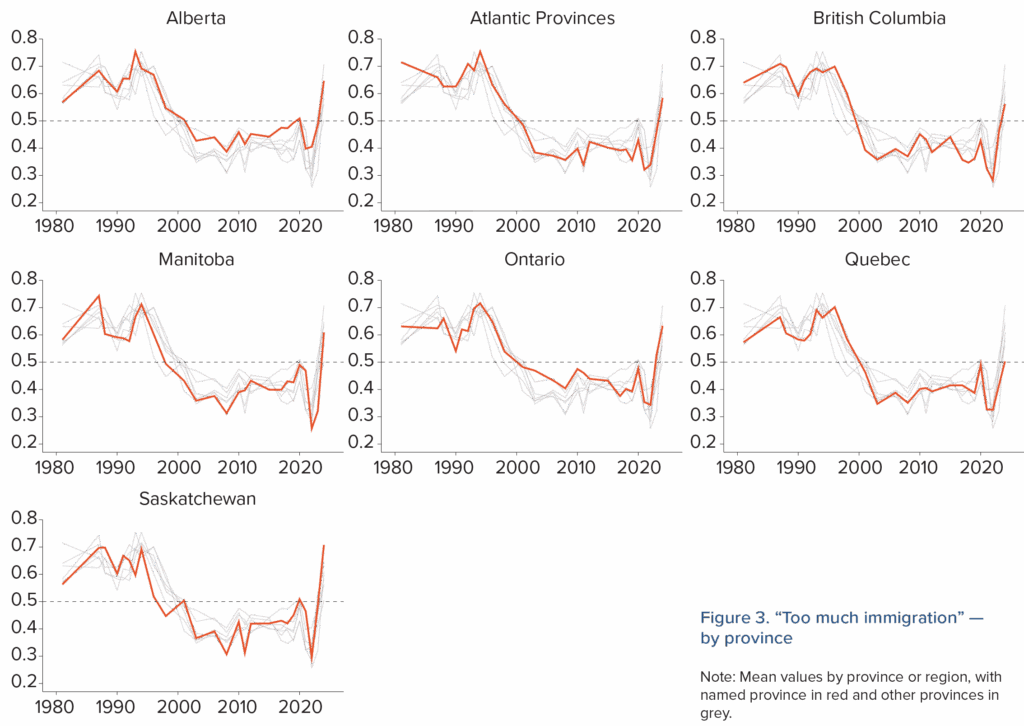
Figure 4 reinforces this point, based on language.5 Over time, there was little systematic difference between English-speaking and French-speaking respondents. If anything, francophone respondents were slightly more opposed in the 1990s and 2000s, although this didn’t last. In 2024, however, English-speaking respondents were far more opposed to immigration. French-speaking respondents were also more opposed than in the past, but the size of the change was more modest. The increase in opposition was much larger for English-speaking respondents, with 2024 levels comparable to opinion in the 1980s. The difference between anglophone and francophone opinion was the highest on record in 2024.

Figure 5 also shows substantial change in 2024 by gender. Previously, women had been slightly more likely than men to think there was too much immigration. By 2023, however, the gender gap had reversed and increased substantially, roughly doubling in size between 2022 and 2024 to the largest on record. In 2024, the gender gap for “strongly agree” there is too much immigration was eight percentage points (men 37, women 29), compared to just two years earlier when it was only two percentage points (men 14, women 12). For most of the period before 2015, the gap was three to four percentage points, but in the other direction, with women more opposed. Some caution is warranted here. The gender gap seems to have narrowed or closed earlier, starting in 2017. It is possible that the recent trend toward men being more opposed is part of a longer-running shift, rather than directly due to events in 2023-24.

Finally in Figure 6, we review changes in opinion based on several other demographic factors: education, employment, income and immigration status.
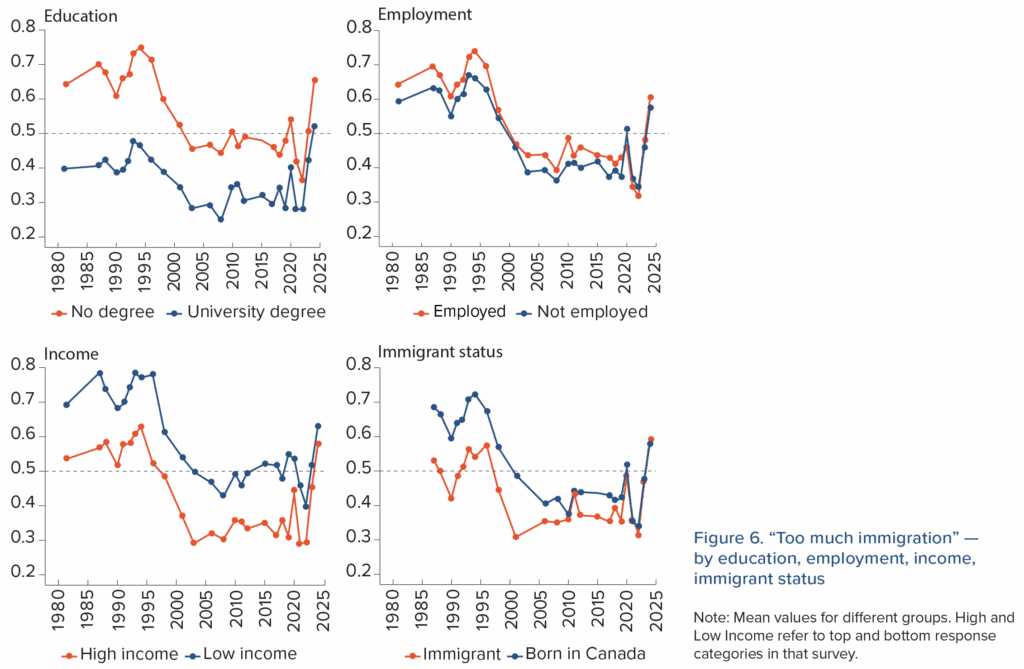
The education gap has narrowed, but this began earlier in the 2000s and may be a result of growing levels of university attainment. Since the proportion of Canadians with university degrees is larger than in earlier time periods, they may be less different from the rest of the population than in the past, when having a university degree was less common. While there are often differences in views of immigration according to education, it is difficult to tell what causes this, such as the experience of education itself, or a selection effect of the kind of people who are able, or choose, to go to university. In any case, the narrowing of the education gap is modest, and may be a long-term process rather than related to recent events.
The difference between employed and not-employed people has always been quite narrow with occasional reversals, although employed people have usually been slightly less positive about immigration. In 2023 and 2024, there is essentially no change from earlier periods.
For income, lower-income people tend to be less supportive of immigration, although the gap narrows in 2023 and 2024, with higher-income people changing more and ending up closer to the opinions held by those with lower incomes.6
We might expect people born outside Canada to be much more supportive of immigration than Canadian-born individuals. This has generally been the case, but the gap between immigrants and non-immigrants narrowed in the 2000s, with immigrants becoming just as concerned about immigration levels as non-immigrants. The small differences in the 2010s are not statistically significant. Overall, the closure of the gap in opinion between immigrants and non-immigrants which occurred in the 1990s and 2000s has been maintained, rather than reversed.
Discussion and conclusions
In the mid-1990s to mid-2000s shift, the answer to “who changed their minds?” was essentially “everyone.” In this period, support for immigration increased in similar ways across nearly all major demographic groups. The exception was differences based on education and whether the respondents were born in Canada, but even then, gaps between groups were narrowing rather than widening. Overall, there was a gradual shift to people becoming more positive, and also more similar, in their immigration attitudes. In general, the pro-immigration shift of the late 1990s and early 2000s was broad-based.
The 2023-24 shift to much greater concern over immigration is quite different. The most striking reversal is seen in the generational divide. Older Canadians had long been less positive about immigrants. However, in the latest surveys, younger respondents expressed higher levels of opposition. This change may reflect concern about the housing affordability crisis, which disproportionately affects younger Canadians. High rents and limited prospects for home ownership, combined with media coverage and statements by politicians, may be leading younger respondents to link immigration to their economic anxieties.
One potential explanation for the greater anti-immigration concern in English Canada recently is that the housing crisis has had a less acute impact in many parts of Quebec (Polèse, 2023), although differences in media coverage or the geographic distribution of new immigrants themselves may also play a role.
The change to men being more concerned about immigration than women is in line with some recent public opinion data that indicates larger gender differences on multiple social issues, though it is unclear if it is men or women who are moving or how robust this shift is (Sides, 2024). In general, men, especially young men, may be more attuned to cultural clashes between left and right, and may be more susceptible to linking immigration to housing. Still, younger women also became more anti-immigrant recently, so this is a matter of degree.
It is unclear whether generational and gender shifts in public opinion are temporary or reflect a new pattern. High housing costs will likely continue to be an important issue for the foreseeable future, but their link to immigration may continue or fade.
As well, ideological divides and polarization seem to be deepening. The federal Conservative Party has generally avoided taking extreme anti-immigrant positions — explicitly targeting and vilifying immigrants — unlike other right-of-centre parties around the world. However, over the last two decades, core Conservative supporters have become increasingly opposed to admitting more immigrants (Banting & Soroka, 2020; Besco, 2021). Conservative Leader Pierre Poilievre has been critical of Liberal immigration policy and has linked it to housing prices, but it remains to be seen if this Conservative approach will continue or be expanded to other areas.
Finally, Canada does not exist in isolation. Political developments in the United States frequently spill over the border, shaping public opinion here. Exposure to what U.S. politicians say about immigration and immigrants might lead to heightened concern in Canada. But it is also possible that U.S. developments could push Canadian public opinion in a more welcoming direction.
Ultimately, how these competing influences are navigated by politicians, the media and ordinary Canadians will define the trajectory of immigration attitudes in the coming years.
Notes
1 Data were generously provided by Environics via donation to the Canadian Opinion Research Archive for surveys prior to 2014. Data from more recent surveys were provided directly by the Environics Institute. We appreciate Andrew Parkin’s support in compiling the datasets.
2 The mode changed from face-to-face to telephone interviews after 1998, which corresponds to a decline in opposition to immigration. However, a similar pattern and timing occurs in the Canadian Election Study, which didn’t change mode at that point. Therefore, this is likely not primarily a mode effect (Besco, 2021).
3 Alternative ways of examining age show essentially the same point. If age is treated as a continuous variable rather than four separate categories, in regression models (not shown), the age coefficient becomes negative (and statistically significant) in 2024 — the only such instance in the entire series. In other words, in 2024, for the first time, the younger a person was, the more they tended to think there was too much immigration.
4 Note that Saskatchewan had the highest average opposition in 2024, but this was based on only a small number of respondents (only 75 in 2024), so that estimate has a high degree of uncertainty.
5 This analysis produces similar result to the provincial figures because most francophones live in Quebec while other provinces are primarily anglophone. Unfortunately, there were not sufficient Quebec anglophones or francophones outside Quebec who responded to these surveys to estimate effects for the critical 2024 year.
6 Because income is more difficult to compare across time due to changing categories, we estimate the Ordinary least squares regression model with the income categories as a continuous variable and show predicted values for the top and bottom categories. This is useful for a general illustration of the relationship, but should not be interpreted as referring to specific values such as the low-income cut-off or income percentiles.
REFERENCES
Banting, K., & Soroka, S. (2020). A distinctive culture? The sources of public support for immigration in Canada, 1980-2019. Canadian Journal of Political Science, 53(4), 821-838. https://doi.org/10.1017/s0008423920000530
Besco, R. (2021). From stability to polarization: The transformation of Canadian public opinion on immigration, 1975-2019. American Review of Canadian Studies, 51(1), 143-165. https://doi.org/10.1080/02722011.2021.1902169
Bilodeau, A., Turgeon, L., & Karakoç, E. (2012). Small worlds of diversity: Views toward immigration and racial minorities in Canadian provinces. Canadian Journal of Political Science, 45(3), 579-605. https://doi.org/10.1017/s0008423912000728
Breton, C., & Eady, G. (2022). Does international terrorism affect public attitudes toward refugees? Evidence from a large-scale natural experiment. The Journal of Politics, 84(1), 554-559. https://doi.org/10.1086/714781
Champagne, J., Ens, E., Guo, X., Kostyshyna, O., Lam, A., Luu, C., Miller, S., Sabourin, P., Slive, J., Taskin, T., Trujillo, J., & Wee, S. L. (2023). Assessing the effects of higher immigration on the Canadian economy and inflation. Bank of Canada.
https://doi.org/10.34989/san-2023-17
Environics Institute for Survey Research. (2024). Canadian public opinion about immigration and refugees. Environics Institute. https://www.environicsinstitute.org/docs/default-source/default-document-library/final-report94fae631-0284-4ba5-b06a-e0aeeab5daf3.pdf?sfvrsn=9f47b717_1
Government of Canada. (2025). Canada strong. Budget 2025. Government of Canada. https://budget.canada.ca/2025/home-accueil-en.html
Immigration, Refugees and Citizenship Canada. (2023, January 3). Canada welcomes historic number of newcomers in 2022. Government of Canada. https://www.canada.ca/en/immigration-refugees-citizenship/news/2022/12/canada-welcomes-historic-number-of-newcomers-in-2022.html
Kiley, K., & Vaisey, S. (2020). Measuring stability and change in personal culture using panel data. American Sociological Review, 85(3), 477-506.
https://doi.org/10.1177/0003122420921538
Kustov, A., Laaker, D., & Reller, C. (2021). The stability of immigration attitudes: Evidence and implications. The Journal of Politics, 83(4), 1478-1494. https://doi.org/10.1086/715061
MacDonald, B. (2023, August 23). Poilievre calls on Trudeau to recall MPs to Ottawa to address the housing crisis. CBC News. https://www.cbc.ca/news/politics/poilievre-demand-trudeau-recall-mps-housing-1.6945021
Page, B. I., & Shapiro, R. Y. (1982). Changes in Americans’ policy preferences, 1935-1979. Public Opinion Quarterly, 46(1), 24-42. https://doi.org/10.1086/268697
Palmer, D. L. (1996). Determinants of Canadian attitudes toward immigration: More than just racism? Canadian Journal of Behavioural Science / Revue canadienne des sciences du comportement, 28(3), 180-192. https://doi.org/10.1037/0008-400x.28.3.180
Polèse, M. (2023, August 7). Why is housing cheaper in Quebec than in Ontario? Policy Options. https://policyoptions.irpp.org/magazines/august-2023/affordable-housing-quebec-ontario
Sears, D. O., & Funk, C. L. (1999). Evidence of the long-term persistence of adults’ political predispositions. The Journal of Politics, 61(1), 1-28. https://doi.org/10.2307/2647773
Sides, J. (2024, January 29). Maybe young men and women aren’t so ideologically different. Good Authority. https://goodauthority.org/news/maybe-young-men-and-women-arent-so-ideologically-different/
Thanthong-Knight, R., Pandey, S., & Rees, T. (2024, May 6). Immigration-fuelled growth hits the housing crisis wall in Canada, around the world. Financial Post. https://financialpost.com/news/economy/housing-shortages-crush-immigration-fuelled-gdp-per-capita
Veall, M. (2023, August 9). Amid Canada’s housing crisis, immigration needs to be slower, more focused. The Globe and Mail. https://www.theglobeandmail.com/business/commentary/article-canada-immigration-housing-crisis/
Wilkes, R., & Corrigall-Brown, C. (2010). Explaining time trends in public opinion: Attitudes towards immigration and immigrants. International Journal of Comparative Sociology, 52(1-2), 79-99. https://doi.org/10.1177/0020715210379460
Wilkes, R., Guppy, N., & Farris, L. (2008). “No thanks, we’re full”: Individual characteristics, national context, and changing attitudes toward immigration. International Migration Review, 42(2), 302-329. https://www.jstor.org/stable/27645253
Zimonjic, P. (2024, January 21). Linking immigration to the housing shortage may be missing the problem, experts say. CBC News. https://www.cbc.ca/news/politics/immigration-housing-crisis-costs-1.7088878