

From Temporary to Permanent Residency: Recent Trends in Canada’s Two-Step Immigration Selection

 |
Canada’s Changing Immigration Landscape |
| Immigration policy is central to the future of the federation. This series explores recent challenges and opportunities, turning complex issues into clear, actionable insights. |
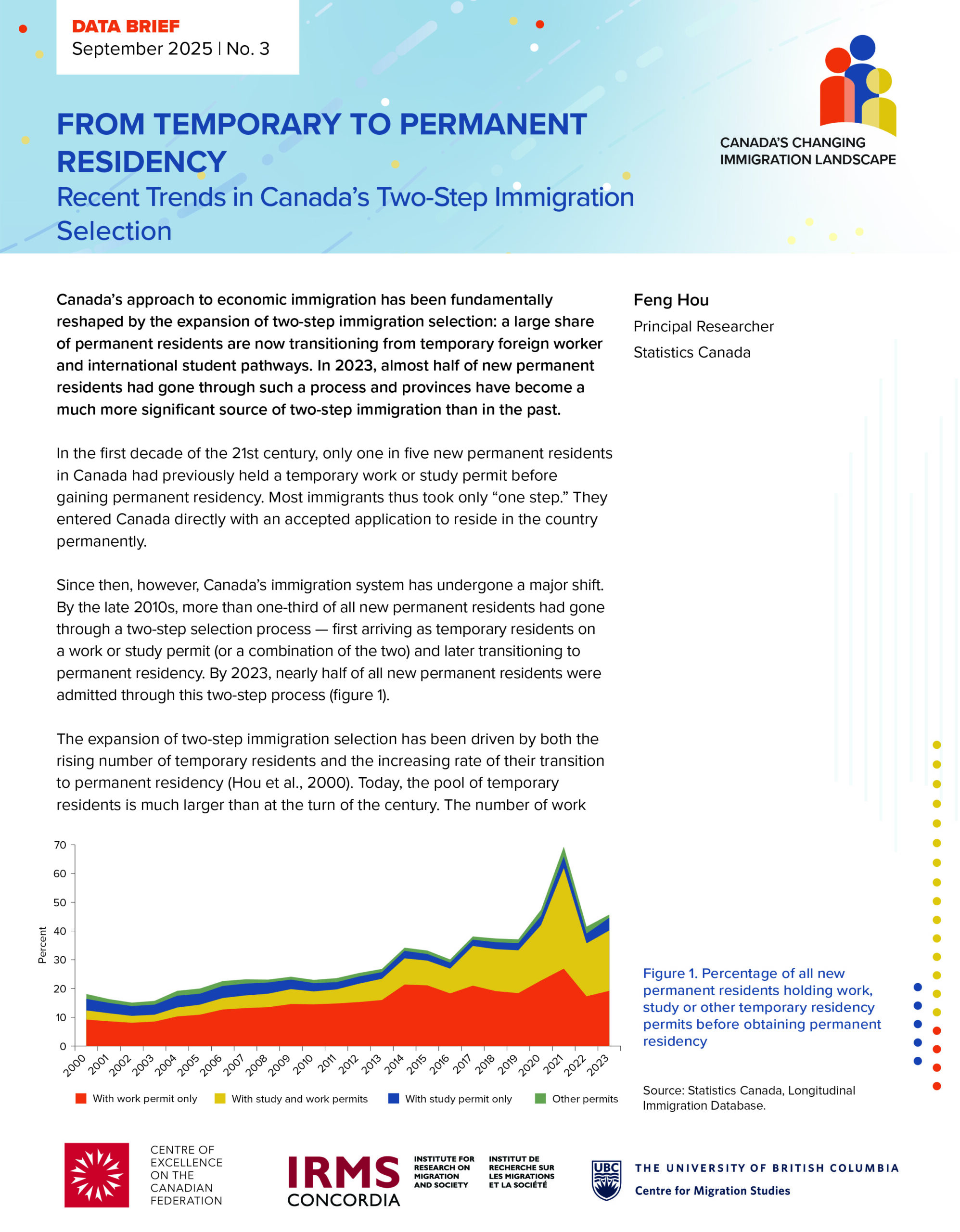
Canada’s approach to economic immigration has been fundamentally reshaped by the expansion of two-step immigration selection: a large share of permanent residents are now transitioning from temporary foreign worker and international student pathways. In 2023, almost half of new permanent residents had gone through such a process and provinces have become a much more significant source of two-step immigration than in the past.
In the first decade of the 21st century, only one in five new permanent residents in Canada had previously held a temporary work or study permit before gaining permanent residency. Most immigrants thus took only “one step.” They entered Canada directly with an accepted application to reside in the country permanently.
Since then, however, Canada’s immigration system has undergone a major shift. By the late 2010s, more than one-third of all new permanent residents had gone through a two-step selection process — first arriving as temporary residents on a work or study permit (or a combination of the two) and later transitioning to permanent residency. By 2023, nearly half of all new permanent residents were admitted through this two-step process (figure 1).
The expansion of two-step immigration selection has been driven by both the rising number of temporary residents and the increasing rate of their transition to permanent residency (Hou et al., 2000). Today, the pool of temporary residents is much larger than at the turn of the century. The number of work permit holders in Canada (measured as those holding valid work permits on December 31 of each year) grew to 1,499,000 in 2024 from approximately 67,000 in 2000.1 The number of study permit holders grew to 1,037,200 in 2023 from 122,600 in 2000, then decreased slightly to 996,400 in 2024.

Further, the rates of transition to permanent residency from the pool of temporary residents increased for both temporary foreign workers and international students. The share of first-time work permit holders who obtained permanent residency status by the fifth year after receiving their first work permit increased to 46 per cent in 2015-19 from 30 per cent in 2000-04 (figure 2). Among first-time study permit holders, the five-year transition rate increased to 34 per cent in 2015-19 from 20 per cent in 2000-04.

These rising transition rates can be attributed to two main factors. The first is the expansion of the Provincial Nominee Program (PNP) and the introduction of the Canadian Experience Class (CEC). Many PNP streams are geared toward immigrants with prior work or study experience in Canada, while the CEC is specifically designed to facilitate the transition of skilled temporary foreign workers to permanent residency.
The second factor is the increasing share of permanent residents admitted through provincial programs who had prior Canadian work or study experience (Hou et al., 2020). From 2010-23, the proportion of all new permanent residents admitted through the PNP rose to 23 per cent from 13 per cent, while the share of provincial nominees who were previously temporary residents grew to 59 per cent from 33 per cent.
During the same period, the share of new permanent residents admitted through the CEC increased to nine per cent — nearly all of whom had prior Canadian work experience — from one per cent. Meanwhile, the share of new permanent residents admitted under the Federal Skilled Worker Program (FSWP) declined to eight per cent (with 19 per cent having prior temporary status) from 30 per cent (with 13 per cent being former temporary residents).
Two-step immigration is therefore shifting at the federal level from the FSWP to the CEC stream, while provincial pathways have become a much more significant source of two-step immigration than in the past.

By the early 2020s, the two-step process had become the predominant pathway for principal applicants in the economic class — the only group of immigrants whose human capital characteristics are explicitly assessed for their potential to succeed in the Canadian labour market (figure 3). In 2023, three-quarters of these principal applicants had previously held work or study permits. A substantial proportion (39 per cent) of spouses or dependants in the economic class, as well as many (21 per cent) family-class immigrants also held prior work or study permits.
In summary, the expansion of two-step immigration selection has fundamentally reshaped Canada’s approach to economic immigration, with a large share of permanent residents now transitioning from temporary foreign worker and international student pathways. Two-step immigration enables employers and the government to assess the candidates’ labour market performance before granting permanent status, potentially improving economic outcomes (Crossman et al., 2020). However, this approach may also limit opportunities for qualified applicants who lack the means to come to Canada initially as temporary residents.
The immigration plan announced by the federal government in 2024 set a target of selecting 40 per cent of permanent residents annually from among temporary residents for the 2025-27 period. This is consistent with the trends observed in recent years. As Canada moves toward this target, the two-step selection model will remain central to policy discussions.
Notes
1 These numbers refer to work permits for work purposes. Some work permits are issued for other purposes such as study, humanitarian and compassionate considerations, as well as permanent residency applicants. In 2023, there were 1,761,000 foreign residents with work permits for all purposes, compared with 1,253,000 foreign residents with work permits for work purposes.
REFERENCES
Crossman, E., Hou, F., & Picot, G. (2020). Two-step immigration selection: A review of benefits and potential challenges (Catalogue no. 11-626-X — 2020009 – No. 111). Statistics Canada Economic Insights. https://www150.statcan.gc.ca/n1/pub/11-626-x/11-626-x2020009-eng.htm.
Hou, F., Crossman, E., & Picot, G. (2020). Two-step immigration selection: An analysis of its expansion in Canada (Catalogue no. 11-626-X — 2020009 – No. 112). Statistics Canada Economic Insights. https://www150.statcan.gc.ca/n1/pub/11-626-x/11-626-x2020010-eng.htm.