


The Effect of National Borders as an Obstacle to Trade Flows: Consequences for Our Economic and Political Choices


 |
Barriers and Bridges: Rethinking Trade Within the Federation |
| Interprovincial trade opens up new possibilities for the economic future of the federation. This series provides an overview of recent changes in trade between Canadian provinces, analyzes the challenges for the country’s economy, and offers concrete proposals to help Canada achieve its ambitions. |
Introduction
The resurgence of protectionism internationally and trade tensions between Canada and the United States have brought the issue of borders in international trade back to the forefront. While at one time many envisioned a future in which national borders would cease to be a significant economic factor, the current situation very much suggests otherwise.
This resurgence has prompted us to update research findings published in 2012 by co-author Stéphane Dion and the late John McCallum on the border effect, which can be defined as the barriers, obstacles or impediments that national borders create for trade flows. The aim of the 2012 study was to contribute to the debate on national unity, and it highlighted the importance of factoring in the Canada-U.S. border effect to explain trade flows between Canadian provinces and with U.S. states (Dion & McCallum, 2012). In our view, updating this research is even more relevant today: the current context is marked by a clear desire to diversify Canada’s international trade but also by vigorous debates on Canadian national unity, particularly in Alberta and Quebec.
Context
According to one school of thought in economics, national borders have ceased to be a significant economic factor. Driven by free trade agreements and the globalization of markets, national borders and different languages, currencies and legal systems are no longer seen as obstacles to the exchange of goods and services between countries; they no longer impede access to major markets (Ohmae, 1990).
This view is no longer in fashion, given the resurgence of tariffs and protectionist measures of all kinds. Yet even though we are well aware of the fact that a borderless economy does not exist, we may not be giving due consideration to the border effect in our understanding of the economy and in our public policy choices.
The border effect — the trade barriers created by national borders — is measured by calculating the difference between trade flows simulated in the absence of borders and observed trade flows. This involves using two explanatory variables to model trade relations: (1) the size of the entities being studied (countries, subnational entities), and (2) the distance between them. It is therefore a calculated indicator, not a directly observable one.
In 2026, the border effect issue is of particular concern as it relates to Alberta and Quebec: independence movements there are advocating for the establishment of national borders between their economies and the rest of the Canadian economy. This article will therefore focus on these two provinces, as well as Ontario, which will serve as a basis for comparison.
It should be kept in mind that the theory of the borderless economy was popular in Quebec independence circles during the 1995 referendum debate. They drew two conclusions from the theory: first, that the Canadian internal market was steadily losing its importance for Quebec; secondly, that the Canadian market would remain just as open if Quebec seceded from Canada.
This thesis was defended in conjunction with another one, which held that Canada, with its east-west orientation, made no sense economically because the normal flow of the North American economy was north-south. From this perspective, free trade with the United States was supposed to unleash an “irresistible north-south push,” with trade aligning itself “with natural tendencies and the overriding necessities of geography” (Landry, 1987, p. 88, our translation for all quotes by former premiers).
In 1999, Quebec Premier Lucien Bouchard even stated that Canada’s economic weight was no longer the key factor it once was because Quebec’s economic future was with the United States and Europe. In his view, this meant that, in practical terms, Quebec was commercially independent from the rest of Canada (Bouchard, 1999).
Jacques Parizeau, Premier of Quebec from 1994 to 1996, contended that the North American economies had become highly integrated, that Quebec’s economic future was clearly with the United States, and that Canada as an economic entity was “a dead end” (Parizeau, 1997, p. 48; Parizeau, 2009, p. 65).
Today, Quebec independence leaders no longer seem to be talking about a borderless economy. However, they maintain a fuzzy optimism about the consequences that the imposition of national borders between Quebec and the rest of Canada could have for the Quebec economy. They simply assert that it is in everyone’s interest for business to continue as usual and that Quebec’s interests are aligned with those of the United States (Bellerose, 2025). As for Albertan independence activists, their position on the importance of east-west and north-south trade links is unclear. It is therefore important to build a more precise, clearer picture and measure the potential effect of borders as barriers to trade.
In this context, our goal is to determine whether the relative weight of international trade in our economy has indeed grown considerably over the years, whether the weight of interprovincial trade really has declined, and whether, and to what extent, free trade has reduced the measurable effect of the Canada-U.S. border on trade flows between Canadian provinces and U.S. states. Our study covers the period from 1981 to 2024, or from the first to the last year for which Statistics Canada data are available (as at February 2026).
Importance of the international and Canadian markets
Figure 1 shows changes in the value of international exports of goods and services as a percentage of the gross domestic product (GDP) of Quebec, Ontario and Alberta for the period 1981 to 2024.1

The trend was the same for Quebec, Ontario and Alberta, except from 2021 onward, when Alberta experienced significant growth in international exports. From 1992 to 2000, the share of international exports in the economy grew sharply in the three provinces under consideration, rising from 21 per cent to 42 per cent for Quebec, from 31 per cent to 52 per cent for Ontario, and from 27 per cent to 41 per cent for Alberta. One might have expected that, under the influence of free trade and globalization, the push of our economy toward foreign markets would intensify and become “irresistible.” However, this is not what happened.
Following the signing of the Free Trade Agreement between Canada and the United States (which would become NAFTA) in 1988, and until 2000, there was strong growth in international exports, especially to the United States (Statistics Canada, 2024). Around the year 2000, however, after the economy had absorbed the effects of free trade, the share of international exports in the economy stopped growing and even began to decline, settling in the 30 to 35 per cent range. The share of international exports in Quebec’s economy was lower in 2024 (29 per cent) than in 1995 (32 per cent), the year of the second Quebec referendum. A similar decrease in exports occurred in Ontario, from 43 per cent to 35 per cent. However, in Alberta, over the same period, there was a 10 per cent increase, from 32 per cent to 42 per cent. These variations are partly explained by changes in the world price — and therefore the Alberta price — of a barrel of oil (Macrotrends, 2026).
Figure 2 compares the value of interprovincial exports of goods and services as a percentage of GDP for the same period (1981-2024).
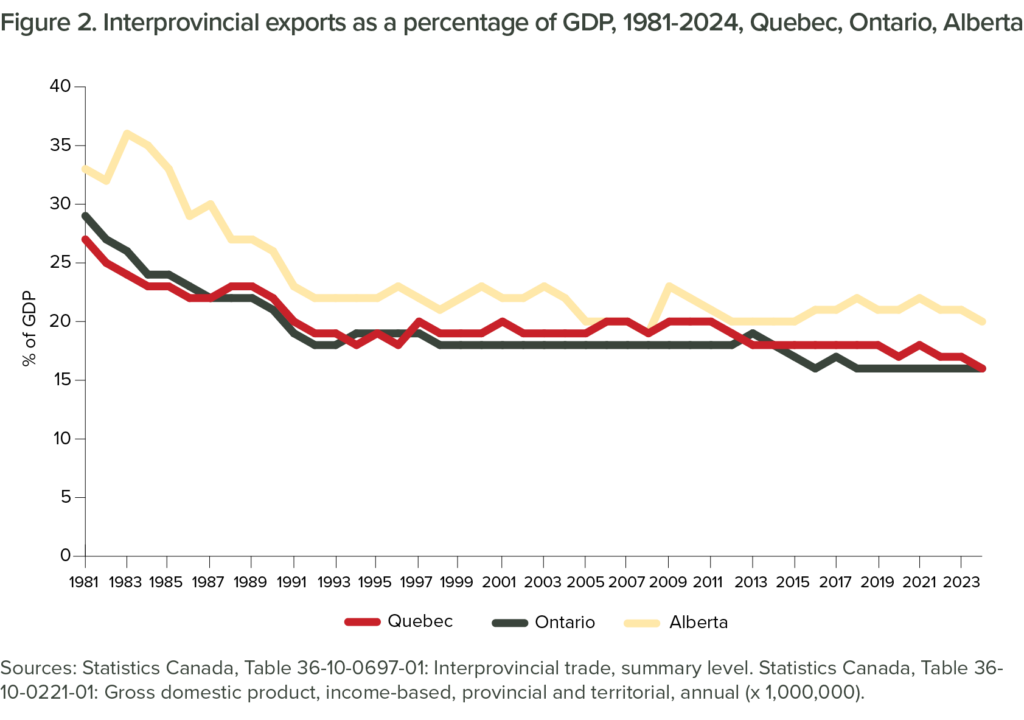
The figure shows that interprovincial exports have remained comparatively stable relative to GDP since the early 1990s. Despite the implementation of free trade agreements, interprovincial trade has been maintained. It remains to be seen what the relative weight of interprovincial trade in the economy will be under the combined effect of the new tariffs imposed by President Donald Trump and Canada’s efforts to reduce interprovincial trade barriers.
Of course, it is possible that foreign trade will expand significantly in the coming years and that, in particular, Canada will succeed in doubling the value of its exports to countries other than the United States within 10 years and achieve the goal set by the Carney government. However, the data show us that foreign trade growth is not constant; foreign trade can shrink. When that happens, the Canadian internal market becomes a stabilizing factor for our economy.
The border effect on Canada
There is a border effect that hinders trade between countries — even between two countries as integrated as Canada and the United States. John McCallum quantified this border effect in a 1995 article (McCallum, 1995). Taking into account the effects of economic size (GDP) and distance between pairs of provinces or states, he showed that, in 1988, the Canadian provinces traded 22 times more with each other than with U.S. states. McCallum called this phenomenon “the interprovincial advantage.”
The discussion that follows is based on comparing the predictions of a so-called “gravitational” model with observed trade flows. According to this model, Quebec’s exports to British Columbia and California, for example, would depend on the size (measured by GDP) of these two entities and their distance from Quebec. Since the distances between Quebec and these two entities are comparable, and California has a GDP at least 10 times higher than British Columbia’s, the model suggests that Quebec should export 10 times more goods to California than to British Columbia. In 1988, however, Quebec exported more than three times as many goods to British Columbia as it did to California.
The existence of a border effect between Canada and the United States, as well as between other countries, has been confirmed, in particular, by subsequent research conducted by Helliwell (1988), Downs and Sawchuck (2007) and Nitsch (2000).
The border effect can be inferred numerically for a year other than 1988. To do this, we use data for all of Canada on interprovincial and international exports of goods, and we assume that the other explanatory factors for these two types of trade have remained unchanged over time.
Figure 3 presents our estimates of the border effect between 1988 and 2024. In 1988, it was 22. We see that it falls to 12 in 2000, before stabilizing around 14 or 15 between 2014 and 2024.

In 2024, despite the full implementation of the Canada-United States Free Trade Agreement in 1988, interprovincial trade in goods was still 14 times higher than trade in goods with U.S. states, taking into account the size and distance between states and provinces.
Conclusion: Explaining the border effect
As we have just shown, the border effect has stabilized in the last decade around 14 or 15, which is high. What accounts for this? Essentially two things.
First, there is the fact that we are a country. As Canadians, we are more deeply connected to one another than we are to Americans. This is due to our historical ties, our national transportation, communication and higher education networks, our legal framework, and the fact that we share the same currency, the same banking system, the same federal government, and the same federal institutions, laws and regulations. It is also due to the transferability of our health care and pension rights, to our affinities with one another, to our habit of working together, … and to that thing called national solidarity.
Secondly, the tendency to trade less with Americans than between Canadians can be partly attributed to the barriers to cross-border trade that have persisted even after the full implementation of NAFTA.
Borders continue to play a significant role. The protectionism embraced by other countries remains a reality, as illustrated by the “Buy American” or “America First” policies of our neighbours to the south. Of course, the border effect is particularly evident now, with the escalatory tariffs imposed by President Trump. In Europe, we are making effective diplomatic efforts to prevent Canadian exporters from becoming collateral victims of the industrial and trade strategies adopted by the European Union to counter American protectionism and stem the flow of Chinese goods. In many countries, the electoral weight of protectionist movements is increasing with the rise of the radical nationalist right and the anti-globalization left.
Let us summarize what all this means for Alberta, Quebec and Canadian unity. When the global economy falters, the Canadian internal market provides a common foundation and therefore remains crucial for Alberta and Quebec, as well as for the other provinces. Economic exchanges within Canada remain far more fluid than the ones that Alberta and Quebec could develop with other countries. To benefit from this fluidity, Albertans and Quebecers must remain part of Canada, not turn other Canadians into foreigners. In the event of secession, Alberta, Quebec and the rest of Canada would continue to trade, but the trade would be severely limited.
Making the decision to secede would be serious and likely irreversible. It is therefore essential to rely on established facts, robust concepts, and a reasonable and reasoned vision of an uncertain future. The example of Brexit, with the visible remorse it has now engendered, shows us that misconceptions and fallacies can lead to negative outcomes that are very difficult to reverse (Difford, 2025; Statista, 2026). The leaders of the Quebec independence movement in 1995 claimed that the Canadian market was losing its importance to the Quebec economy because borders no longer mattered. This has not been borne out by the facts. As our data show, and as Stéphane Paquin has pointed out, “the Canadian market is as crucial for Quebec exporters as the American market, even though the Canadian economy is comparable in size to that of New York State” (Paquin, 2025a, our translation). Let us hope that the necessary intellectual rigour and logic prevail in the upcoming debates in Alberta and Quebec.
The border effect is here to stay. We must approach the issue with due rigour and consistency and take it into account in two ways. First, we must continue to make our internal market more fluid by eliminating unnecessary barriers to interprovincial trade; second, we must make our trade policy ever more proactive and effective in supporting our exporters in all markets and in defending our interests both in bilateral negotiations and in international forums. We must promote our trade interests more vigorously than ever before in our dealings with the United States but also with other countries and regions, so as to be less dependent on our American neighbours.
The approach outlined above underscores the importance of rethinking trade within our federation. This imperative echoes the very theme of the Centre of Excellence on the Canadian Federation’s “Barriers and Bridges” series, which includes this article. In particular, it will be necessary to assess Daniel Teeter and Christopher S. Cotton’s concrete proposals. They suggest that exceptions and extensions of barriers to interprovincial free trade should expire automatically if they are not renewed; that new incentives should encourage provinces and businesses to take advantage of trade liberalization; and that investments in infrastructure and workforce training should be increased to enhance the size and competitive strength of the Canadian market (Teeter & Cotton, 2025).
It will also be necessary to leverage the role of the provinces in Canada’s trade negotiations and to ensure that the First Nations participate fully at all stages (Paquin, 2025b; Picard, 2025).
Once size and distance are taken into account, Canadian provinces trade 14 times more with each other than with U.S. states. This illustrates the magnitude of the border effect on Canada and, by extension, the crucial importance of streamlining our internal trade and choosing the right strategies to increase and diversify our foreign trade.
Note
1 The data used to create figures 1 and 2 are presented in table A1 in the Appendix.

REFERENCES
Bellerose, P. (2025, November 6). Économie et défense: l’avenir d’un Québec indépendant lié aux États-Unis, malgré Trump, dit PSPP. Un Québec indépendant devra aligner ses politiques économique et militaire sur celles des États-Unis, croit Paul St-Pierre Plamondon. Le Journal de Québec.
https://www.journaldequebec.com/2025/11/06/economie-et-defense–lavenir-dun-quebec-independant-lie-aux-e-u-malgre-trump-dit-pspp
Bouchard, L. (1999, March 19). Le Canada et le Québec divergent de plus en plus. Le Figaro.
Difford, D. (2025). How do Britons feel about Brexit five years on? YouGov.
https://yougov.com/en-gb/articles/51484-how-do-britons-feel-about-brexit-five-years-on
Dion, S., & McCallum, J. (2012). La redécouverte du marché canadien : trois fois bravo pour le commerce interprovincial! L’Idée fédérale.
Downs, A., & Sawchuk, G. (2007). Do cross-border regions matter for trade? Canada-US border effects and cross-border regions (Working Paper Series 034). Policy Research Initiative.
Helliwell, J. F. (1988). How much do national borders matter? Brookings Institution Press.
Landry, B. (1987). Commerce sans frontières : le sens du libre-échange. Québec-Amérique.
Macrotrends. (2026). Crude oil prices (1946-2026). https://www.macrotrends.net/1369/crude-oil-price-history-chart
McCallum, J. (1995). National borders matter: Canada-US regional trade patterns. The American Economic Review, 85(3), 615-623. http://www.jstor.org/stable/pdfplus/2118191.pdf?acceptTC=true
Nitsch, V. (2000). National borders and international trade: Evidence from the European Union. The Canadian Journal of Economics/Revue canadienne d’économique, 33(4), 1091-1105. https://doi.org/10.1111/0008-4085.00055
Ohmae, K. (1990). The borderless world: Power and strategy in the interlinked economy. Harper Business.
Paquin, S. (2025a, February 17). Le Québec est-il si dépendant des États-Unis? Conseil des relations internationales de Montréal. https://blogue.corim.qc.ca/qc-dependance-us/
Paquin, S. (2025b). The growing influence of provinces in Canada’s trade negotiations. Institute for Research on Public Policy. https://centre.irpp.org/research-studies/influence-provinces-canada-trade-negociations/
Parizeau, J. (1997). Pour un Québec souverain. VLB Éditeur.
Parizeau, J. (2009). La souveraineté du Québec : Hier, aujourd’hui et demain. Michel Brûlé.
Picard, M. (2025). From exclusion to shared prosperity: The vital role of First Nations in Canada’s economic future. Centre of Excellence on the Canadian Federation.
https://centre.irpp.org/research-studies/first-nations-canada-economic-future/
Statista. (2026). “In hindsight, do you think Britain was right or wrong to vote to leave the European Union?” (January 2020 to January 2026). https://www.statista.com/statistics/987347/brexit-opinion-poll/?srsltid=AfmBOorOCXRlnOQL4v3noR_ox2uir_ojA-wn3ekCeB1IsV7bmG2zMTTh
Statistics Canada. (2024). Canada’s exports over time: Resources and manufactured goods. Government of Canada. https://www150.statcan.gc.ca/n1/pub/11-630-x/11-630-x2017005-eng.htm
Teeter, D., & Cotton, C. S. (2025). Reforms that stick: A roadmap for strengthening Canada’s internal market. Centre of Excellence on the Canadian Federation. https://centre.irpp.org/research-studies/strengthening-canada-internal-market/
This text examines how national borders continue to restrict trade flows between Canada and the United States. The authors argue that, despite free trade agreements and globalization, borders still create major obstacles to international commerce. Canadian provinces still trade far more with each other than with U.S. states, even after NAFTA. The study highlights the importance of Canada’s internal market for the economic stability of Quebec, Ontario, and Alberta. It also challenges the idea that Quebec or Alberta could become independent without significant economic consequences. The authors conclude that Canada should strengthen interprovincial trade while also diversifying its international trade partnerships.
This essay was published as part of the series, Barriers and Bridges: Rethinking Trade Within the Federation, under the direction of Valérie Lapointe by the Centre of Excellence on the Canadian Federation. Editorial co-ordination was by Étienne Tremblay, proofreading was by Zofia Laubitz, and production and layout were by Chantal Létourneau and Anne Tremblay.
This essay was translated from French by John Detre. It is also available in French under its original title L’effet des frontières nationales comme entrave aux flux commerciaux : conséquences pour nos choix économiques et politiques.
Stéphane Dion is a former Canadian diplomat and politician. He served as Canada’s ambassador to Germany from 2017 to 2022, and then to France and Monaco from 2022 to 2025, while also serving as the Prime Minister of Canada’s special envoy to the European Union and Europe from 2017 to 2025. From 2006 to 2008, he served as Leader of the Opposition and Leader of the Liberal Party of Canada. He also served as Minister of Foreign Affairs (2015-17), Minister of the Environment (2004-06), and Minister of Intergovernmental Affairs (1996-2003). He represented the riding of Saint-Laurent-Cartierville (now Saint-Laurent) in the House of Commons from 1996 to 2017. Back at the Université de Montréal, where he previously served as a professor of political science, Mr. Dion is now a diplomat-in-residence and shares his experience with students there.
François Vaillancourt is Professor Emeritus of Economics at the Université de Montréal and a Fellow at CIRANO. He has published extensively and has served as a consultant to numerous national and international organizations in the fields of intergovernmental financial relations and language policy. He was a Fulbright Scholar in 2007, was elected to the Royal Society of Canada in 2009, and received an honorary doctorate from the University of Geneva in 2021.
To cite this document:
Dion, S. & Vaillancourt, F. (2026). The effect of national borders as an obstacle to trade flows: Consequences for our economic and political choices. Institute for Research on Public Policy. https://doi.org/10.26070/az5w-d294
In memory of John McCallum.