
Do Candidates in Canadian Elections Share the Same Views as Their Constituents on the Division of Powers within the Federation?


A comparison of two separate surveys conducted during the 2021 and 2025 election years shows a misalignment between the positions of election candidates and those of their constituents on the division of powers in Canada. While the views of candidates and voters were relatively close on this issue in 2021, the gap widened in 2025. The percentage of voters who want the federal government to have more power is increasing, while candidates’ views remain close to what they were at the time of the 2021 election.
The division of powers and responsibilities between the federal and provincial governments is a central issue within the Canadian federation. It is part of the country’s political landscape, and Canadians form their own opinions on the matter. Although the division of powers is defined by the Canadian constitution and the legal system, there are still many areas where the sharing of powers poses a problem for various levels of government: immigration, the environment, health transfers, etc. Tensions surrounding the issue fuel public opinion, shape voter preferences, and inform distinct positions within political parties across the spectrum, at all levels and among their election candidates.
The data analyzed in this bulletin comes from the Canadian Candidate Survey (CCS), which surveys election candidates on various topics, including the division of powers within the federation. Data is also drawn from the Confederation of Tomorrow Survey (CTS), which asks voters about the same issue. We pay particular attention to variations by region and party affiliations among voters and candidates between the 2021 and 2025 elections. Comparing the data from the two surveys provides a better understanding of voter preferences and party proposals on the division of powers within the Canadian federation.
Congruence on the balance of powers in the Canadian federation: A matter of great importance
In representative systems such as ours, democratic legitimacy rests in part on the congruence between voters’ preferences and the positions adopted by their elected representatives. Congruence refers to the idea that there must be a degree of alignment (or representativeness) between the political preferences, values and opinions of voters and those of the people elected to represent them in political institutions, regardless of the level of government. An appropriate degree of congruence is important because it reflects, at least in part, the proper functioning of a democracy.
The division of powers between the federal and provincial governments is a central element in the proper functioning of Canadian federalism. It follows that exploring the alignment between political party supply and voter demand on this issue can enhance our understanding of the political representation underpinning the Canadian democratic system.
Methodology
With this in mind, our analysis draws on two separate surveys. The CCS data was collected following the 2021 and 2025 Canadian federal elections. To conduct these surveys, all candidates from political parties represented in the House of Commons (Liberal, Conservative, New Democratic, Green and Bloc Québécois) were contacted via email or social media, such as LinkedIn and Facebook. Nearly 300 candidates responded to each survey (response rates of 25 per cent and 28 per cent, respectively).
The CTS data was collected in January 2021 and May 2025 from 4,500 respondents.1 The samples are representative of Canadians of voting age.
The CCS and CTS used similar methods to gauge respondents’ views on the division of powers. First, the candidates were asked to indicate their level of agreement or disagreement with the following statement: It is preferable to give more power to the federal government and less power to provincial governments. Voters were asked to indicate which of the following options best represented their view of how governments should operate in Canada: (1) The government of [the province] should take on several responsibilities currently handled by the federal government; (2) The federal government should take on several responsibilities currently handled by the government of [the province]; or (3) Things should remain largely as they are now. Survey responses were then analyzed to determine whether respondents preferred to allocate more power to the federal government, allocate more power to provincial governments, or maintain the status quo.
Differences in views on the centralization of powers between 2021 and 2025
Figure 1 shows that candidates’ positions remained relatively stable during the last two elections in Canada (2021 and 2025). Specifically, 46 per cent of candidates surveyed believed the provinces should have more power than the federal government, compared with only 16 per cent who believed the opposite. Despite the change in government in the United States — which has been accompanied by aggressive tariff policies and recurring threats of territorial annexation — the 2025 election did not significantly alter election candidates’ positions on the division of powers within the federation.
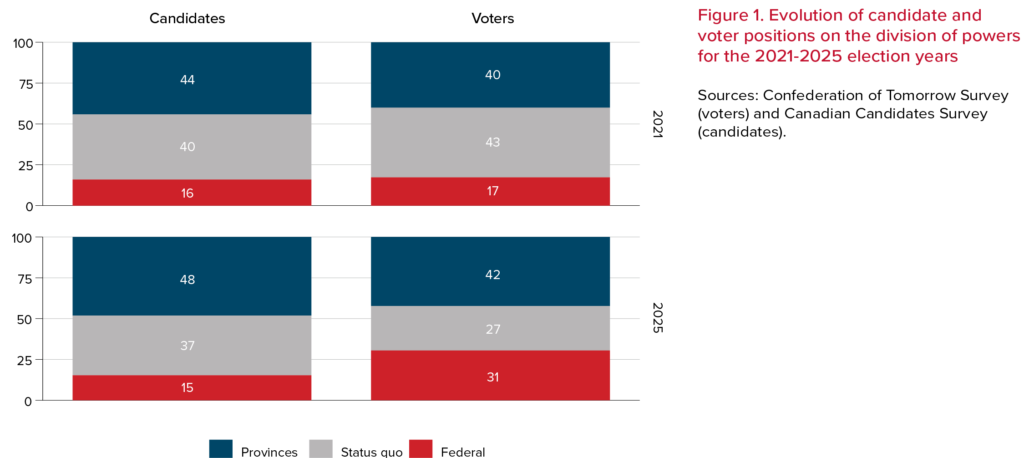
Voter attitudes, however, shifted between the two elections. While public opinion was similar to that of candidates in the 2021 federal election, with 16 per cent of candidates and 17 per cent of voters wanting the federal government to have more power, by 2025, nearly twice as many voters (31 per cent) wanted greater centralization. Conversely, while 43 per cent of voters wanted the division of powers to remain the same in 2021, only 27 per cent felt that way in 2025. The status quo was therefore no longer the dominant option in 2025.
One key factor explaining this significant shift is the new climate of tension in Canada-U.S. relations. During the 2025 election period, nearly 58 per cent of voters stated that U.S. President Donald Trump’s tariff threats could influence their vote. This electoral context, unprecedented in the country’s history, may have prompted voters to want to give more power to the federal government.
A second explanatory factor is Canada’s domestic political context: 2025 saw a sharp drop in former Prime Minister Justin Trudeau’s popularity, his subsequent resignation, and the emergence of Mark Carney — now Prime Minister — on the political scene. It may be that voters adjust their views on the division of powers within the federation based on their assessment of the federal prime minister compared with their provincial premier. The rise in popularity of a political leader at one level of government, potentially combined with the decline in popularity of a leader at the other level, can certainly influence voters’ views on the division of powers. It is reasonable to assume that this phenomenon has less influence on election candidates, for whom the issue is not tied to a politician’s popularity but instead relates to the principles driving their involvement in politics.
It will also be interesting to track these variations over time during future election years to see whether this trend solidifies or simply reflects a specific set of circumstances. That said, we are witnessing a short-term misalignment between voters’ opinions and those of candidates.
A look at regional variations
When the survey data is broken down by region, the results are just as interesting.
In Quebec, both candidates and voters are in favour of decentralizing powers within the federation (respective combined averages of 66 per cent and 52 per cent. In the Atlantic provinces, candidate support for decentralization and greater provincial autonomy grew significantly from 2021 to 2025, rising from 27 per cent to 44 per cent. The opposite trend occurred in Ontario, however, with candidate support for decentralization dropping from 44 per cent in 2021 to 35 per cent in 2025.
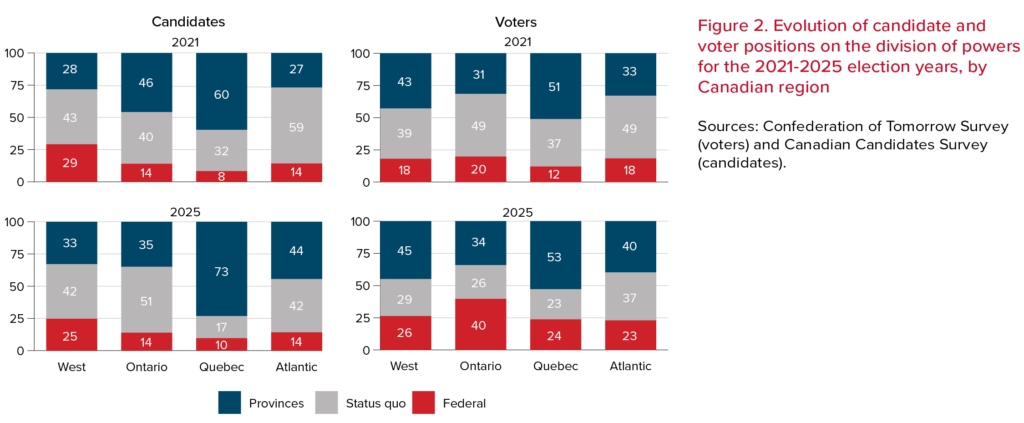
Furthermore, when comparing candidate data with public opinion data, we find that voters across the country, with the exception of the Western provinces, express greater support for centralization and increased powers for the federal government. Here too, it appears that the current geopolitical context — Canada’s relationship with the United States — and the resulting climate of uncertainty are spurring a marked increase in Canadians’ anxiety.
In short, our regional analysis highlights differing dynamics in the positions of election candidates and voters. However, public opinion has evolved much more uniformly: from 2021 to 2025, voters in almost all regions have adopted a more centralizing stance, confirming a Canada-wide trend. This convergence in public opinion stands in stark contrast to the regional diversity observed among candidates. By 2025, it has created a situation where voters take a globally more centralizing stance than those who aspire to represent them across most regions of the country.
Western Canada is a notable exception too: the proportion of voters in favour of decentralization remains higher than that of election candidates. Thus, our analysis shows that regional differences in preferences persist, despite a trend toward centralization in public opinion. This citizen-level convergence contrasts sharply with the regional diversity observed among candidates and, in 2025, leads to a situation in which citizens are, overall, more centralizing than those who aspire to represent them across all regions of the country. Western Canada, however, constitutes a notable exception, where the proportion of citizens favouring decentralization remains higher than that of candidates, indicating that regional specificities persist in federal preferences despite a broader trend toward centralization in public opinion. Moreover, it is important to note that, in the case of Quebec, the slight shift toward greater centralization must be understood in light of the unique powers the province holds in certain policy areas.
Variations in congruence by political affiliation
Finally, when we examine alignment by political party, we see similar trends. Unsurprisingly, the Liberals and the NDP were more centralizing in their positions than other political parties in 2021 and in 2025. However, NDP candidates took a more decentralizing stance in the 2025 election, with the percentage of those calling for more provincial power nearly doubling (28 per cent in 2021 and 45 per cent in 2025). This shift in stance may well be attributable to the NDP’s particular electoral situation — it lagged in the polls in 2025. The Green Party, for its part, has shifted slightly toward greater centralization. In fact, Liberal, New Democratic and Green voters were already exhibiting a preference for greater centralization in 2021, and this trend grew stronger in 2025.
As for the Bloc Québécois, all of its candidates in the 2021 and 2025 elections were in favour of Quebec gaining more power. This stance is hardly surprising, as the party has campaigned for Quebec independence since its inception. In 2025, 70 per cent of Bloc voters still supported granting more power to Quebec, compared with 21 per cent who favoured the status quo and 9 per cent who wanted the federal government to have more power. It remains to be seen whether this trend will hold over time or whether that nine per cent took this position because of current political circumstances (in particular, the growing threats from across the border).
This shift in stance on the division of powers also extends to Conservative voters, who have traditionally been more supportive of decentralizing power in Canada. Except for Liberal voters, whose positions remain aligned with those of their candidates, Canadians appear to be more in favour of centralization than their party’s candidates. The data therefore suggests that political party supply on the division of powers within the federation does not match voter demand. This finding deserves to be highlighted.

Conclusion
The results highlight a disconnect between election candidates’ positions and public opinion on the division of powers in Canada. In 2021, the preferences of federal election candidates and voters on the balance of power between the federal and provincial governments were fairly closely aligned. Analysis of the 2025 data, however, shows a different dynamic: voters have shifted toward a more centralizing stance than that advocated by candidates. This change suggests a growing percentage of the population perceives the federal government as being more effective, at least in the current climate of uncertainty around Canada-U.S. relations.
The disconnect indicates that debates on Canadian federalism may increasingly be shaped by a tension between growing popular demand for centralization of powers and a political party supply that remains rooted in the traditional balance between federal and provincial jurisdictions. Do federal election candidates share a similar view on the division of powers to that of their voters? Although the answer does not fall squarely on one side or the other, it is clear that the 2025 election year yielded results quite different from those of 2021.
As Prime Minister Carney stated during his historic speech in Davos, “We are in the midst of a rupture, not a transition.” This rupture in the world order will affect voter expectations for both the Canadian federation and party platforms. Measuring expectations around the division of powers between the provinces and the federal government is essential if we are to gain a better understanding of the challenges that this recomposition poses for Canada, its federation and, ultimately, its democracy.
Note
1. In 2021, 5,814 respondents participated in the survey, compared with 5,391 in 2025. We excluded “don’t know” responses from our analysis to facilitate comparison of the data from the two surveys. It is clear that more voters have no opinion on the division of powers within the federation than do election candidates for whom this issue is central to the office they seek.