

Is the Canada-U.S. Safe Third Country Agreement Doing What It Is Supposed to Do?

 |
Canada’s Changing Immigration Landscape |
| Immigration policy is central to the future of the federation. This series explores recent challenges and opportunities, turning complex issues into clear, actionable insights. |
The Canada-U.S. Safe Third Country Agreement (STCA) was signed in 2002, implemented in 2005 and expanded in 2023. With limited exceptions, asylum-seekers travelling overland must claim refugee protection at the border of the first country of arrival. Initially applied only at official ports of entry on the border, the STCA’s first country of arrival rule now applies across the full length of the Canada-U.S. border.
The premise and prerequisite of the STCA is that both Canada and the United States are safe countries for asylum-seekers to apply for and obtain refugee protection. Canada’s motive in securing it was to reduce the number of asylum-seekers who can reach Canada and thereby invoke Canada’s legal obligations to protect refugees.
One anticipated effect, which manifested itself under the first Trump administration, was the diversion of Canada-bound asylum-seekers from official entry points to irregular and potentially dangerous entry points elsewhere along the border (mainly Roxham Road). This became the rationale for expanding the STCA across the full length of the border in 2023. The effect of this expansion — anticipated by the government’s own prior analysis — was to make border crossing more hazardous and to drive asylum-seekers into the hands of smugglers.
Following the second election of U.S. President Donald Trump in 2024, the prospect of irregular entry and human smuggling was then used to justify Ottawa’s investment of $1.3 billion in militarizing the Canada-U.S. border. The recently passed Strengthening Canada’s Immigration System and Borders Act furthers the objective of preventing refugees from obtaining protection in Canada by imposing additional requirements on asylum-seekers.
This policy brief argues that the STCA is designed for an illegitimate purpose — to evade Canada’s legal obligations toward refugees — and causes the very problems it claims to solve.
Introduction
Why does the Safe Third Country Agreement (STCA) exist and how has its raison d’être evolved over two decades?
In 1969, Canada signed the 1967 protocol to the 1951 UN Convention relating to the Status of Refugees and incorporated elements of the convention into Canadian law. This constituted a legally binding promise to the international community that people at or inside Canada’s borders who meet the definition of a refugee would not be deported back to the country they fled.
Until the end of 2004, people who reached Canada by land, sea or air could ask for refugee protection at an official port of entry or immigration office inside Canada. They did not need to enter irregularly or clandestinely, so they didn’t.
From 2005 onward, the STCA barred people from asking for refugee protection at one of several dozen ports of entry along the Canada-U.S. border. Asylum-seekers on the U.S. side seeking entry to Canada would be sent back to the United States and vice versa.
The UN Refugee Convention of 1951 prohibits return of a refugee (refoulement) to the country of origin but says nothing about returning an asylum-seeker to a third country that is neither the country of origin nor the country of destination. This created a loophole for states wishing to avoid their obligations under the convention.
Safe third country agreements such as the STCA exploited that by permitting the expulsion of asylum-seekers to third countries, as long as the third country can and will provide refugee protection to those meeting the refugee definition. Under such agreements, a safe third country is usually defined as the first country of arrival among parties to the agreement.
In the case of the STCA, the operating premise is that both Canada and the United States are safe countries to seek and obtain refugee protection; that both abide by relevant human rights obligations in their treatment of asylum-seekers; and that each will assume responsibility for determining the refugee claim of a person sent back to it.
The STCA contains narrow exceptions to the first country of arrival rule — the presence of close relatives in the destination country, unspecified “public interest” considerations, status as an unaccompanied minor and an exemption from visa requirements (Government of Canada, 2023a).
For pragmatic and logistical reasons, the first iteration of the STCA did not apply at airport or marine ports of entry, or between official ports of entry along the Canada-U.S. border. The ability to ask for refugee protection upon arrival in Canada, as the UN Refugee Convention of 1951 anticipates, remains the norm at airports and marine ports.
In 2017, during U.S. President Trump’s first term, asylum-seekers began crossing irregularly — but not illegally — from the United States into Canada between official ports of entry. The primary entry point was adjacent to a decommissioned point of entry between New York State and Quebec known as Roxham Road. From 2017 to 2019, almost 60,000 asylum-seekers entered irregularly, igniting a storm in the media, political opposition and concern that Canada had “lost control” of its border (Coté-Boucher et al., 2023).
In 2020, at the outset of the COVID-19 pandemic, the federal government invoked the Quarantine Act to prohibit all “non-essential” border crossing into Canada, deemed refugee protection non-essential and effectively shut down the Roxham Road crossing. Later, the Justin Trudeau government renegotiated the STCA with the Biden administration, culminating in a 2023 revision that expanded the STCA across the full length of the almost 9,000-kilometre Canada-U.S. land border.
Bill C-12, the Strengthening Canada’s Immigration System and Borders Act, introduced in June 2025, adds new grounds of asylum ineligibility to prevent more people who otherwise meet the refugee definition from receiving protection in Canada. If it is enacted into law, any asylum-seeker who enters Canada from the United States by land at any time will be sent back to the United States unless they fall into one of the exceptions.
What Problem Is the STCA Supposed to Solve?
Canada is geographically remote from the refugee-producing regions of the world. In 2024, Canada received just 5.6 per cent of the more than three million worldwide asylum claims, while the United States received 21.5 per cent.
Over the years, Canada has pioneered several initiatives to prevent people who might spontaneously claim refugee protection from reaching Canada (Macklin, 2005). By the late 1990s, around 30 per cent of asylum-seekers made their refugee claims at a port of entry at the land border with the United States (CIMM, 2002). Backlogs grew in the face of inadequate resources allocated to process these asylum-seekers.1
Canada had sought an arrangement with the United States since the early 1990s that would require asylum-seekers to make their protection claim in the first country of arrival. Since far more asylum-seekers sought to enter Canada from the U.S. than vice versa, the agreement would reallocate more asylum-seekers to the United States and fewer to Canada. The U.S. long refused to enter into such an agreement, relenting only to obtain Canada’s consent to its post-9/11 smart border action plan (Macklin, 2005)
After 9/11, the United States sought to impose a border security package on Canada; in exchange, Canada obtained an STCA that it anticipated would diminish the number of refugee claimants reaching Canada and thereby triggering Canada’s legal obligations toward them (Macklin, 2005).
In 2002, Immigration Department officials candidly informed the House of Commons standing committee on citizenship: “The purpose of the Agreement is to reduce the number of refugee claims being referred to the IRB” (CIMM, 2002, p. 6). More recently, the Canadian government euphemistically described the function of the STCA as “minimizing unnecessary border volume” (Public Safety Canada, 2024), which translates into reducing the number of asylum-seekers.
A desire to shirk one’s international legal obligations toward refugees (including by deflecting the responsibility onto another state) is not in itself a lawful policy objective, especially where Canada’s global share of asylum-seekers is already so small in absolute and relative terms.
So, what additional reasons does the government advance for denying asylum-seekers at the U.S. border access to Canada’s refugee system?
Responsibility sharing
The STCA is often defended as a mechanism to share responsibility for refugee protection among two states that adhere to the UN Refugee Convention. Over 70 per cent of the world’s 42.5 million refugees are hosted in low- and middle-income countries of the Global South (UNHCR, 2025a). The STCA does not even purport to redress this egregious imbalance between wealthy countries such as Canada and these host states (Milner, 2023).
The Supreme Court of Canada accepted responsibility-sharing at face value in its 2023 judgment upholding the constitutionality of the STCA (CCR v. Canada, 2023). The Canadian government has never explained how the distribution of asylum-seekers between Canada and the United States before the STCA was inequitable, so it is unclear how a first country of arrival rule would rectify any imbalance. Figure 1 shows per capita rate of asylum applications per year in Canada, the U.S. and comparable EU countries.
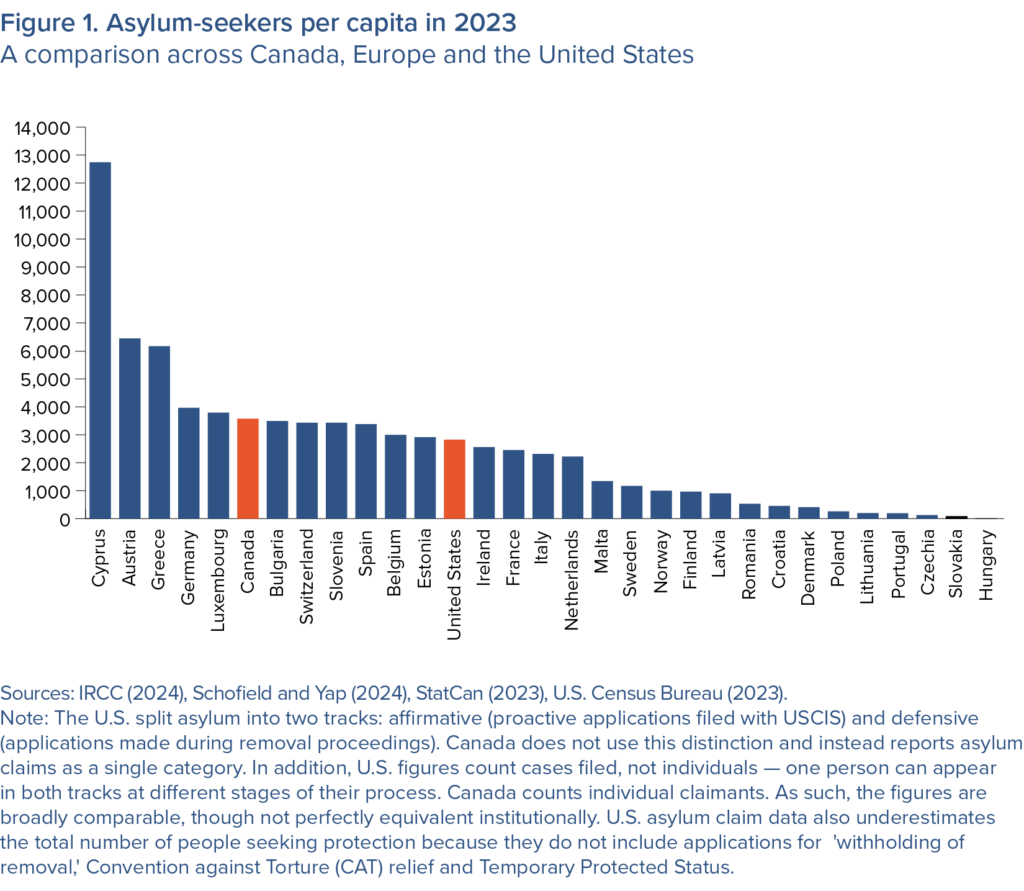
The norm animating a first country of arrival rule is simply geographic proximity: states closer to regions from which refugees flee should assume more responsibility for receiving asylum-seekers than states further away. The United States borders Mexico and is closer than Canada to Central and South America, from where many asylum-seekers originate.
Therefore, virtually no asylum-seekers who want to enter the United States by land need to pass through Canada, whereas virtually all asylum-seekers who want to enter Canada by land need to pass through the U.S. first.2 A “first country of arrival” rule guarantees that the United States will be responsible for more asylum-seekers than Canada. Ottawa has yet to explain why the accident of geography is a fair way of distributing responsibility for asylum-seekers.
The first country of arrival principle also incentivizes a phenomenon known as chain refoulement, in which states consecutively send asylum-seekers back to states closer to their country of origin without properly determining their refugee status. As discussed in the companion policy brief (see Macklin, forthcoming, in this series), this is precisely what the current Trump administration is doing with its agreement with Honduras.
Forum shopping
The responsibility-sharing principle is sometimes recast as a technique for forcing asylum-seekers to seek protection in the first safe country they reach to prevent them from being able to seek what they believe is the best forum to gain protection. This rationale taps into a wider discourse that discredits many asylum-seekers as bogus or as abusing the system.
While not all asylum-seekers meet the UN refugee definition, which is quite restrictive, countries cannot know whether an asylum-seeker is a refugee before there is a process to determine that.
Policies to exclude asylum-seekers (and thereby exclude refugees) often suppress the reality that some proportion of those excluded asylum-seekers are actually refugees. The “forum shopping” rhetoric does this by insinuating that a real refugee would not be choosy about their destination (Sadiqi, 2023). Or, as former deputy prime minister John Manley once said, “It’s not a matter of shopping for the country that you want. It’s a matter of escaping the oppression that you face” (Macklin, 2005, p. 381).
Apart from the many legitimate reasons that asylum-seekers might attempt to reach a place where they are most likely to flourish, this forum shopping concern is misguided in the context of the STCA. Asylum-seekers who choose to seek protection in the United States generally do not need to pass through Canada en route, so the STCA does not constrain their ability to choose the United States. It impedes only asylum-seekers who choose Canada because they will almost certainly need to pass through the United States first. In 2004, the year prior to the STCA coming into force, more than 97 per cent of the cross-border movement of asylum-seekers was from the U.S. to Canada (Macklin, 2005).
Promoting safe, regular, orderly migration
The federal government calls the STCA “a comprehensive means for the compassionate, fair, and orderly handling of asylum claims in our two countries” (CIMM, 2022). This might suggest that the STCA rectified a previously harsh, unfair and disorderly system.
But that is incorrect, as the Commons standing committee on citizenship and immigration acknowledged in its 2002 report on the then-proposed legislation (CIMM, 2002, p. 10). The report noted that a “fairly orderly system … now exists at Canada’s ports of entry, including the land border. All claimants are fingerprinted, photographed and issued instructions for medical examinations. This will … not occur if people avoid reporting to border posts.”
The committee recognized that barring asylum-seekers from claiming refugee protection at ports of entry would not necessarily deter asylum-seekers, but would instead divert some to irregular and unsafe modes of entry. Its report made the following recommendations (CIMM, 2002, p. 10):
The Committee recommends that, as part of the monitoring of the implementation of the Agreement, the issues of “irregular migration” and people-smuggling be closely watched. Should the Agreement fail to decrease the number of claims being referred to the Immigration and Refugee Board, and should an increase in the number of illegal [sic] entries to Canada be apparent, the government must be prepared to exercise its authority to suspend or terminate the Agreement.
Its 2002 report identified two metrics for evaluating the impact of the STCA: changes in the number of asylum-seekers eligible for protection in Canada and changes in the number of irregular entries.
Outcomes of the STCA 2005-25
Numbers and backlogs
The number of asylum-seekers entering Canada overland initially declined after the STCA entered into force but rebounded within three years to pre-2005 levels (Arbel, 2013). During the same period, the number of asylum claims in the United States also increased. It is impossible to know how many of those seeking asylum in the U.S. would have sought refugee protection in Canada without the STCA.
Refugee and asylum flows fluctuate according to circumstances beyond the control of receiving states. Since 2005, the number of refugees worldwide has soared to 42.5 million from 8.4 million (UNHCR, 2025a), and the annual number of asylum applications globally has climbed to 3.1 million from 668,000 (UNHCR, 2006, 2025b).
Backlogs are chronic. They are a function of how well the resources allocated by governments match the volume of demand for processing and adjudication. They also reflect governments’ policy and political choices and priorities (Paquet & Boucher, 2025).
The number of worldwide asylum-seekers fluctuates according to factors beyond the control of any destination state. Therefore, a policy that justifies denying access to asylum-seekers to avoid or reduce a backlog (while increasing the backlog in another state) is arbitrary, futile and ultimately indistinguishable from a policy to simply reduce the overall number of asylum-seekers.
In any event, the number of asylum-seekers continues to grow in both Canada and the United States. By mid-2025, the Immigration and Refugee Board (IRB) had an inventory of about 280,000 refugee protection claims. About a third (98,000) were “incomplete due to pending security screening and/or other outstanding requirements” that fall within the mandate of other government agencies. Time to adjudication from submitting a claim is estimated at two to three years except in Quebec, where it is significantly longer. Average time to completion from the point where a claim is ready for adjudication was about 1.5 years (CIMM, 2025; IRB, 2026; Immigration, Refugees and Citizenship Canada [IRCC], 2026).
The United States divides jurisdiction over asylum adjudication between two government agencies, and they have a combined backlog of over 3.9 million asylum claims, with wait times averaging about four years. The U.S. figures do not include an additional 1.3 million beneficiaries of Temporary Protected Status, which is allocated to nationals of designated countries in response to armed conflict, environmental disasters and similar events (American Immigration Council, 2025, 2026; Batalova, 2026; US Citizenship and Immigration Services, 2026; US Library of Congress, 2025). Adjusting for population, Canada’s backlog is 60 per cent the size of the U.S. asylum backlog.
Irregular border crossings
Despite the recommendation from the Commons committee in 2002, the federal government did not report irregular entry across the U.S. border until 2017. The data released from 2017 onward, following Trump’s first election in 2016, validated the prediction that the STCA would eventually generate irregular migration. From 2017 to the onset of the COVID-19 pandemic, almost 60,000 asylum-seekers crossed the Canada-U.S. border at other than official ports of entry, mainly at Roxham Road (Paquet & Schertzer, 2020).
Research by Smith (2023) confirms that the policies of the first Trump administration stoked fear, anxiety and the search for other options among asylum-seekers already in the United States. Smith also finds that neither public pronouncements by Canadian leaders nor Canadian refugee policies exerted an independent pull on asylum-seekers. They considered Canada as a destination only after they concluded they had to leave the United States.
At Roxham Road, border-crossers encountered RCMP and/or Canada Border Services Agency (CBSA) officials, who intercepted them and transported them to the nearest port of entry where they could initiate the asylum process. These asylum-seekers crossed openly — irregularly, but not illegally because neither domestic immigration law nor international law penalize refugees for irregular entry, recognizing that desperate people may take desperate measures to reach safety (Immigration and Refugee Protection Act [IRPA], s. 133; IRP Regulations, s. 27(2); UNHCR, 2025c). They did not require smugglers to learn about Roxham Road, to find it or to cross it.
Quebec bore most of the short-term financial costs associated with this and strenuously objected to the lack of federal co-ordination and support (Paquet & Schertzer, 2020). The COVID-19 epidemic provided the federal government with a public health basis for banning asylum-seekers from entering Canada regularly or irregularly because it was not deemed essential travel (Mercier & Rehaag, 2020). The pandemic also gave Ottawa time to lobby the United States to revise the STCA.
Legal challenges
The Canadian Council for Refugees, the Canadian Council of Churches, Amnesty International and individual litigants have twice challenged the STCA in Canadian courts.
The general argument in both cases was that the United States is not a safe country for refugees to seek and obtain protection because of its unfair and abusive treatment of asylum-seekers and because of the risk that refugees would be sent back to their country of origin or to another country where they faced a significant risk of persecution.
Therefore, it was argued that Canada would violate its international legal obligations under the UN Refugee Convention, as well as its constitutional obligations under the Canadian Charter of Rights and Freedoms, if it transferred asylum-seekers to a country that was unsafe for refugees.
In both cases, the challenge succeeded — at first.
In the 2007 case, the Federal Court found that the United States did not comply with its international obligations toward refugees and therefore it was unreasonable for the federal cabinet to designate the United States as safe (CCR v. Canada, 2007). However, the Federal Court of Appeal allowed the government’s appeal on the grounds that in effect it did not matter in law if the United States was actually safe, once cabinet certified that it was safe (CCR v. Canada, 2008).3 The Supreme Court of Canada denied leave to appeal.
The second challenge was launched shortly after the beginning of Trump’s first term as conditions in the U.S. worsened for non-citizens and migrants, including asylum-seekers. The applicants succeeded before the Federal Court, although the court relied almost entirely on only one basis for the challenge, namely the abusive and arbitrary detention conditions of one of the litigants, an Eritrean refugee claimant.
The court ruled that such detention impeded the ability to advance a refugee claim and therefore led to a risk of refoulement. It found the harm of Canada returning refugee claimants to these conditions in the United States was overbroad, grossly disproportionate to the Canadian government’s stated objective of sharing responsibility to protect refugees and a violation of the Charter’s Section 7 guarantee of life, liberty and security of person. The Federal Court did not rule on other grounds for challenging the STCA.
This time, the case made its way to the Supreme Court, which upheld the constitutionality of the STCA (CCR v. Canada, 2023). The Supreme Court rejected the Federal Court finding that those returned to detention in the United States faced a real and substantial risk of refoulement owing to practical obstacles to making their claims. It said that the trial judge exaggerated the likelihood of detention of asylum-seekers, and further ruled that cruel and inhumane detention conditions (though publicly reported by Human Rights Watch and other sources) were not foreseeable to Canadian authorities (Blum & Macklin, 2025). Therefore, Canada’s practice of systematically returning asylum-seekers to the United States under the STCA was not overbroad or grossly disproportionate in impact.
The Supreme Court also ruled that the Canadian immigration system offers discretionary safety valves capable of curing any overbroad or grossly disproportionate impact of the STCA as applied in an individual case. It found this relief was available — even though the litigants argued, and the Federal Court agreed, that such safety valves were non-existent or illusory (CCR v. Canada, 2023).
The Supreme Court declined to rule on cabinet’s failure to fulfil its legislated duty to maintain an ongoing review of whether the United States was still a safe country. Since the Federal Court did not determine whether the STCA violated the Section 15 equality provision of the Charter (mainly because the U.S. does not consistently or fully recognize gender-related persecution), the Supreme Court sent the Section 15 issue back to the Federal Court.
These aspects of the judgment have been widely criticized by legal scholars (Aiken & Grey, 2025; Arbel, 2024; Blum & Macklin, 2025; Liew, 2025). At present, there are several ongoing legal challenges that test the availability of safety valves, attempt to hold the federal government accountable for failing to monitor U.S. conditions as required by law and pursue the Section 15 argument. Thus far, the government has implacably denied the existence of a safety valve in any individual case, and has aggressively opposed disclosure of any evidence that the government has, in fact, maintained an ongoing review of the United States’ safety for asylum-seekers and refugees.
Expansion of the STCA
The Commons Committee in 2002 recommended that, if the STCA demonstrably generated significant irregular border crossing from the United States to Canada, the federal government should terminate the agreement. However, when this trend materialized, the government did not follow the recommendation and instead took two steps.
First, in 2021, it made asylum-seekers who had commenced refugee claims in any of the other Five Eyes partners (U.S., U.K., Australia, New Zealand) ineligible to claim refugee status in Canada (IRPA, 101(1)(c.1)), confining them to a pre-removal risk assessment.
Secondly, it negotiated a revision to the STCA to extend its application across the almost 9,000 kilometres of the Canada-U.S. border, including internal waterways. Under the Additional Protocol to the Agreement between the Government of Canada and the Government of the United States of America for Cooperation in the Examination of Refugee Status Claims from Nationals of Third Countries (Government of Canada, 2023b), asylum-seekers who cross into either country other than at official ports of entry cannot seek refugee protection in the destination state and will be sent back if apprehended within 14 days of arrival.
According to the CBSA, the protocol will mitigate the problem of irregular entry by asylum-seekers (Public Safety Canada, 2024) — a problem that was produced by the original STCA. In so doing, the protocol has also incentivized human smuggling. Whereas asylum-seekers entered Canada in a safe, orderly, regular way at official ports of entry until 2005 or crossed irregularly but openly at Roxham Road from 2017 to 2020, they now need to enter clandestinely, possibly resorting to smugglers to avoid detection (Steiner, 2023).
Indeed, the regulatory assessment accompanying the protocol concedes that it puts asylum-seekers’ lives and safety at risk and amounts to a stimulus for smugglers (IRCC, 2023).4 The risks of injury or death from hypothermia, drowning or exposure are all intended to deter people from irregular border crossing. The STCA thus uses and hides behind nature as a source of danger and harm to the lives and safety of asylum-seekers.
Bill C-12 and Beyond
To appease Trump and/or address the heightened risk of human smuggling created by the protocol, the federal government pledged in December 2024 to spend $1.3 billion over six years to fortify the Canadian border with drones, surveillance, infrastructure, enforcement personnel and detention facilities. This budget is divided between the RCMP, CBSA, the Communications Security Establishment, Health Canada and Public Safety (Public Safety Canada, 2024).
Trump’s allegation that Canada is a source of fentanyl and irregular migrants to the United States is wildly exaggerated (Global Affairs Canada, 2024), but the militarization of the border on the Canadian side is not really about stopping drugs or migrants moving from north to south. The movement of illicit drugs and guns is overwhelmingly from the U.S. into Canada, but mainly through ports of entry. There is no evidence of significant cross-border movement of people from the U.S. into Canada apart from asylum-seekers, leading some to infer that asylum-seekers are the human targets of Canada’s border militarization.
While the government proclaimed its investment of $1.3 billion dollars in policing almost 9,000 kilometres of border, it quietly abandoned a $68-million project to, among other tasks, improve efficiency in processing asylum claims and address the backlog of pending asylum cases (Hwang, 2025). It also cut 30 per cent of the IRCC budget for immigrant selection and refugee integration (Glass, 2025).
These actions represent a choice to direct funds toward border militarization and away from developing the legal, administrative and policy infrastructure to respond constructively when external forces bring more asylum-seekers to the border. This also reveals that the government would rather spend a billion dollars (so far) to avoid its refugee obligations than $68 million to comply with them.
If nothing else, evidence from around the world confirms that indulging the fantasy of sealing the “world’s longest undefended border” through military technology and infrastructure will prove futile and will consume billions of tax dollars in perpetuity.
Bill C-12, the Strengthening Canada’s Immigration System and Borders Act, aims to further shrink access to refugee protection by creating two new grounds for ineligibility. The first is a harsher version of a U.S. law that imposes a post-arrival deadline of one year on anyone seeking refugee protection, retroactive to June 24, 2020. The second disqualifies a person from refugee protection if they enter Canada irregularly across the U.S. border and make a claim more than 14 days after entry. In both cases, people will be denied access to the refuge determination process conducted by the Immigration and Refugee Board.
This means that asylum-seekers who enter irregularly will be sent back to the United States under the STCA if apprehended in the first two weeks, or shunted into a less fair and less protective pre-removal risk assessment (PRRA) conducted by an immigration officer, if more than two weeks have passed. The PRRA officers are not independent or expert in refugee determination. In the precedential 1985 Singh decision, the Supreme Court of Canada ruled that the Charter affords refugee claimants a right to an oral hearing where credibility is at stake. The PRRA process is paper-based. A process that denies asylum-seekers an oral hearing prior to refusal will likely violate the Charter; instituting oral PRRA hearings will simply shift a backlog from one decision-making body to another.
In brief, at a time when the United States is increasingly unsafe for asylum-seekers, Canada is expanding and intensifying efforts to prevent an asylum-seeker currently in the U.S., or who entered Canada in the last five years, from obtaining refugee protection in Canada. And it is doing so by borrowing policies and practices from the United States.
Notes
1 This led to a “direct back” policy under which asylum-seekers would be sent back to the United States (with U.S. consent) with an appointment to return to a port of entry for processing at a future date. This temporary practice was unsustainable over time and legally dubious (IACHR, 2011).
2 In rare cases, asylum-seekers may fly to one country (Canada or the United States) and then seek to enter the other country overland.
3 The Federal Court of Appeal also ruled that John Doe, the individual refugee claimant in that case, could not benefit from Charter protection because he did not present himself at “an official port of entry” at the Canadian border (because he feared the consequences of being returned to the U.S. under the STCA). For an excellent analysis, see Arbel (2013).
4 The regulatory assessment acknowledges that asylum-seekers will now “face increased danger, such as involvement with human smugglers and may be at risk for physical, mental, or financial abuse. They may also face risks from exposure to extreme weather conditions if they cross at remote locations or fail to secure access to shelter. This could increase the health and security risks of living in dangerous. natural habitats, as well as a possible lack of access to food, water, health care, and other basic services” (IRCC, 2023).
References
Aiken, S. J., & Grey, C. (2025). Equality rights and the Canada-U.S. Safe Third Country Agreement. Supreme Court Law Review (Third Series), 5, 109-135.
American Immigration Council. (2025, May 9). Asylum in the United States: Fact sheet.
https://www.americanimmigrationcouncil.org/fact-sheet/asylum-united-states/
American Immigration Council. (2026, March). Temporary Protected Status: An overview.
https://www.americanimmigrationcouncil.org/wp-content/uploads/2017/08/Temporary-Protected-Status-An-Overview-3-6-2026.pdf
Arbel, E. (2013). Shifting borders and the boundaries of rights: Examining the Safe Third Country Agreement. International Journal of Refugee Law, 25(1), 65-86.
Arbel, E. (2024). Border trouble: Critical reflections on the Canada-U.S. Safe Third Country Agreement litigation. International Journal of Migration and Border Studies, 8(3/4), 240-260.
Batalova, J. (2026, January 8). Spotlight: Refugees and asylees in the United States. Migration Policy Institute. https://www.migrationpolicy.org/article/refugees-and-asylees-united-states
Blum, J., & Macklin, A. (2025). Always elsewhere: Constitutional rights in CCR. Supreme Court Law Review (Third Series), 5, 85-107.
Canadian Council for Refugees (CCR) v. Canada, 2007 FC 1262.
Canadian Council for Refugees (CCR) v. Canada, 2008 FCA 229.
Canadian Council for Refugees (CCR) v. Canada, 2023 SCC 17.
Coté-Boucher, K., Vives, L., & Janard, L-P. (2023). Chronicle of a crisis foretold: Asylum seekers and the case of Roxham Road on the Canada-US border. Environment and Planning C: Politics and Space, 41(2), 408-426.
Glass, M. (2025, July 23). IRCC forecasts 30 per cent spending cut by 2028 amid lower immigration targets. Hill Times. https://www.hilltimes.com/story/2025/07/23/ircc-forecasts-30-per-cent-spending-cut-by-2028-amid-lower-immigration-targets/468286/
Global Affairs Canada. (2024, February 9). Build eh wall [redacted]. WSHDC 11965 (on file).
Government of Canada. (2023a). Safe Third Country Agreement. https://www.canada.ca/en/immigration-refugees-citizenship/corporate/mandate/policies-operational-instructions-agreements/agreements/safe-third-country-agreement.html#toc1
Government of Canada. (2023b, March 24). Additional protocol to the agreement between the government of Canada and the government of the United States of America for cooperation in the examination of refugee status claims from nationals of third countries. https://www.canada.ca/en/immigration-refugees-citizenship/corporate/mandate/policies-operational-instructions-agreements/agreements/safe-third-country-agreement/additional-protocol.html
Hwang, P. K. S. (2025, July 23). $68M project to secure, revamp Canada’s asylum system shut down unexpectedly, documents show. CBC News Online. https://www.cbc.ca/news/canada/ottawa/68m-project-to-secure-revamp-canada-s-asylum-system-shut-down-unexpectedly-documents-show-1.7582366
Immigration and Refugee Board of Canada (IRB). (2026, February 13). Claims by country of alleged persecution — 2025. https://www.irb-cisr.gc.ca/en/statistics/protection/Pages/RPDStat2025.aspx
Immigration and Refugee Protection Act, SC c.27 (2001).
Immigration and Refugee Protection Regulations, SOR/2002-227.
Immigration, Refugees and Citizenship Canada (IRCC). (2023, March 23). Regulations amending the Immigration and Refugee Protection Regulations (examination of eligibility to refer claim): SOR/2023-58. Canada Gazette, Part II, Volume 157, Number 8. https://gazette.gc.ca/rp-pr/p2/2023/2023-04-12/html/sor-dors58-eng.html
Immigration, Refugees and Citizenship Canada (IRCC). (2024). 2024 annual report to Parliament on immigration. Government of Canada. https://www.canada.ca/en/immigration-refugees-citizenship/corporate/publications-manuals/annual-report-parliament-immigration-2024.html?utom
Immigration, Refugees and Citizenship Canada (IRCC). (2026, February 24). Check our current processing times. Government of Canada. https://www.canada.ca/en/immigration-refugees-citizenship/services/application/check-processing-times.html
Inter-American Commission on Human Rights (IACHR). (2011). John Doe et al v. Canada. Inter-American Commission on Human Rights Report No. 08/16.
https://www.refworld.org/jurisprudence/caselaw/iachr/2011/en/88133
Liew, J. C. Y. (2025). Safety valves in charter analysis: A quick fix rather than a structural solution. Supreme Court Law Review (Third Series), 5, 65-83.
Macklin, A. (2005). Disappearing refugees: Reflections on the Canada-U.S. Safe Third Country Agreement. Columbia Human Rights Law Review, 36(2), 365-426.
Macklin, A. (2018). Citizenship, non-citizenship and the rule of law. University of New Brunswick Law Journal, 69, 19-56.
Mercier, E., & Rehaag, S. (2021) The right to seek asylum in Canada (during a global pandemic). Osgoode Hall Law Journal, 57.3, 705-738.
Milner, J. (2023). The principle, practice and politics of responsibility sharing. PKI Global Justice Journal, 6(7), Article 2.
Office of the United Nations High Commissioner for Refugees (UNHCR). (2006). 2005 global refugee trends. https://www.unhcr.org/sites/default/files/legacy-pdf/4486ceb12.pdf
Office of the United Nations High Commissioner for Refugees (UNHCR). (2025a). Figures at a glance. https://www.unhcr.org/about-unhcr/overview/figures-glance
Office of the United Nations High Commissioner for Refugees (UNHCR). (2025b, June 15). Global trends: Forced displacement in 2024. https://www.unhcr.org/global-trends-report-2024
Office of the United Nations High Commissioner for Refugees (UNHCR). (2025c, June 6). Summary of the UNHCR guidance on article 31 of the 1951 convention. https://www.refworld.org/policy/legalguidance/unhcr/2025/en/150108
Paquet, M., & Boucher, A. K. (2025). Beyond the queue: The sources and politics of migration backlogs in Canada and Australia. Journal of Immigrant & Refugee Studies, 1-14.
Paquet, M., & Schertzer, R. (2020, November 10). Irregular border crossers and asylum-seekers in Canada: A complex intergovernmental problem. Centre of Excellence on the Canadian Federation. https://centre.irpp.org/research-studies/irregular-border-crossings-and-asylum-seekers-in-canada-a-complex-intergovernmental-problem/
Public Safety Canada. (2024, December 17). Government of Canada announces its plan to strengthen border security and our immigration system. Government of Canada.
https://www.canada.ca/en/public-safety-canada/news/2024/12/government-of-canada-announces-its-plan-to-strengthen-border-security-and-our-immigration-system.html
Sadiqi, A. (2023). Examining the impact of refugee responsibility sharing agreements and border crossings on the stigmatization of refugees and migrants. PKI Global Justice Journal, 7(6), Article 8.
Schofield, N., & Yap, A. (2024). Asylees: 2023. Office of Homeland Security Statistics, U.S. Department of Homeland Security. https://ohss.dhs.gov/sites/default/files/2024-10/2024_1002_ohss_asylees_fy2023.pdf
Singh v. Minister of Employment and Immigration, [1985] 1 SCR 177.
Smith, C. D. (2023). Policy change, threat perception, and mobility catalysts: The Trump administration as driver of asylum migration to Canada. International Migration Review, 57(4), 1678-1709.
Standing Committee on Citizenship and Immigration (CIMM). (2002, December 5). The safe third country regulations: Report of the Standing committee on citizenship and immigration.
https://www.ourcommons.ca/Content/Committee/372/CIMM/Reports/RP1032292/cimmrp01/cimmrp01-e.pdf
Standing Committee on Citizenship and Immigration (CIMM). (2022, May 12). Asylum and the Safe Third Country Agreement. Immigration, Refugees and Citizenship Canada. https://www.canada.ca/en/immigration-refugees-citizenship/corporate/transparency/committees/cimm-may-12-2022/asylum-safe-third-country-agreement-stca.html
Standing Committee on Citizenship and Immigration (CIMM). (2025, October 30), Asylum. Immigration, Refugees and Citizenship Canada. https://www.canada.ca/en/immigration-refugees-citizenship/corporate/transparency/committees/cimm-oct-30-2025/asylum.html
Statistics Canada (StatCan). (2023). Canada’s demographic estimates for July 1, 2023: record-high population growth since 1957. Government of Canada. https://www150.statcan.gc.ca/n1/daily-quotidien/230927/dq230927a-eng.htm?utm_
Steiner, I. (2023, September 14). Safe Third Country Agreement expansion causes asylum-seekers to explore new routes. Wilson Center.
Strengthening Canada’s Immigration System and Borders Act, Bill C-12, 45th Parl, 1st Sess (third reading December 11, 2025).
United Nations Convention relating to the Status of Refugees (adopted July 28, 1951, entered into force April 22, 1954). United Nations Treaty Series, 189, p. 137.
United Nations Protocol relating to the Status of Refugees (adopted January 31, 1967, entered into force October 4, 1967). United Nations Treaty Series, 606, p. 267.
US Census Bureau. (2023, December 19). U.S. population trends return to pre-pandemic norms as more states gain population [News release]. https://www.census.gov/newsroom/press-releases/2023/population-trends-return-to-pre-pandemic-norms.html
US Citizenship and Immigration Services. (2026, February 20). DHS proposes rule to prioritize Americans’ safety by strengthening screening of asylum seekers. https://www.uscis.gov/newsroom/news-releases/dhs-proposes-rule-to-prioritize-americans-safety-by-strengthening-screening-of-asylum-seekers
US Library of Congress. (2025, December 10) Asylum process in immigration courts and selected trends. https://www.congress.gov/crs-product/R47504
About this paper
This Policy Brief was published as part of the Canada’s Changing Immigration Landscape series from the Centre of Excellence on the Canadian Federation. The manuscript was copy-edited by Jim Sheppard, proofread by Zofia Laubitz, editorial co-ordination was by Étienne Tremblay, production was by Chantal Létourneau, publication management was by Prasanthi Vasanthakumar and art direction was by Anne Tremblay.
Canada’s Changing Immigration Landscape is a partnership between the Centre of Excellence on the Canadian Federation at the IRPP, the Institute for Research on Migration and Society at Concordia University (IRMS) and the Centre for Migration Studies at the University of British Columbia (CMS). All publications are under the direction of Charles Breton, Executive Director of the Centre of Excellence on the Canadian Federation, Mireille Paquet, Director of IRMS, and Irene Bloemraad, Co-director of CMS.
Audrey Macklin is Professor of Law and Chair in Human Rights at University of Toronto, and a Fellow of the Canadian Institute for Advanced Research. She teaches, researches and publishes on migration, citizenship, refugees, administrative law and human rights.
A French translation of this text is available under the title L’Entente entre le Canada et les États-Unis sur les tiers pays sûrs remplit-elle son rôle ?
To cite this document:
Macklin, A. (2026). Is the Canada-U.S. Safe Third Country Agreement doing what it is supposed to do? Institute for Research on Public Policy. https://doi.org/10.26070/m54f-z370