


Two-Step Immigration Selection and Post-Admission Earnings

 |
Canada’s Changing Immigration Landscape |
| Immigration policy is central to the future of the federation. This series explores recent challenges and opportunities, turning complex issues into clear, actionable insights. |
Economic immigrants selected through the two-step process — first as temporary foreign workers before being permanent residents — generally earn more than those selected directly from abroad. But outcomes vary widely: two-step immigrants with high pre-admission Canadian earnings enjoy substantial and persistent earnings advantages, while those with lower pre-admission earnings often fare worse than one-step immigrants. The findings suggest that pre-admission Canadian earnings can strongly predict post-admission economic success.
A premise of the two-step selection of economic immigrants is improved labour market outcomes through a multi-stage process. First, temporary foreign workers are chosen by employers, can better align immigrants’ skills and labour market needs because employers can directly assess their competencies and intangible qualities. Second, these workers self-select after experiencing life in Canada, and those who are satisfied with their work and life are more likely to apply for permanent residency. Immigrants who succeed as temporary foreign workers are less likely to face challenges on their skills transferability — an issue that often affects one-step immigrants who are those with no prior Canadian experience (Hou & Bonikowska, 2018).
However, the success of two-step selection partly depends on how well employers involved in the process can identify and consider longer-term labour demand. Simply filling routine openings in short-term, low-wage jobs may not lead to long-term economic success for immigrants.
Some employers may use temporary foreign workers as a source of low-cost labour (Crossman et al., 2020). Lower-skilled temporary foreign workers are also generally more motivated to seek permanent residency in Canada (Picot et al., 2022a). Previous research indicates that temporary foreign workers in low-skilled or low-paying jobs tend to have lower earnings and slower earnings growth compared to one-step immigrants (Hou & Bonikowska, 2018).
Recent data confirm two key findings of earlier studies:
- On average, two-step immigrants earned more than one-step immigrants.
- There is considerable heterogeneity among two-step immigrants, as those who held low-paying jobs as temporary foreign workers earned less than one-step immigrants after obtaining permanent residency.
As figure 1 shows, two-step immigrants in the Federal Skilled Worker Program and the Provincial Nominee Program consistently had higher annual earnings than their one-step counterparts in the same program when the comparison begins from the year of arrival in Canada. Two-step immigrants had an even larger earnings advantage when the comparison starts with the year they obtain permanent residency (Hou & Picot, 2024).
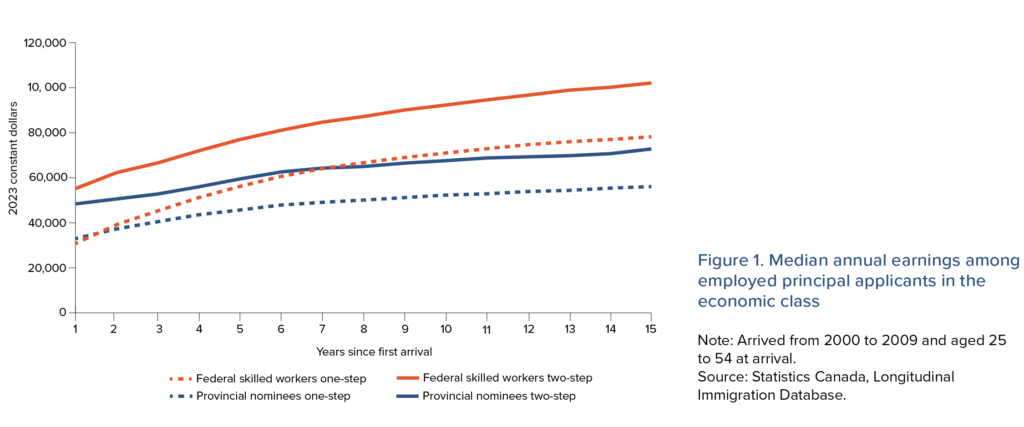
For instance, among immigrants who arrived from 2000 to 2009, two-step immigrants who obtained permanent residency through the Federal Skilled Worker Program earned about $22,000 (in 2023 constant dollars) yearly more than their one-step counterparts in the first 15 years after arrival. In these same periods, two-step immigrants in the Provincial Nominee Program earned about $15,000 yearly more than one-step immigrants. These earnings gaps mostly hold when sociodemographic differences between the groups are considered. Similar patterns are observed for immigrants who arrived between 2010 and 2019.
However, some two-step immigrants achieve better labour market outcomes than others. A key predictor of success is their earnings level as temporary foreign workers (Picot et al., 2022b). Pre-admission Canadian earnings likely reflect “realized market value” of temporary foreign workers’ skills and qualifications (Hou & Picot, 2016).
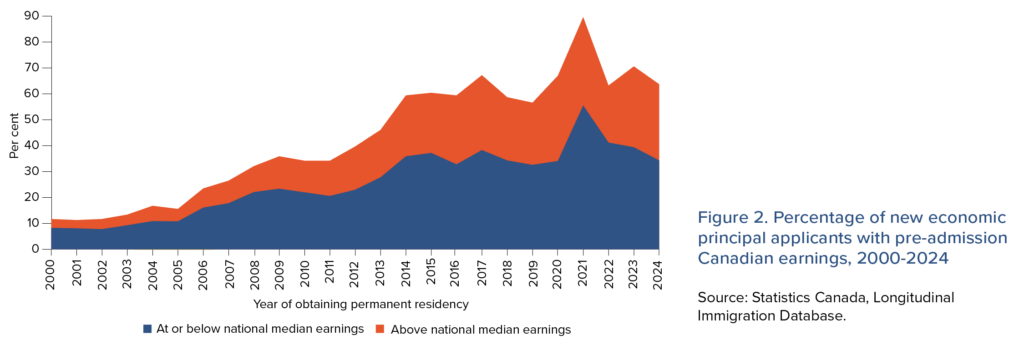
Among two-step immigrants, only a minority had annual earnings above the national median employment earnings as temporary foreign workers (figure 2).1 For example, in 2010, 12 per cent of economic principal applicants had pre-admission earnings above the national median, while 22 per cent had earnings at or below the median. By 2024, these shares had increased to 29 per cent and 34 per cent, respectively. These increases suggest that the expansion of the two-step selection process was associated with a growing share of higher-earning temporary foreign workers being admitted, likely driven in part by the rapid expansion of the overall temporary foreign worker population, which enlarged the pool of eligible candidates.
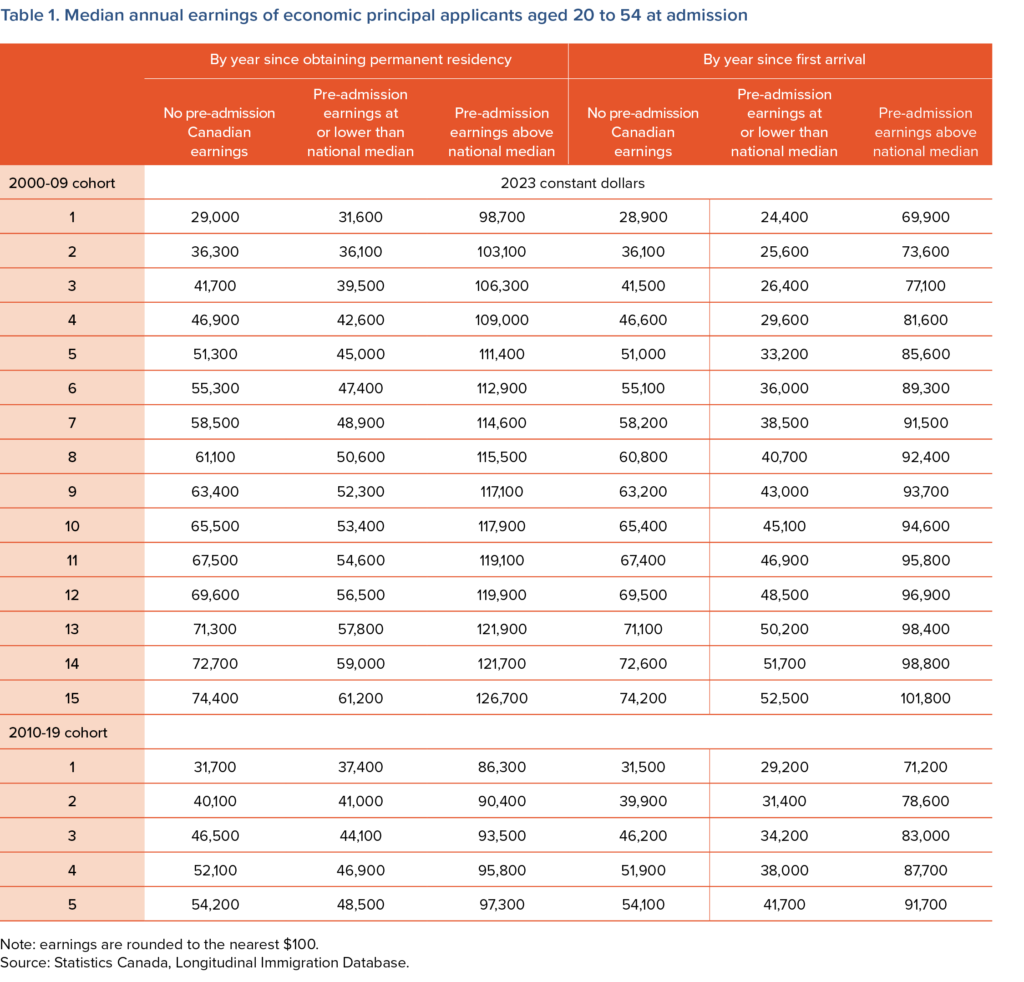
Two-step immigrants with pre-admission Canadian earnings above the national median earnings earned substantially more than one-step immigrants after obtaining permanent residency. For the 2000-09 admission cohort, the earnings gap between the two groups was $70,000 one year after admission and remained at $52,000 15 years later (table 1, left panel). Part of this difference reflects a head start — these two-step immigrants had already accumulated more years of work experience in Canada. However, even when the comparison begins in the year they first arrived (the year they obtained their temporary work permit), the earnings gap remained substantial (table 1, right panel).
Similar patterns are observed for the 2010-19 admission cohort, although the earnings advantage of two-step immigrants with high pre-admission earnings was smaller compared with the earlier cohort. This was mostly because the latter cohort had proportionately fewer top earners (with at least twice the national median earnings as temporary foreign workers). Among two-step immigrants with high pre-admission earnings, 47 per cent of the 2000-09 cohort had annual earnings at least twice the national median earnings, compared with 31 per cent in the 2010-19 cohort.
In contrast to two-step immigrants with high pre-admission earnings, two-step immigrants with pre-admission earnings at or below the national median had similar earnings to one-step immigrants in the first year after obtaining permanent residency. However, they were surpassed by the latter group within three years (table 1). When the comparison begins from the year of arrival, two-step immigrants with lower pre-admission earnings earned less than one-step immigrants initially and over the long term.
In summary, economic immigrants selected through the two-step process generally earn more than those selected directly from abroad, though outcomes vary widely. Two-step immigrants with high pre-admission Canadian earnings enjoy substantial and persistent earnings advantages, while those with lower pre-admission earnings often fare worse than one-step immigrants. The findings suggest that pre-admission Canadian earnings can strongly predict post-admission economic success, largely reflecting the realized market value of two-step immigrants’ skills and quality of Canadian work experience.
Note
1 The national median earnings are derived from the Longitudinal Administrative Databank for each tax year among workers aged 20 to 64 and with positive earnings. For example, the national median earnings (in 2023 constant dollars) was $49,500 in 2010 and $57,000 in 2023.
References
Crossman, E., Hou, F., & Picot, G. (2020). Two-step Immigration Selection: A Review of Benefits and Potential Challenges (statcan.gc.ca) Statistics Canada: Economic Insights, Catalogue no. 11-626-X — 2020009 – No. 111.
Hou, F., & Bonikowska, A. (2018). Selections before the selection: Earnings advantages of immigrants who were former skilled temporary foreign workers in Canada. International Migration Review, 52(3), 695-723. https://doi.org/10.1111/imre.12310
Hou, F. & Picot, G. (2016). Changing immigrant characteristics and pre-landing Canadian earnings: Their effect on entry earnings over the 1990s and 2000s. Canadian Public Policy, 42(3), 308-232. https://doi.org/10.3138/cpp.2015-062
Hou, F. & Picot, G. (2024). Earnings of one-step and two-step economic immigrants: Comparisons from the arrival year. Economic and Social Reports, 4(1). Statistics Canada.
https://doi.org/10.25318/36280001202400100006-eng
Picot, G., Hou, F., Crossman, C., & Lu, Y. (2022a). Transition to permanent residency by lower- and higher-skilled temporary foreign workers. Economic and Social Reports, 2(1). Statistics Canada. https://doi.org/10.25318/36280001202200100002-eng
Picot, G., Hou, F., Xu, L., & Bonikowska, A. (2022b). Which immigration selection factors best predict the earnings of economic principal applicants? Immigration, Refugees and Citizenship Canada. https://www.canada.ca/en/immigration-refugees-citizenship/corporate/reports-statistics/research/immigration-selection-factors-predict-earnings-economic-principal-applicants.html