


Whither Temporary Migrant Work? Differential Inclusion and Precarity in Canada’s International Mobility Program

 |
Canada’s Changing Immigration Landscape |
| Immigration policy is central to the future of the federation. This series explores recent challenges and opportunities, turning complex issues into clear, actionable insights. |
Recently, political debate around the future of migrant work in Canada has intensified, with mounting calls to reform or even eliminate the Temporary Foreign Worker Program (TFWP). But, even though improvements are imperative, reforming the TFWP would not end exploitation among workers migrating to Canada for employment. This policy report shows that Canada’s International Mobility Program (IMP) — now accounting for 80 per cent of all temporary work permits — reproduces many of the same problems that have long plagued the TFWP, while remaining far less scrutinized.
At a policy level, the IMP is often presented as a means for employers to recruit highly educated, mobile workers with high levels of socially recognized skills. The reality is more complex. Drawing on administrative data from the Canadian Employer and Employment Dynamics Database and in-depth interviews with current and former permit holders, this report shows that large and fast-growing IMP subprograms, including the post-graduation and spousal work permit programs, are generating precarity among participants: the simultaneous experience of tenuous residency status and insecure employment.
Precarity among participants within the IMP is not uniform. Workers under the agreements category fare better than those under Canadian interests, where income levels, unionization rates and multiple jobholding closely resemble those of TFWP permit holders. Within Canadian interests, workers under the competitiveness and public policy stream, which houses the post-graduation and spousal work permit programs, face the highest rates of precariousness, with 54 per cent holding jobs characterized by multiple indicators of labour market insecurity.
This report focuses on two structural forms of precarity. Post-graduation work permit holders experience probationary precarity: they must fulfil a protracted sequence of educational and employment requirements to access permanent residency, leading many to accept work outside their field and to endure poor employment conditions for fear of jeopardizing their likelihood of transitioning to permanent residency. Meanwhile, spousal work permit holders experience relational precarity: their right to remain in Canada and their access to the labour market depend on maintaining a relationship with a “principal” work-permit holder (spouse), leaving them vulnerable to exploitation and with few independent sources of protection.
Gender and country of origin compound these vulnerabilities. For example, some holding spousal work permits are particularly disadvantaged: 68 per cent earned less than $30,000 in 2021, and their access to independent pathways to permanent residency is severely constrained. Similarly, about 70 per cent of spousal permit holders from China, Korea, and Iran and about 45 per cent of post-graduation permit holders from Vietnam, China, and Korea earned less than $30,000 that year.
To address these challenges, the report calls for:
- An extension of the federal workplace enforcement regime to cover all open work permit holders under the IMP
- The introduction of a wage premium for middle- and low-income IMP permit holders to compensate for the structural insecurities embedded in permit design
- The creation of direct, streamlined routes to permanent residency for post-graduation work permit holders to reduce occupational downgrading and insecurity of residency status
- The issuance of free-standing open work permits to spousal permit holders, along with independent pathways to permanent residency that do not depend on the continuation of a relationship
Canada cannot address the structural conditions that produce precarious migrant work by ignoring the IMP. A comprehensive approach that strengthens rights and protections for all temporary work permit holders is essential.
Introduction
Political debate around temporary migrant work in Canada reached new heights recently. Last fall, Conservative Party Leader Pierre Poilievre called for a permanent end to the Temporary Foreign Worker Program (TFWP), while B.C. Premier David Eby called for reworking it. Meanwhile, many other commentators have entered the fray with calls for major reforms (DeRosa, 2025; Hua, 2025).
Workers who come to Canada on temporary work permits play a central role in our labour market but often face precarity. Historically, many have arrived through the TFWP, which typically gives them a closed work permit tied to a specific employer. The program has long aimed to address “qualitative labour shortages” — unfilled job openings that are unattractive to citizens and permanent residents.
Yet, the presence of migrant workers is routinely met by public anxiety (Marsden et al., 2021a), as evidenced recently by misdirected suggestions that TFWP participants are taking jobs from young people (Zimonjic, 2025). Starting in 2014, amid such public sentiments, as well as mounting concerns about working conditions under the TFWP, the federal government began to tighten program rules and reduce the size of key streams (Marsden et al., 2021b).
At the same time, Ottawa expanded opportunities for what it called worker mobility through the International Mobility Program (IMP). Unlike the TFWP — which mainly targets migrant workers with fewer formally recognized skills to fill difficult low-wage jobs in industries such as agriculture — the IMP targets highly educated mobile workers with widely recognized skills1 and qualifications. These workers are assumed to be moving here for better career opportunities and, in some cases, the possibility of permanent residence (see Banerjee’s 2026 contribution to this series). This type of mobility is presented as good for Canada’s economy because it is linked to higher-quality value-added jobs.
From 2014 to 2024, the number of permit holders under the IMP increased about 4.5 times to 1,312,667 from 287,921 (Government of Canada, 2025). Over the same period, the number of permit holders under the TFWP also increased by over 3.5 times to 236,130 from 64,025 (IRCC, 2021, 2023a, 2024c, 2024d). Yet by 2024, as figure 1 shows, 80 per cent of all temporary work permits were issued through the IMP, compared to 20 per cent through the TFWP (Government of Canada, 2025).
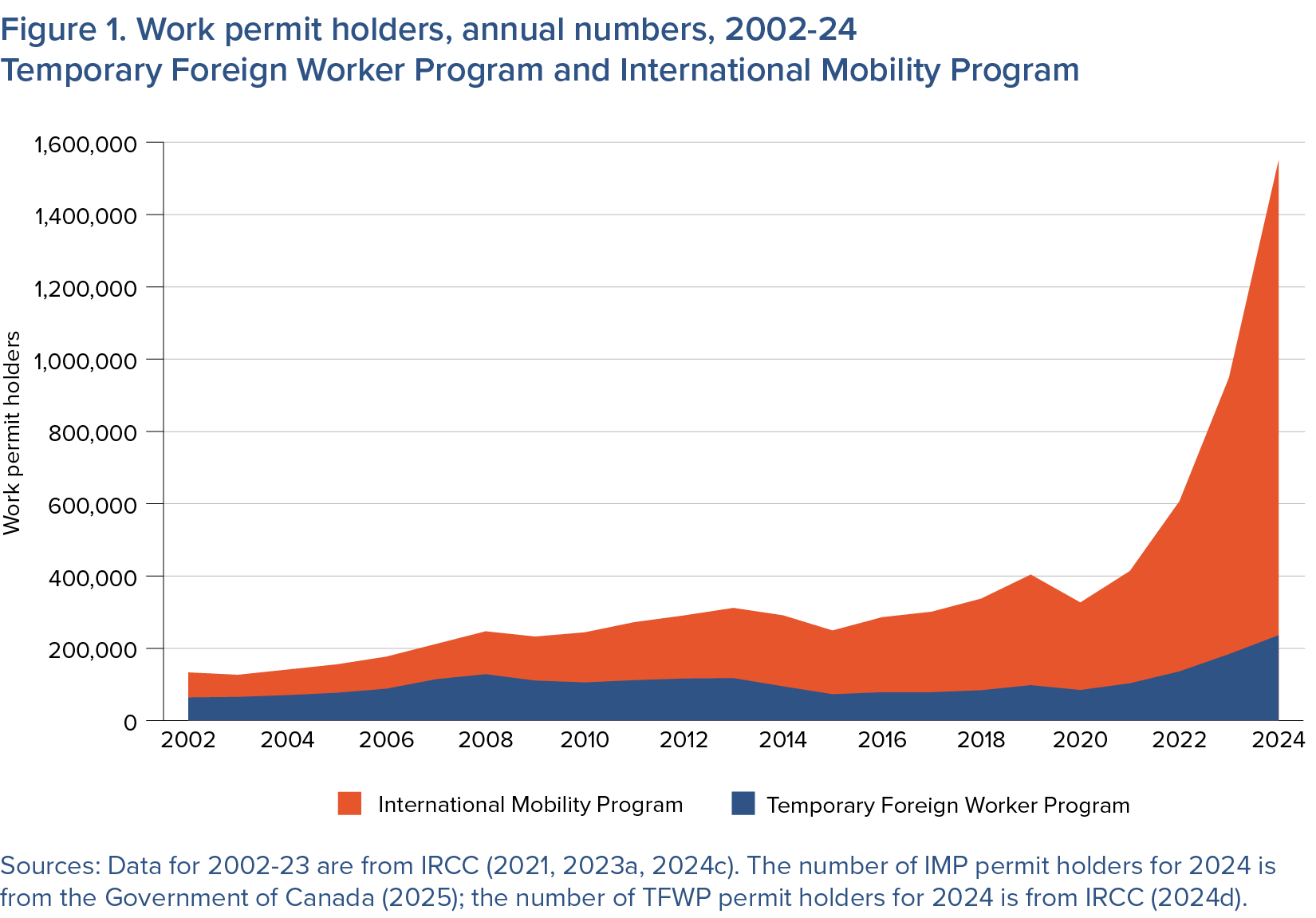
With mounting calls to eliminate the TFWP, along with the rapid growth of the IMP, this report describes how opportunities for mobility under the IMP operate and how they affect permit holders, with a focus on federally led programs. It considers the extent to which the IMP marks a departure from conditions long associated with migrant work in Canada, revealing that programs under this umbrella can foster precarity. By precarity, I mean the simultaneous experience of precarious status (i.e., insecurity of presence) and precarious employment (i.e., work for remuneration characterized by uncertainty, low income, and limited social benefits and statutory entitlements).
As I show, shutting down the TFWP would not eliminate precarity among workers migrating for employment to Canada. IMP migrants can also face precarity. What is necessary, therefore, is improving protections for all temporary work permit holders, regardless of the programs through which they come to Canada, while also expanding meaningful opportunities for permanent residency.
The International Mobility Program
The IMP emerged in its current form in 2014, although some of its categories, streams and subprograms found their origins earlier. In some cases, long-standing programs were rebranded. Meanwhile, new programs arose in response to free trade agreements and the intensification of globalization (Chartrand & Vosko, 2021; Pellerin, 2008, 2017).
Officially, the IMP is designed to make it easier for people to take short-term jobs in Canada as part of various international arrangements, which may be set by international agreements or created to encourage reciprocal worker mobility between countries. It is also meant to position Canada as a leader in the global economy by promoting national competitiveness and/or reciprocity, with subprograms “whose primary objective is to advance Canada’s broad economic and cultural national interest” (ESDC, 2014, p. 1).
These twin goals of reciprocity and competitiveness shape the federal government’s rationale for the IMP and help justify why the program does not require labour market testing — a condition that was removed in 1994 under NAFTA, creating a powerful exemption from the well-established processes designed to tightly control which occupational groups could enter signatory countries to engage in employment temporarily.
The stated goals of the TFWP differ. It is positioned as “a last and limited resort to fill [employers’] acute labour shortages on a temporary basis” (HUMA, 2016, p. 1615). Since its overhaul in 2014, the TFWP has been divided into four streams — primary agriculture, the largest in recent years; low-wage; high-wage; and global talent — each still requiring labour market tests known as “labour market impact assessments” (LMIAs).
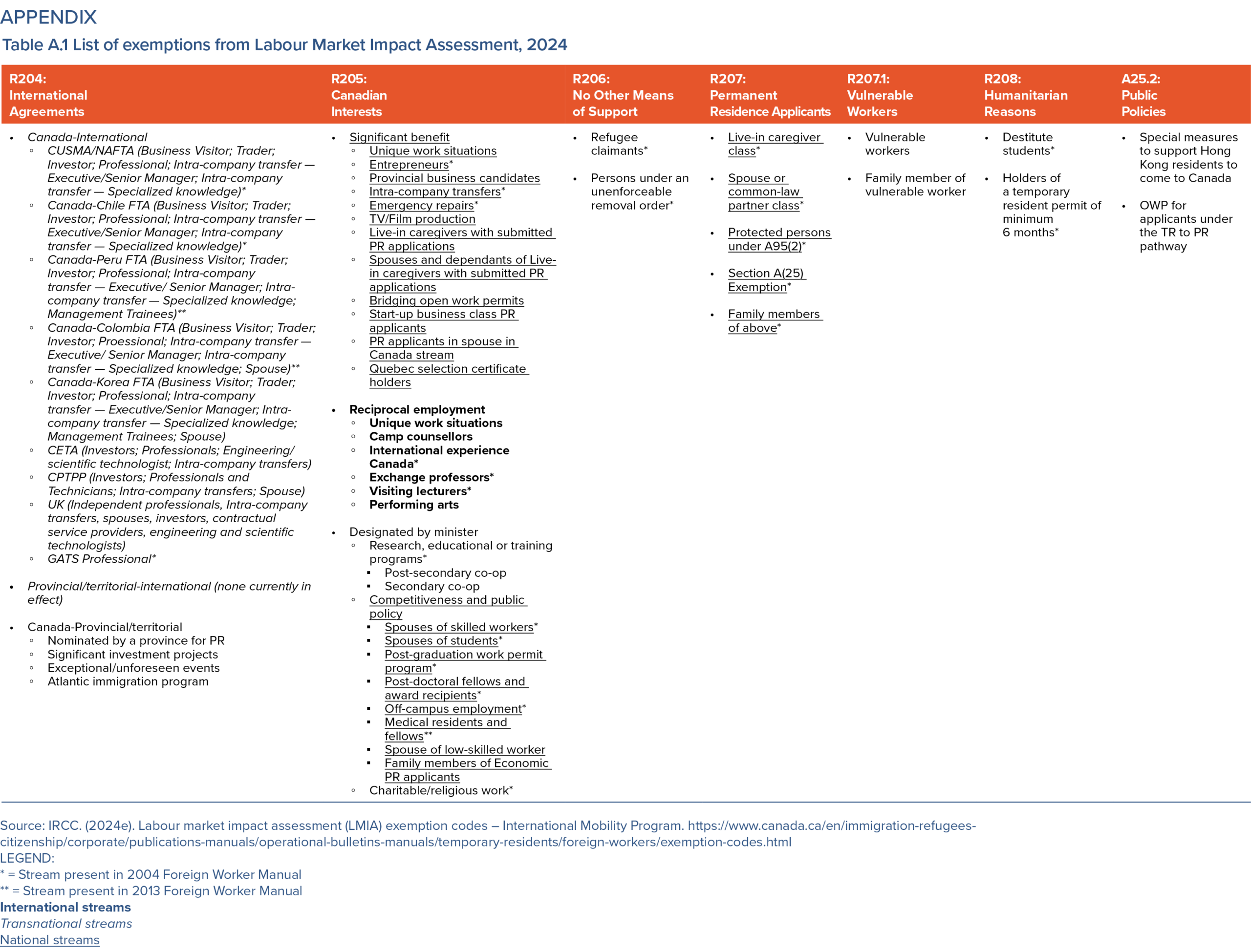
In contrast, the IMP is an umbrella program whose various subprograms are unified by the lack of a requirement for labour market testing. The structure of the IMP includes categories, streams and subprograms, which are organized by LMIA exemption code (see Appendix for a full list of exemptions).2 As figure 2 shows, the IMP’s three overarching categories encompass seven streams, divided further into about 90 subprograms.

IMP subprograms generally involve nominally open work permits, although they may involve de facto restrictions such as those tied to fulfilling criteria for extension (e.g., on type of work or occupation, duration, and place of work). These permits range from one month to seven years — some of which may be extended or renewed. In 2024, 88 per cent of IMP work permits were open, and 12 per cent were employer-specific or closed (Government of Canada, 2025).
The federal government made a number of regulatory changes in 2015 designed to reduce migrant worker mistreatment, including the introduction of a protective regime and inspection system to enforce workplace laws. However, these policies are directed at closed work permit holders, who are generally thought to be more vulnerable. This means that few permit holders under IMP subprograms benefit from these protections (Marsden et al., 2021a, 2021b) even though many IMP permit holders hold precarious jobs.
Some IMP subprograms also offer pathways to permanent residency, a form of two-step immigration (Hou, 2025), although such pathways are narrowing because of policy changes to the post-graduation and spousal work permit programs (as described below).
Despite differences in permit type and duration by IMP category, stream and subprogram, there are certain broad patterns. Numerically, the Canadian interests category dominates the IMP, followed distantly by the agreements category.
The disparity is striking, given that streams under the agreements category reflect the IMP archetype because they are often tied to trade-related reciprocal international agreements3 facilitating entry for business visitors. These visitors are typically traders, investors, professionals, technicians, intra-company transferees of various kinds and, in a small number of cases, spouses of work permit holders who are entering under agreements.4
In contrast, Canadian interests, the largest umbrella category within the IMP, is designed to advance Canada’s economic, social and cultural interests (IRCC, 2025b).
One of the main streams in Canadian interests is the significant benefit stream — affording government flexibility in responding to situations where hiring “foreign national[s] would create or maintain significant social cultural or economic benefits or opportunities for Canadian citizens or permanent residents” (IRCC, 2025c).
At the time of data collection, another major stream was reciprocal employment — enabling “temporary workers to take up employment in Canada when citizens or permanent residents of Canada have similar reciprocal opportunities in countries where the worker is coming from” (IRCC, 2025d). This stream became marginal in 2025 when International experience Canada, the foremost stream under reciprocal employment, and its subprograms, were moved to the agreements category. Because data for 2025 were not yet available at the time of writing, the ensuing analysis considers those subprograms under the Canadian interests category.
A third major stream is competitiveness and public policy, which encompasses subprograms deemed necessary for public policy reasons related to the competitiveness of Canada’s academic institutions or economy, within which the two largest IMP subprograms fall — the post-graduation and spousal work permit programs.
Other, more minor streams include the designated by the minister stream, which encompasses those devoted to educational co-ops, as well as charitable and religious work.
Assessing precarity within the IMP
Many workers migrating under the TFWP, such as those entering via the seasonal agricultural worker program and the agricultural stream, hold precarious jobs and/or experience exploitative conditions of employment (Obokata, 2024; Senate of Canada, 2024).
In comparison, little is known about the job quality of IMP work permit holders.5 It is sometimes assumed that their job quality will be relatively high because the IMP targets people with more formal education and higher levels of socially recognized skills. Looking beyond insecurity of presence (i.e., temporary status) and low income alone, I examine precarity among IMP permit holders by considering three dimensions of labour market (in)security in their main jobs — their degree of control over the labour process, their income level and their access to regulatory protection, as well as indicators of these dimensions (Vosko, 2006, 2010).
Figure 3 tracks the labour force experiences of temporary work permit holders under key IMP categories, streams and subprograms, using data from the Canadian employer and employment dynamics database (CEEDD).6
To explore their degree of control over the labour process, I analyze rates of unionization/professionalization.7 I use firm size as an indicator of access (or lack of access) to minimum terms and conditions of employment because evidence suggests that workers in firms of 20 employees or greater are more likely to see their labour standards enforced than those employed by smaller firms.
Finally, to assess income level, I consider both income from employment8 — the central means of attaining resources required for individual and household subsistence — and multiple jobholding, which indicates inadequate income in a main job.
Because experiencing more than one dimension of labour market insecurity arguably makes a job precarious (Vosko, 2006, 2010), figure 3 also applies a composite variable to IMP permit holders, defining a job as precarious when at least two of the following three indicators are present: no union/professional association, small firm and multiple jobholding, which is a proxy for low income.
Overall, this analysis shows a greater disadvantage for workers migrating under the Canadian interests than the agreements category. A smaller proportion of work permit holders under Canadian interests have high annual employment incomes, compared to the proportion of permit holders under agreements (six per cent vs. 22 per cent), and they are overrepresented in lower-income categories (see figure 3).
A larger proportion (50 per cent) of permit holders enrolled in streams falling under Canadian interests than those under agreements (23 per cent) are also multiple jobholders. Proportions working in small firms are similar under both categories, while only slightly more permit holders under Canadian interests than agreements are unionized. Considering indicators of precarious jobs cumulatively, fully 50 per cent of work permit holders under Canadian interests experience multiple vulnerabilities compared to 37 per cent of those falling under agreements.
Canadian interests
If we compare the Canadian interests category overall to the TFWP, which is intended to fulfil a different function, we see many similarities in degrees of precariousness. Figure 3 illustrates that income distributions are remarkably similar to the TFWP: 48 per cent of Canadian interests permit holders make less than $30,000 per year, compared to 53 per cent of TFWP permit holders. For the $30,000-$50,000 group, the proportions are 28 per cent and 30 per cent, respectively. Unionization percentages are also similar: 79 per cent of Canadian interests permit holders, compared to 85 per cent of TFWP permit holders, are non-unionized. Fewer Canadian interests permit holders are employed in small firms (24 per cent) than TFWP permit holders (34 per cent). In short, labour market insecurity in this category of the IMP closely resembles that of the TFWP permit holders.
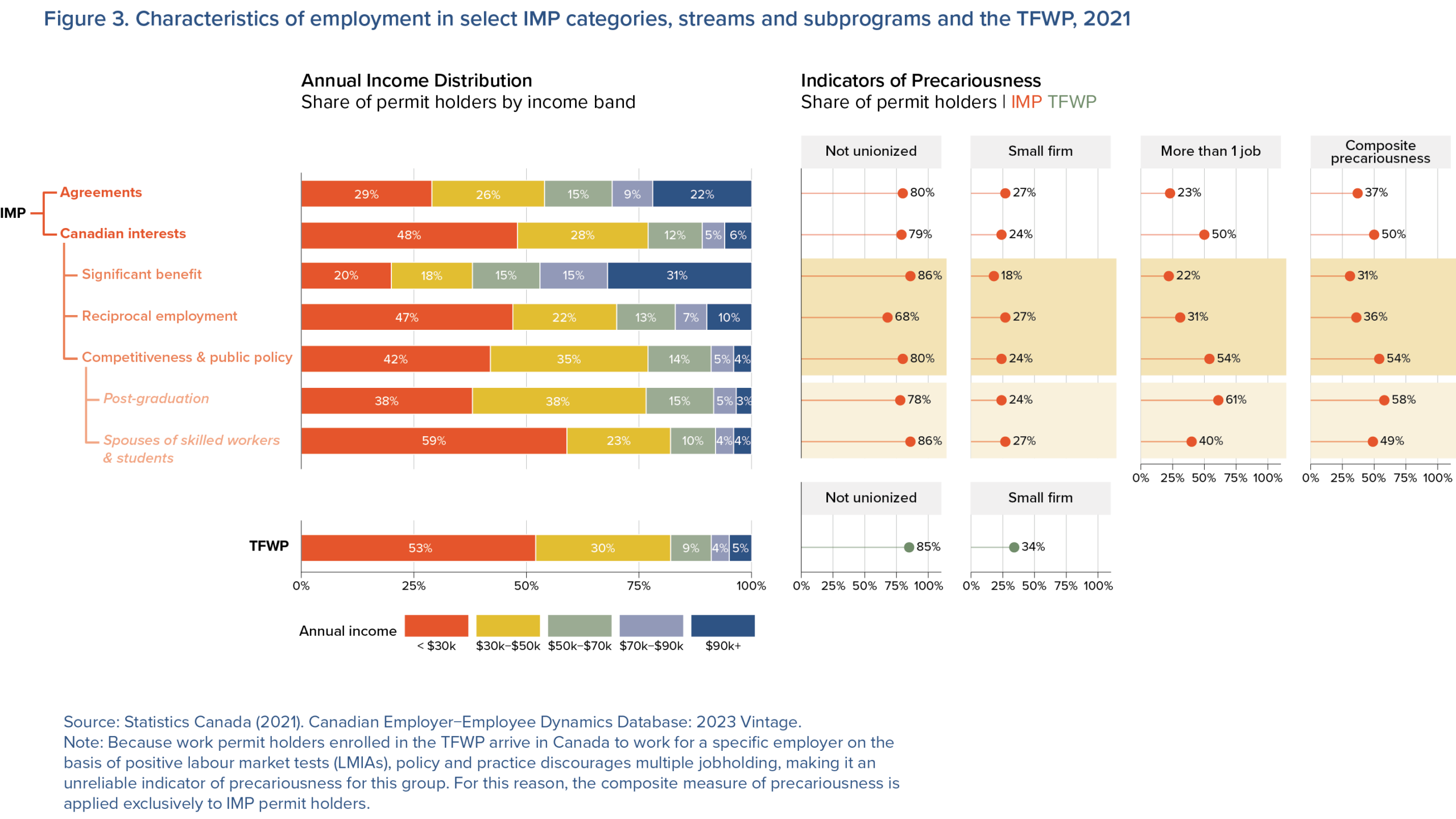
Considering streams within the Canadian interests category, we see differences in employment characteristics. As figure 3 illustrates, rates of unionization/professionalization are higher for reciprocal employment permit holders (32 per cent) compared to other permit holders, such as those migrating under the competitiveness and public policy (20 per cent) or significant benefit (14 per cent) streams, whose rates are more similar to TFWP permit holders (15 per cent).9
While employment at a small firm is consistent across major streams, permit holders under competitiveness and public policy and reciprocal employment also have higher rates of multiple jobholding (54 per cent and 31 per cent, respectively) compared to those under the significant benefits stream (22 per cent). In turn, considerably more permit holders under significant benefits (fully 45 per cent) report relatively high annual employment income ($70,000+) compared to their counterparts under reciprocal employment, and competitiveness and public policy, where only 17 per cent and nine per cent respectively report earnings at this level.
Such income differences are inseparable from industry dynamics.
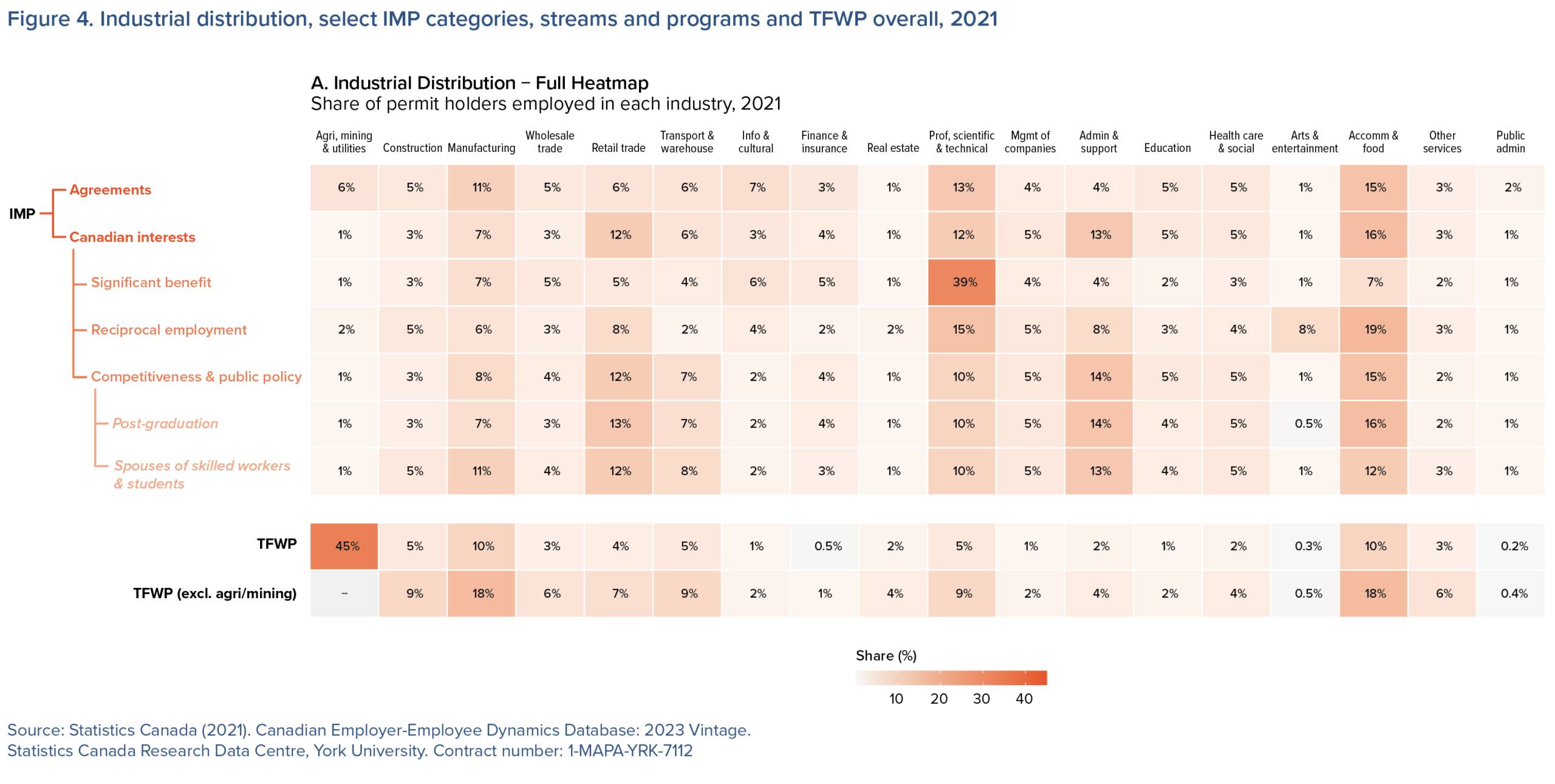
As figure 4a shows, significant benefit permit holders are overrepresented in professional, scientific and technical services, while underrepresented in retail, administration, and food and accommodations services.
Those under the reciprocal employment stream, as well as non-agricultural TFWP permit holders, are overrepresented in food and accommodations services.
Those falling under the competitiveness and public policy stream are overrepresented in retail, as well as administrative and support services — industries associated with high levels of precariousness. The industry distribution of permit holders in competitiveness and public policy is similar in several ways to that of non-agricultural TFWP permit holders, with high proportions employed in accommodation and food services, manufacturing and transport.
However, a markedly higher proportion hold jobs in administrative and support services than in the TFWP, reflecting the relatively higher level of socially recognized skills associated with these IMP permit holders. In short, the IMP streams characterized by relatively lower wages — reciprocal employment, and competitiveness and public policy — are the same streams where workers are overrepresented in more precarious industries. Figure 4b displays the top 5 industries for each categories, streams and programs.
These patterns of industry of employment reveal a disconnect between the formal aims of the streams (i.e., to provide mobility for workers migrating with high levels of education and socially recognized skills) and the positions they hold (i.e., relatively low-wage jobs in industries identified with precariousness). Underlining the risk of overlooking workers in need of protection, the composite variable (figure 3) reveals that 31 per cent of permit holders under the significant benefit stream, 36 per cent of permit holders under the reciprocal employment stream and fully 54 per cent of permit holders under the competitiveness and public policy streams hold precarious jobs: they experience two of the three indicators of labour market insecurity in their main jobs.

Snapshots of Precarity: Post-graduation and Spousal Permit holders’ Labour Force Experiences
The statistical profile above illustrates that Canada’s largest and fast-growing mobility programs create migrant work by another name. As such, many permit holders experience precarity — or the simultaneous experience of labour market insecurity and insecurity of presence — in IMP programs.
The post-graduation and spousal work permit programs, falling under the competitiveness and public policy streams of the Canadian interests category, are the two largest such programs. The 421,380 permit holders enrolled in these programs represented 53 per cent of IMP permit holders in 2023.
Both post-graduation and spousal work permit holders experience precarity through conditionality — specifically, conditions that must be fulfilled to remain in Canada and/or to apply for permanent residency. Post-graduates must fulfil work experience criteria — what I call “probationary precarity.” Meanwhile, spouses must retain their married or common-law status (i.e., to a principal work permit holder) — what I call “relational precarity.”
Post-graduation work permit holders’ probationary precarity
The post-graduation work permit program is Canada’s largest IMP and its premier educational migration program (see Brunner (2025) in this series). It aims to attract highly trained workers with high levels of socially recognized skills, a subset of whom aim to settle in Canada permanently. With changes to the program in 2025, eligibility for graduates of college or diploma programs rests on whether the post-graduate’s field of study falls under designated “eligible fields,” which the federal government updates periodically based on assessed labour shortages (IRCC, 2025b).
It is fuelled on the one hand by Canadian universities’ need to increase direct revenue in response to restricted government funding by attracting international students who can be charged high fees, and on the other hand by students’ larger contributions to the country’s economy. Federal and provincial/territorial governments’ desire to attract and retain such workers from abroad also motivates the program.
Policymakers believe post-graduation permit holders are desirable future immigrants, particularly due to their high levels of educational attainment and age. But while the post-graduation work permit program provides participants with open work permits and can offer pathways to permanent residency, this possibility is conditional. To participate, applicants must first fulfil qualifying criteria as students coming to Canada for non-work purposes, then engage in eligible employment for a sufficient duration over a specified period to gain access to pathways to permanent residency. Finally, they must apply successfully under a suitable immigration scheme.
These migrants thus endure a protracted process, akin to probation (Vosko, 2023), during which they must fulfil a series of educational and subsequent employment requirements to acquire permanent residency. Throughout this trial period — during which their residency status is tenuous — permit holders who wish to remain in Canada must demonstrate their value to the labour force. This leads many to accept employment that is out of sync with their credentials, skills and experience.
I am just waiting for my PR card […] I can’t directly work in the nursing field yet [until I pass my NCLEX and get the hours of nursing work required for licensure] but I can work as [a] PSW (personal support worker) and get paid more than this job. (Permit holder from India)10
Conditions for accessing pathways to permanent residency thus position post-graduation work permit holders for precarious employment along the lines depicted in figure 3. Among those who report earnings, nearly 40 per cent earn extremely low incomes, and another nearly 40 per cent earn relatively low incomes from employment (i.e., less than $30,000 and $30,000 to $50,000 per year, respectively).
I definitely feel we are underpaid because our disposable income is not a lot at the end of the day. I have a full-time salary position … but I am not too far off from minimum wage when I calculate it down to the hours. (Permit holder from Bangladesh)
Earnings are also stratified by country of origin. Particularly high proportions of permit holders from Vietnam (47 per cent), China (46 per cent), Korea (45 per cent) and Bangladesh (42 per cent) earned less than $30,000 in 2021 (Vosko, 2025).
More than half of post-graduation permit holders also hold more than one job. As well, the top three sectoral employers of post-graduation permit holders — accommodation and food services, administrative support and retail trade — are all characterized by high levels of precariousness. Relatedly, these permit holders’ low rates of unionization/professionalization — as shown in figure 3, 78 per cent are non-unionized — reflect a lack of control over the labour process.
Employers … know that you need the hours and the position. They do take advantage of that. (Permit holder from India)
Given their insecure residency status, some participants are hesitant to challenge the status quo at work.
I do feel like we do have rights but … sometimes you are in a position where you cannot really use them … For example, [at] my job, something did happen … there was an incident [of harassment] … I wanted to file a complaint against my employer, but I couldn’t … because it would jeopardize my employment. (Post-graduation permit holder from India)
Spousal work permit holders’ relational precarity
The spousal work permit program provides admission and work permits to partners of certain international students and workers seeking to reside and work in Canada on a temporary basis. Participation is available only to spouses who demonstrate they are in a genuine union (i.e., either a marital relationship or common-law partnership) with a “principal foreign national” (or principal).
Prior to the introduction of new restrictions on spousal work permits in 2025 (IRCC, 2025a), the principal permit holder was required to be a full-time student enrolled in a wide range of programs (encompassing public college/diploma programs and undergraduate and graduate programs) or a skilled worker coming to Canada either under an open or closed work permit or pursuing permanent residency through the Atlantic Immigration Program or a provincial/territorial nominee program. Recent changes have limited spousal accompaniment to a narrower group of students and workers: students enrolled in PhD programs, master’s programs lasting 16 months or more and certain professional programs, and workers employed in TEER11 0 or 1 occupations, or TEER 2 or 3 occupations with labour shortages or linked to government priorities (IRCC, 2024b, 2025a).12
The goal of the program is to support the retention and integration of principal migrants deemed desirable for long-term residence in Canada (IRCC, 2024a). Spousal work permit holders receive open work permits and can accept any employment available in the general labour force. The duration of such permits corresponds to the length of the work permit of the associated principal.
The rationale behind the spousal work permit program resembles the post-graduation work permit program, but with a twist. Spousal permit holders’ access to Canada and its labour market is secondary, conditional upon their current and future relationship with principal permit holders.
We have to apply for everything together in the future … to make sure we can both work and [that] we can stay here. Because … our permits are joined. (Spousal permit holder from Colombia)
While spousal permit holders represent a growing number of transnational workers in the high-income receiving countries in the OECD, they are not typically treated as such. Rather, belying the reality that spousal permit holders’ income is often essential to their households, laws and policies tend to characterize spousal permit holders as dependants pursuing family reunification. Yet, their experiences defy this characterization.
I have to grind hard to provide for him [my partner] because he’s studying and sometimes doesn’t earn as much as I do. (Permit holder and spouse of a student from Uganda)
Because spousal permit holders nominally hold open work permits, they are excluded from protections available to those with closed work permits, such as an expanded workplace enforcement regime. However, their security of presence in Canada is conditional upon remaining in their married or common-law relationships, akin to how migrant workers with closed work permits must retain good relationships with their employers. I dub this “relational precarity.”
Indeed, among spousal work permit holders for whom data are available, the majority earn extremely low or relatively low incomes from employment, even lower than post-graduation permit holders. Nearly 60 per cent of spousal permit holders earn less than $30,000 a year, with another 23 per cent earning $30,000 to $50,000 annually.
When analyzed by gender, the picture is even starker. The share of women holding spousal permits who earn less than $30,000 is 68 per cent, compared to men in the same category (48 per cent). The share of women earning more than $50,000 is exceedingly low (13 per cent, compared to 25 per cent of men). The share of men earning $70,000+ is almost double (11 per cent) compared to women in that category (six per cent) (Vosko, 2025).
As with post-graduation permit holders, spousal permit holders’ income is also stratified by country of origin. The share of spouses making less than $30,000 in 2021 was particularly high for those from China (72 per cent), Korea (71 per cent) and Iran (68 per cent) (Vosko, 2025).
Like their post-graduation counterparts, spousal permit holders tend to work in industries where precarious jobs are the norm and rates of unionization/professionalization are similarly low, with 86 per cent of spousal permit holders in non-unionized/non-professionalized jobs.
When it comes to working in a small firm, both groups also have similar participation rates (24 per cent and 27 per cent respectively). However, spousal work permit holders are less likely than post-graduation work permit holders to hold more than one job, presumably because of their family responsibilities (Lightman, 2024). This lower rate of multiple jobholding leads them to have a lower overall score on the precarity index than post-graduation permit holders, even though spouses’ employment earnings are lower (figure 3).
Conclusions and Policy Recommendations
As public debate mounts over the future of migrant work in Canada, policymakers ought to consider how best to augment conditions of work and security of presence under the TFWP. At the same time, the IMP, which permits the expansion of migrant work by another name, also needs reform. Evidence suggests that large subprograms of the IMP, which target highly educated mobile workers with high levels of socially recognized skills for employment opportunities, and may offer the possibility of permanent residency in Canada, are reproducing problems plaguing the TFWP.
When it comes to employment, permit holders enrolled in mobility programs, including those with open work permits, require the protection of an (already existing) improved federal system designed to enforce workplace laws — specifically, a system expanded to encompass temporary work permit holders of all types and establishing cross-Canada standards that do not defer to provincial inspectors for their enforcement, as the present system is not fulfilling its promise because it is “flawed by design” on both counts (Marsden et al., 2021b).
Toward this end, the federal government should extend its novel 2015 regime, only applying protective measures to closed work permit holders, to cover open work permit holders, and introduce measures, ideally in co-operation with provinces and territories, to ensure that provinces and territories comply with a set of federally-defined standards tailored to the forms of precarity that migrant workers experience alongside provincial/territorial workplace laws.
Another medium-term strategy for addressing the precarity confronting many IMP permit holders involves instituting — as a condition of hiring workers migrating under this umbrella — an across-the-board “precarity premium” on the wages of middle- and low-income IMP permit holders to compensate for the insecurities documented here.
Moving beyond the outmoded distinctions between high-wage and low-wage streams of the TFWP and taking into account the rising cost of living, a wage premium of this sort would help ensure that neither entrants across the IMP’s major categories, streams and subprograms nor entrants under the TFWP are unfairly positioned to fill precarious jobs undesirable to citizens/permanent residents. It would also help counter the narrative that migrant workers are undercutting the wages of citizens/permanent residents.
More broadly, the analysis of post-graduation work permit holders’ labour force experiences calls for the introduction of straightforward, direct routes to permanent residency. Establishing such routes could mitigate skill and education mismatches that result in occupational downgrading, which are evident among permit holders required to engage in full-time employment (or its equivalent) for 12 months in prescribed occupational categories (i.e., TEERs) to apply for permanent residency.
Where spousal work permit holders are concerned, relational precarity must be alleviated. One way of doing so would be to issue free-standing open work permits to spouses upon arrival, which also provide independent routes to permanent residency. Gender equity dictates that, if relationships dissolve, if the work/study permit of the principal permit holder ends, or if the principal permit holder leaves the country or terminates their studies, spousal work permit holders should be able to continue to work and apply for permanent residency.
It is critical to dispel the myth that permit holders under the TFWP and IMP are taking jobs from Canadians. They are filling critically important — indeed essential — yet precarious positions. Eliminating programs under the TFWP would not address the structural dynamics integral to a global economic system that — reflecting and reproducing a global hierarchy of receiving and sending states of migrants — relies on labour markets segmented along the lines of race and gender. Nor would it put an end to qualitative labour shortages in key sectors.
Canada needs a comprehensive approach to strengthening rights and protections for all workers migrating internationally for employment.
Notes
1 This report takes “skill” to be a socially constructed category, referring to “socially recognized skills” to indicate that casting certain occupations as “high-skill” or “low-skill” relates at least partly to socio-economic desirability. Recognizing this construction is especially important because, starting in the 1960s, Canadian (im)migration policies increasingly came to employ “skill” as a filtering mechanism for sorting (im)migrants by entry category. On the significance of skills discourse in immigration policy, see especially Abu-Laban (2024), and also Rajkumar et al. (2012).
2 See also Table 2 in Banerjee’s contribution (2026) to this series, depicting the organizing logics of the high-level categories.
3 However, in 2025, policymakers moved International experience Canada, housing the third-largest IMP subprogram (the working holiday program), which formerly fell under the Canadian interests category, into the agreements category.
4 Reflecting Canada’s trade obligations, the top three source countries of entrants under agreements in 2022 were the United States, Mexico and Colombia. Canada also has a trade agreement with the latter, though its nationals represent a small share of permit holders overall.
5 Banerjee and Lam (2024) provide valuable data on earnings trajectories for various IMP permit holders who obtain permanent residency, though their analysis excludes workers who have not (yet) obtained permanent residency — a central focus in this report.
6 The most recent vintage of the CEEDD is 2023 and contains data from 2021. Hence, the analysis below refers principally to data trends for that year. By that point, the effects of the pandemic on the categories, streams and subprograms of the IMP under consideration herein had dwindled.
7 In the CEEDD, this variable encompasses not only workers covered by a collective agreement but those represented by a professional association, making the variable less robust as a proxy for control than its label suggests but nevertheless valuable to this analysis.
8 Annual employment income is the measure used in this analysis because income is reported only on that basis in the CEEDD. The number of hours worked is not included, making it impossible to measure hourly wages. This indicator nevertheless helps reveal migrant workers’ level of dependency on paid employment.
9 In 2023, intra-company transferees (ICTs) accounted for a substantial proportion of permit holders under the significant benefit stream (18,335 out of 43,165 or 42 per cent) (Vosko, 2025, p. 172). As Tucker (2020) shows, fissuring can affect this group, including in firms employing large numbers of people holding different residency and employment statuses. ICTs can face fissuring in two dimensions: (1) the “fissuring employer responsibility because of a blurring of the lines of legal responsibility between the parent firm and the sending and receiving subsidiaries” (Tucker, 2020, p. 373); and (2) at the level of the workforce in a given firm, whereby workers with several different immigration statuses and types of employment contracts are part of the same workforce, producing “organized disorganization” (Tucker, 2020, p. 373). As such, access to collective representation (i.e., unionization) can be challenging.
10 As mentioned earlier, the material highlighted in the snapshots draws on in-depth interviews with 35 current and former work permit holders.
11 TEER is a Canadian government classification of the level of training, education, experience and responsibilities required for specific occupations based on the 2021 national occupational classification.
12 A detailed list is available at: https://www.canada.ca/en/immigration-refugees-citizenship/news/notices/changes-open-work-permits-family-members-temporary-residents.html
References
Abu-Laban, Y. (2024). Middle class nation building through a tenacious discourse on skills: Immigration and Canada. Journal of Ethnic and Migration Studies, 50(7), 1803-1821. https://doi.org/10.1080/1369183X.2024.2315357
Banerjee, R. (2026). Not all immigration paths are equal: Some immigrants thrive, others struggle, in Canada’s two-step system (Policy brief). Institute for Research on Public Policy.
Banerjee, R., & Lam, L. (2024). Paths to permanence: Permit categories and earnings trajectories of workers in Canada’s international mobility program. Canadian Public Policy, 50(S1), 143-160. https://doi.org/10.3138/cpp.2023-062
Brunner, L. R. (2025, October). Canadian international student policy at a crossroads (Policy brief
no. 1). Institute for Research on Public Policy.
Chartrand, T., & Vosko, L. F. (2021). Canada’s temporary foreign worker and international mobility programs: Charting change and continuity among source countries. International Migration, 59(2), 89-109. https://doi.org/10.1111/imig.12762
DeRosa, K. (2025, September 5). B.C. premier wants temporary foreign worker program cancelled or reformed. CBC News. https://www.cbc.ca/news/canada/british-columbia/b-c-premier-wants-temporary-foreign-worker-program-to-be-cancelled-or-reformed-1.7625804
Employment and Social Development Canada (ESDC). (2014). Overhauling the temporary foreign worker program. Government of Canada. https://www.canada.ca/en/employment-social-development/services/foreign-workers/reports/overhaul.html
Government of Canada. (2025). Temporary workers – Ministerial transition binder 2025. Immigration, Refugees and Citizenship Canada. https://www.canada.ca/en/immigration-refugees-citizenship/corporate/transparency/transition-binders/minister-2025-05/temporary-workers.html
Hou, F. (2025). From temporary to permanent residency (Data brief no. 3). Institute for Research on Public Policy.
Hua, C. (2025, September 6). B.C. industry leaders react to calls to scrap temporary foreign worker program. CityNews. https://vancouver.citynews.ca/2025/09/06/bc-temporary-foreign-worker-program-industry-reacts/
Human Resources, Skills and Social Development and the Status of Persons with Disabilities, Standing Committee on (HUMA). (2016, May 11). Evidence, 1st Session, 42nd Parliament, 11 May 2016, 1615 (Paul Thompson, Senior Assistant Deputy Minister, Skills and Employment Branch, ESDC). As cited in https://www.ourcommons.ca/DocumentViewer/en/42-1/huma/report-4/page-21#_ftn7
Immigration, Refugees and Citizenship Canada (IRCC). (2021). CR-21-0358: Canada — Work permit holders by program, country of citizenship and year in which permit(s) became effective, 2002 — March 31, 2021 [Customized data request].
Immigration, Refugees and Citizenship Canada (IRCC). (2023a). CR-23-0177: Canada — Work permit holders by permit holder type and year in which permit(s) became effective, 2021-2022 [Customized data request].
Immigration, Refugees and Citizenship Canada (IRCC). (2023b). Overview of work designated by the Minister [R205(c)(ii) – C41, C42, C44, C45, C46, C47, C48, C49, C52] – Canadian interest – International mobility program. Government of Canada. https://www.canada.ca/en/immigration-refugees-citizenship/corporate/publications-manuals/operational-bulletins-manuals/temporary-residents/foreign-workers/exemption-codes/public-policy-competitiveness-economy.html
Immigration, Refugees and Citizenship Canada (IRCC). (2024a). Spouses and common-law partners of study permit holders – [R205(c)(ii) – C42]– Canadian interest – International mobility program. Government of Canada. https://www.canada.ca/en/immigration-refugees-citizenship/corporate/publications-manuals/operational-bulletins-manuals/temporary-residents/foreign-workers/public-policy-competitiveness-economy/c42.html
Immigration, Refugees and Citizenship Canada (IRCC). (2024b, January 22). Canada to stabilize growth and decrease number of new international student permits issued to approximately 360,000 for 2024 [Press release]. Government of Canada.
https://www.canada.ca/en/immigration-refugees-citizenship/news/2024/01/canada-to-stabilize-growth-and-decrease-number-of-new-international-student-permits-issued-to-approximately-360000-for-2024.html
Immigration, Refugees and Citizenship Canada (IRCC). (2024c). CR 24-0318: Canada — Work permit holders by program, country of citizenship and year in which Permit(s) became effective, 2023 [Customized data request].
Immigration, Refugees and Citizenship Canada (IRCC). (2024d). Canada — Temporary foreign worker program (TFWP) work permit holders on December 31st by province/territory of intended destination and program, 2000 – 2024 Spreadsheet. https://www.ircc.canada.ca/opendata-donneesouvertes/data/EN_ODP_annual-TR-work-TFW_PT_program_year_end.xlsx
Immigration, Refugees and Citizenship Canada (IRCC). (2024e). Labour market impact assessment (LMIA) exemption codes – International Mobility Program. https://www.canada.ca/en/immigration-refugees-citizenship/corporate/publications-manuals/operational-bulletins-manuals/temporary-residents/foreign-workers/exemption-codes.html
Immigration, Refugees and Citizenship Canada (IRCC). (2025a). Changes to open work permits for family members of temporary residents. Government of Canada. https://www.canada.ca/en/immigration-refugees-citizenship/news/notices/changes-open-work-permits-family-members-temporary-residents.html#:~:text=Effective%20January%2021%2C%202025%2C%20only,apply%20for%20a%20family%20OWP.&text=These%20include%20occupations%20in%20the,education%2C%20sports%20and%20military%20sectors
Immigration, Refugees and Citizenship Canada (IRCC). (2025b). Field of study requirement. Government of Canada. https://www.canada.ca/en/immigration-refugees-citizenship/services/study-canada/work/after-graduation/eligibility/field-of-study.html
Immigration, Refugees and Citizenship Canada (IRCC). (2025c). Significant benefit to Canada [R205(a) – C10] – Canadian interests – International Mobility Program. [Program descriptions]. Government of Canada. https://www.canada.ca/en/immigration-refugees-citizenship/corporate/publications-manuals/operational-bulletins-manuals/temporary-residents/foreign-workers/exemption-codes/canadian-interests-significant-benefit-general-guidelines-r205-c10.html
Immigration, Refugees and Citizenship Canada (IRCC). (2025d). Reciprocal employment general guidelines [R205(b) – C20] – Canadian interests – International Mobility Program. [Program descriptions]. Government of Canada. https://www.canada.ca/en/immigration-refugees-citizenship/corporate/publications-manuals/operational-bulletins-manuals/temporary-residents/foreign-workers/exemption-codes/canadian-interests-reciprocal-employment-general-guidelines-r205-b-c20.html
Lightman, N. (2024). The high costs of caring: Measuring the prevalence and consequences of birth-related career interruptions for immigrant care workers in Canada. Canadian Public Policy, 50(1), 38-50.
Marsden, S., Tucker, E., & Vosko, L. F. (2021a). The trilemma of Canadian migrant worker policy. In C. Dauvergne (Ed.), Research handbook on the law and politics of migration (pp. 63-81). Edward Elgar Press.
Marsden, S., Tucker, E., & Vosko, L. F. (2021b). Flawed by design: A case study of federal enforcement of migrant workers’ labour rights in Canada. Canadian Labour and Employment Law Journal, 3(1), 71-102.
Obokata, T. (2024). Report of the special rapporteur on contemporary forms of slavery, including its causes and consequences. United Nations. https://documents.un.org/doc/undoc/gen/g24/120/97/pdf/g2412097.pdf
Pellerin, H. (2008). Governing labour migration in the era of GATS: The growing influence of lex mercatoria. In H. Pellerin & C. Gabriel (Eds.), Governing international labour migration: Current issues, challenges and dilemmas. Routledge. https://doi.org/10.4324/9780203564479
Pellerin, H. (2017). States and the management of the international mobility of highly skilled labour in the age of neoliberalism. International Journal of Migration and Border Studies, 3(4), 352-367. https://doi.org/10.1504/IJMBS.2017.086979
Rajkumar, D., Berkowitz, L., Vosko, L. F., Preston, V., & Latham, R. (2012). At the temporary-permanent divide: How Canada produces temporariness and makes citizens through its security, work, and settlement policies. Citizenship Studies, 16(3-4), 483-510. https://doi.org/10.1080/13621025.2012.683262
Senate of Canada. (2024, May). Act now: Solutions for temporary and migrant labour in Canada. Report of the Standing Senate Committee on Social Affairs, Science and Technology. https://sencanada.ca/content/sen/committee/441/SOCI/reports/2024-10-24_SOCI_Migrant_Report_e.pdf
Statistics Canada. (2021). Canadian employer-employee dynamics database: 2023 vintage. Government of Canada. https://www23.statcan.gc.ca/imdb/p2SV.pl?Function=getSurvey&SDDS=5228
Tucker, E. (2020). Migrant workers and fissured workforces: CS Wind and the dilemmas of organizing intra-company transfers in Canada. Economic and Industrial Democracy, 41(2), 372-396.
Vosko, L. F. (2006). Precarious employment: Understanding labour market insecurity in Canada. McGill-Queen’s Press.
Vosko, L. F. (2010). Managing the margins: Gender, citizenship, and the international regulation of precarious employment. Oxford University Press.
Vosko, L. F. (2023) Probationary precarity? Differential inclusion among post-graduation work permit-holders in Canada. International Migration, 63(1), Article e13152.
Vosko, L. F. (2025). Migrant work by another name: Differential inclusion and precarity in Canada’s international mobility program. University of Toronto Press.
Vosko, L. F., & the Closing the Enforcement Gap Research Group. (2020). Closing the enforcement gap: Improving employment standards protections for people in precarious jobs. University of Toronto Press.
Zimonjic, P. (2025, September 3). Poilievre calls for temporary foreign worker program to be scrapped. CBC News. https://www.cbc.ca/news/politics/poilievre-wants-temporary-foreign-worker-program-scrapped-1.7623864
This Report was published as part of the Canada’s Changing Immigration Landscape series from the Centre of Excellence on the Canadian Federation. The manuscript was copy-edited by Jim Sheppard, proofread by Zofia Laubitz, editorial co-ordination was by Étienne Tremblay, and production and art direction was by Anne Tremblay.
Canada’s Changing Immigration Landscape is a partnership between the Centre of Excellence on the Canadian Federation at the IRPP, the Institute for Research on Migration and Society at Concordia University (IRMS) and the Centre for Migration Studies at the University of British Columbia (CMS). All publications are under the direction of Charles Breton, Executive Director of the Centre of Excellence on the Canadian Federation, Mireille Paquet, Director of IRMS, and Irene Bloemraad, Co-director of CMS.
Dr. Leah F. Vosko, FRSC, is Distinguished Research Professor of Political Economy in the Department of Politics at York University. Her current research examines international mobility programs, deportability among workers labouring transnationally, and employment standards enforcement. Vosko’s most recent authored books include Migrant Work by Another Name: Differential Inclusion and Precarity under Canada’s International Mobility Program (University of Toronto Press, 2025), Transnational Employment Strain in a Global Health Pandemic: Migrant Farmworkers in Canada (with T. Basok and C. Spring, Palgrave, 2023), Closing the Enforcement Gap: Improving Employment Standards Protections for People in Precarious Jobs (with the Closing the Enforcement Gap Research Group, University of Toronto Press, 2020), and Disrupting Deportability: Transnational Workers Organize (Cornell/ILR Press, 2019).
A French translation of this text is available under the title Qu’en est-il du travail temporaire des migrants ? Inclusion différentielle et précarité dans le Programme de mobilité internationale du Canada.
To cite this document: Vosko, L. F. (2026). Whither temporary migrant work? Differential inclusion and precarity in Canada’s International Mobility Program. Institute for Research on Public Policy. https://doi.org/10.26070/kjfm-zg60
Acknowledgments
This Report extends findings from the author’s book Migrant Work by Another Name: Differential Inclusion and Precarity Under Canada’s International Mobility Program (2025). Most of the administrative data cited runs through 2023, although the discussion refers to 2024 where comparable data are available. The material highlighted in the snapshots of the Post-graduation and Spousal Work Permit Programs draws on in-depth interviews with 35 current and former work permit holders conducted for the project yielding the book. The author wishes to thank research assistants and trainees supporting the larger endeavour, especially Tim Gadanidis, Shreya Ghimire and Seulsam Lee, who encouraged her to expand upon and update some of the book’s findings, as well as Irene Bloemraad and Linda Bucay Harari for their editorial suggestions, and the SSHRC Partnership Grant Program for its support in taking this research to the next stage.