

A Call for Coherence: Variation in Recent Legislative Approaches to Remedy Internal Trade Barriers

 |
Barriers and Bridges: Rethinking Trade Within the Federation |
| Interprovincial trade opens up new possibilities for the economic future of the federation. This series provides an overview of recent changes in trade between Canadian provinces, analyzes the challenges for the country’s economy, and offers concrete proposals to help Canada achieve its ambitions. |
INTRODUCTION
U.S. President Donald Trump’s tariff belligerence at the start of 2025 set off a maelstrom of interprovincial trade reform initiatives in Canada. Just as Canadian Confederation was spurred on by American cancellation of an early Canada-U.S. free trade agreement in 1866, Trump’s trade posture has catalyzed a flurry of changes to the fabric of our internal market that have long been talked about in policy circles, but which could never garner sufficient attention from and consensus amongst First Ministers.
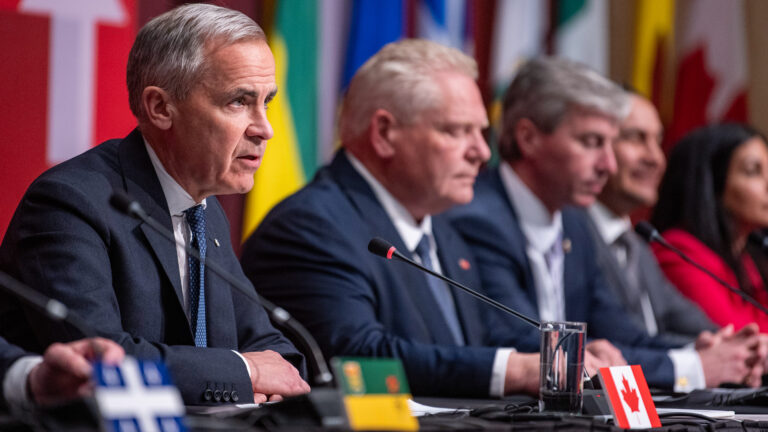
A file that would ordinarily proceed at a snail’s pace has gained unprecedented attention, essentially overnight. By mid-year, Canadians became accustomed to seeing images of their premiers inking domestic trade agreements as if they were heads of nations, not subnational leaders within a single federation. Although some of the achievements have been more performative than others, it is clear that Canada’s federal, provincial and territorial (FPT) governments are seizing the moment. In particular, the passage of legislation in certain capitals across the country, enshrining the concept of “mutual recognition,” has substantial prosperity-inducing potential. The new laws (some more than others) bear certain hallmarks of gold-standard mutual recognition frameworks. Moreover, the mandate of provincial regulators to make mutual recognition happen is clearer than ever before. We can look to 70 years worth of experience, from Australia’s internal market reforms of the early 1990s to the European common market, to learn that the thoughtful implementation of mutual recognition can yield prosperity (Manucha, 2025).
However, in characteristic Canadian style, Canada’s governments have gone about their legislative projects in non-uniform, patchwork fashion. Canada is a federation, with its provinces offering laboratories for policy experimentation. With that said, Canada’s internal trade leaders must remain cognizant of the growing discrepancies and appreciate the risks that come with embarking on this change in a non-harmonized fashion. A lack of alignment will confuse businesses and workers. Fragmented approaches reinforce (or even aggravate) the very source of the barriers: the patchwork nature of the Canadian regulatory landscape. It is bad enough that one must disentangle an increasingly complex web of laws from a single province to comprehend that province’s legislative framework for internal trade. Then looms the threat of up to 14 different variations on a theme.
This piece seeks to unpack the deluge of internal trade legislation (some of which pre-dates Trump 2.0), in hopes of charting a coherent path forward for the implementation of mutual recognition. To do so, it proposes a comparative framework, grounded in key axes such as scope and reporting requirements, axes that are in line with the pursuit of mutual recognition within a federation. Canada is living through an unprecedented opportunity to renew its economic union for the years and decades to come, and the effective implementation of mutual recognition is key to this goal.
Novel Internal Trade Legislation Enshrining “Mutual Recognition”
On New Year’s Eve, 2024, few if any within Canada’s internal trade policy community could have predicted a wave of internal trade legislation across the country enshrining the principle of “mutual recognition.” Canadian governments had been squabbling about how best to go about it for the better part of half a decade (Manucha, 2025). Alberta had shown one way to operationalize mutual recognition for labour with its 2021 Labour Mobility Act, but other First Ministers had not been listening. Trump changed everything.
What is mutual recognition? In its simplest form: if a good, service or worker is certified in Province A, that should be good enough for Province B. This is not the first time in recent years that Canada’s governments have attempted to legislate their way to a more robust economic union. On internal labour mobility, for instance, an earlier wave of legislation among some Canadian governments came in 2009/2010. It failed to move the needle — not a terrible shocker. In the late 1990s, Canada’s first ministers had agreed to eliminate mobility barriers by July 1, 2001, and yet here we are (Knox, 2010).
Many Legislative Initiatives Lack Core Features for Effective Mutual Recognition
Mutual recognition is a culture, not a policy; this is getting overlooked in the current wave of legislation. Mutual recognition relies on mutual trust among regulators. Officials in Province A need to build comfort and reassurance with how gas fitters are licensed in Province B. This takes time and only comes from repeated inter-regulator dialogue and information exchange.
With the notable exception of Alberta, legislative approaches have almost entirely lacked trust-building mechanisms such as inter-regulator notification and reason-giving obligations. Most also lack clear annual reporting obligations imposed on regulators. Without reporting, it will be impossible to monitor the implementation and success of mutual recognition frameworks. More concretely, if a regulator curtails or denies mutual recognition, it should be obliged to notify both the applicant and their home regulator and supply reasons for the decision. On an annual basis, the regulator should be required to report key metrics to help auditors determine how well the regulator is effectuating mutual recognition.
A Chronology of Recent Labour Mobility-Enhancing Legislation
A first wave of legislation in the late 2000s
Throughout 2009 and 2010, a number of provinces and Yukon passed labour mobility-enhancing legislation. It was prompted by a 2009 revision of the labour mobility chapter of the Agreement on Internal Trade (AIT; the Canadian Free Trade Agreement’s predecessor) by Canada’s governments. The amendment had more clearly positioned mutual recognition as the default governing principle for professions and trades (Knox, 2010). As the AIT was merely a political agreement, pairing it with legislation was meant to help effectuate the amendment’s objectives.
These labour mobility acts, though they had good intentions, lacked much of the ambition, detailed procedure and necessary obligations to materially enhance worker mobility by way of mutual recognition. For example, none included a service-day standard (i.e., clear timelines within which regulatory authorities had to make mutual recognition determinations). Moreover, none made clear how a regulator was expected to implement mutual recognition: there was no guidance on how a regulator was to evaluate whether an incoming worker’s credentials were equivalent or comparable to domestic standards and thus warranting recognition. Finally, the entire batch lacked many of the hallmarks of robust mutual recognition measures such as notification requirements, reason-giving obligations and reporting mandates.
Indirect impacts of Fair Registration Practices legislation
Another category of legislation enhancing internal labour mobility are the several Fair Registration Practices acts that have been passed across the country. These are statutes that deal with how professional regulatory bodies license new members. Quebec arguably came first in 1973 with its Professional Code C-26. Ontario passed its Fair Access to Regulated Professions and Compulsory Trades Act in 2006, and several other provinces soon followed as part of a “first wave” (Manitoba in 2007, Nova Scotia in 2008). The core objective of this legislation was less about opening up internal labour markets, and more about enhancing provincial oversight over professional regulatory bodies, and (perhaps more significantly) smoothing the pathway for internationally trained labour to become licensed in Canada.
Alberta an early leader on supercharged mutual recognition legislation
Before jumping to the wave of FPT internal trade legislation that has arisen since President Trump’s inauguration, it is important to discuss Alberta, its pre-Trump 2.0 leadership on internal trade and its 2021 Labour Mobility Act. Alberta’s early and significant innovation is getting overlooked in current discussions, which primarily focus on developments since January 2025.
Mutual recognition as a tool to remedy Canada’s internal trade barrier has long been understood in internal trade policy circles. When the original AIT came into force in 1995, “mutual recognition” was already an explicit means to resolve trade barriers. But Canadian governments have long struggled to broadly activate mutual recognition.
Jason Kenney, the former federal minister and premier of Alberta, played a key role in elevating mutual recognition as a practical solution for both internal trade barriers and labour mobility in particular, and has been consistent in his backing of mutual recognition. In a 2011 speech to the Calgary Chamber of Commerce, Kenney (at that time a federal cabinet minister) stated that “[i]t shouldn’t require a dentist, moving from BC to Alberta, three years to get trained to practice” (Government of Canada, 2011). He went on to call for a “streamlined, common, fast process for considering credential recognition.”
As premier, Kenney continued to advocate for mutual recognition. At a 2019 meeting of the premiers in Saskatoon, Kenney advanced to his fellow first ministers that, if there was no mutual recognition agreement amongst the provinces in place soon, Alberta would go it alone and mutually recognize credentials from elsewhere in Canada (Tombe, 2019). And indeed, in the face of limited buy-in from elsewhere in Canada, then-Premier Kenney tabled Bill 49 in 2021 (Joannou, 2021). This Labour Mobility Act was far more sophisticated than any of the provincial labour mobility acts from the 2009-10 wave. Alberta’s was the first broad-based legislative approach to the mutual recognition of worker credentials from elsewhere in Canada. It is a remarkable framework, especially given that it predates the current Trump 2.0-inspired hype around internal trade reform. It is procedurally rigorous and ambitiously demanding of provincial regulators to recognize the credentials of workers from elsewhere in Canada in a timely and transparent fashion. For example, it calls for decisions within 20 days, and reasons for decisions within 10 days thereafter.
Even though Alberta’s legislative approach predates the start of Trump 2.0, Alberta’s Labour Mobility Act must be considered part of the latest wave of FPT legislative initiatives; it is of similar ambition and intent. Alberta deserves to be recognized as an early mover on the internal trade file.
Saskatchewan joins Alberta’s pre-Trump 2.0 labour mobility-enhancing agenda
Saskatchewan should be given some of the same credit for advancing trade-liberalizing legislation prior to Trump 2.0. In the spring of 2022, Premier Scott Moe’s government introduced the Labour Mobility and Fair Registration Practices Act. Like Alberta’s legislation, introduced only six months before, it aids in operationalizing mutual recognition. With that said, Alberta’s legislation is undeniably superior in terms of implementing mutual recognition for labour: it goes much further than Saskatchewan’s in creating a clear, methodical and robust framework for professional regulatory bodies to follow.
Nova Scotia kickstarts new momentum for a legislative approach
Nova Scotia Premier Tim Houston introduced Bill 36, the Free Trade and Mobility within Canada Act, on February 25, 2025. This bill was the first of those introduced in the wake of Trump 2.0’s tariff onslaught in early 2025. Among the legislation that would soon follow, Prince Edward Island’s in particular closely reflects the Nova Scotia act. Nova Scotia’s legislation and initiative was widely cited as game-changing and yielded much praise for Premier Tim Houston and the province more generally (Campbell, 2025).
In the weeks and months following the introduction of Nova Scotia’s Bill 36, several provinces and the federal government followed suit with net-new legislation or amendments to existing legislation. For the purposes of this paper’s assessment of emergent variation in the approaches, both pathways may be considered legislative initiatives to improve internal trade.
Table 1 provides a listing of recent legislative initiatives to remedy internal trade, ordered by date of introduction.
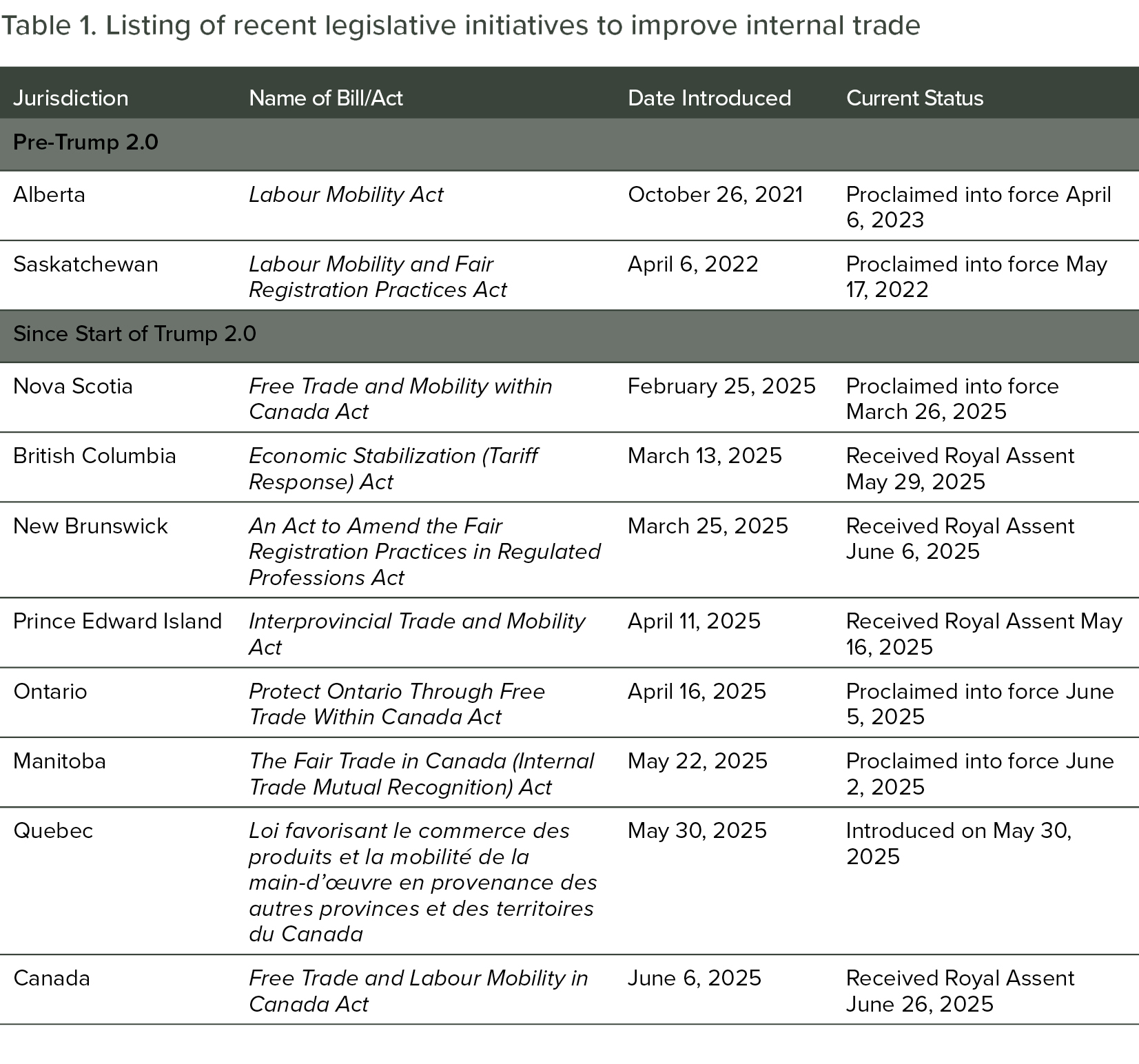
A few notes about this table — first, not all the legislation listed is equally ambitious. Second, Newfoundland and Labrador and the territories are absent as they have not introduced any new legislative initiatives since Trump 2.0. Third, with regard to New Brunswick: almost all provinces (including Newfoundland and Labrador) have a Fair Registration Practices act. But what distinguishes New Brunswick, and allows it to be credited and added to the table, is the extent of and discipline heralded by its recent amendments which introduce an Australia-style “automatic deemed recognition” model. Under this approach, labour mobility applicants are presumed able to practice after notifying the relevant New Brunswick regulator, even before the regulator makes a final determination.
Emergent Variation in Legislative Initiatives
No two FPT legislative initiatives are identical. And when recent FPT legislation is considered in tandem with pre-existing FPT internal trade legislation, no two legislative frameworks are identical in their totality either.
At this point, a few illustrative examples are helpful to show how recent legislative initiatives vary. For instance, Nova Scotia’s addresses both goods and labour, while New Brunswick’s only addresses labour. As another example of variation, not all provinces have identified an explicit timeline for professional regulatory bodies to respond to requests for credential recognition. And among those that have, the timelines range from 10 business days (Nova Scotia, P.E.I. and Ontario in some cases) to 30 calendar days (ON in some cases) to 20 business days (Alberta). As yet another example of variation, some provinces condition mutual recognition on reciprocity (Nova Scotia, P.E.I., Ontario and Manitoba) while others do not.
It is worthwhile noting that, as of the time of writing, regulations are still forthcoming. Alignment (or lack thereof) on accompanying regulations could aggravate or soften the legislative variation.
Why should we care about emergent variation?
To understand why Canada’s governments must rein in the emergent variation among legislative approaches, we must remind ourselves of the very problem they were meant to solve: Canada’s patchwork regulatory landscape, which drives up the cost of transacting across internal frontiers.
Canada no longer has customs officers at domestic crossings, monitoring the passage of goods and levying tariffs on blueberries moving from Nova Scotia to New Brunswick. Rather, internal trade barriers come from the regulatory discrepancies between jurisdictions. Additionally, many are often stuck thinking about barriers in binary terms, where it is only a barrier if the regulation makes the transaction impossible. For instance, an Ontarian consumer of wine cannot presently order a bottle of his favourite Tidal Bay directly from a Nova Scotia winery, and yet he can do so from a Niagara-based vineyard.[1] But internal trade barriers are rarely that stark. More often they are regulatory differences that introduce a degree of friction (large or small) to a transaction between buyer and seller for a good, labour or service. The regulator-induced friction then impacts a buyer’s willingness to purchase, or a seller’s willingness to supply. Whether it takes a small engineering firm 0, 10, 30 or 180 days to get its team re-credentialed for a prospective project in another province, the firm’s willingness to bid and take on the work will degrade as the timeline expands, effectively creating a barrier to trade of greater size.
Regulatory differentials are easier for a large business to navigate. The differences may even offer a protective moat against smaller or mid-sized competitors who do not have the same resources to stickhandle differences. An example of this is the absence of a federal excise tax stamp for cannabis products. In the ordinary course of business, a small-time B.C. producer may package goods for Ontario. As it commonly happens, the Ontarian may cancel or trim their order, or a surge in orders from Nova Scotia may require the B.C. producer to reallocate product from the Ontario-bound shipment to the Nova Scotia bound shipment. That producer must physically scrape off the Ontario stamp, glue it back together, show it to a CRA auditor and then destroy it in a fire. This is a highly inefficient process that advantages the larger producers who have the cash flow to support the scraping and burning.
Regulatory differences reduce Canada’s overall competitive intensity, worsen the option set for consumers of goods/services/labour, and restrain the positive forces of competition. Frictions to transact coming from unjustifiable regulatory differences are the very problem that mutual recognition seeks to solve. To help materially manage the trade barriers resulting from these differences, Canada’s governments are operationalizing mutual recognition by way of legislation.
This brings us to a core tension: the recent, novel legislative means of managing regulatory variation is itself varied among Canada’s governments. The lack of alignment risks harming the very goals of the intense work underway across Canada. Why is this the case? For workers and businesses wishing to avail themselves of the benefits of mutual recognition, they must study and appreciate the relevant government’s unique limitations, timelines, processes and exceptions to mutual recognition. The expectations of would-be mutual recognition beneficiaries will necessarily vary depending on the province or province-pair, giving “mutual recognition” an amorphous meaning.
Perhaps even more importantly, FPT regulatory authorities expected to operationalize mutual recognition obligations for the benefit of workers and businesses are less likely to treat inbound workers consistently and are less able to rely on assessments of equivalence or comparability from other jurisdictions. It dampens the prospect and benefits of both cross-jurisdictional inter-regulator collaboration and the strengthening of inter-regulator trust. A widely understood benefit of mutual recognition is the inter-regulator dialogue and trust-building that it engenders, often yielding to harmonization over time (Janssens, 2013). If regulators are being guided to implement mutual recognition differently, it is far harder to inculcate these inter-regulator linkages.
Australia’s governments operationalize mutual recognition by way of a single mirroring piece of legislation, and mutual recognition within the European Union is activated by measures instituted by the EU’s central legislative bodies. Both models offer a unified simplicity that the fractured terrain of the Canadian FPT approaches do not.
Without concerted thoughtfulness, the variability in legislative approaches will compound over time. Nearly 20 years after the introduction of Australia’s own (singular) mutual recognition law, there were still ongoing reasons to amend the legislation (Productivity Commission, 2009). This will undoubtedly also be true for FPT legislation.
The Core Aspects of FPT Legislative Variation: An Evaluative Framework
In order to determine how recent legislative initiatives by Canada’s various governments compare with one another, we must first establish a framework to conduct this exercise. This paper proposes a comparative framework grounded in key axes that are acutely relevant to the pursuit of mutual recognition within a federation.
The axes in brief:
1. Scope
a. Goods, workers, services
b. Mobility: worker-level vs. services-level
c. Unilateral vs. reciprocal
d. Relationship of new legislation with existing home legislation
2. Definition of “equivalent”
3. Models of recognition
4. Response times
5. Permanent vs. temporary applicants
6. Notification and reason-giving
7. Reporting requirements
Scope
(a) Goods, workers, services
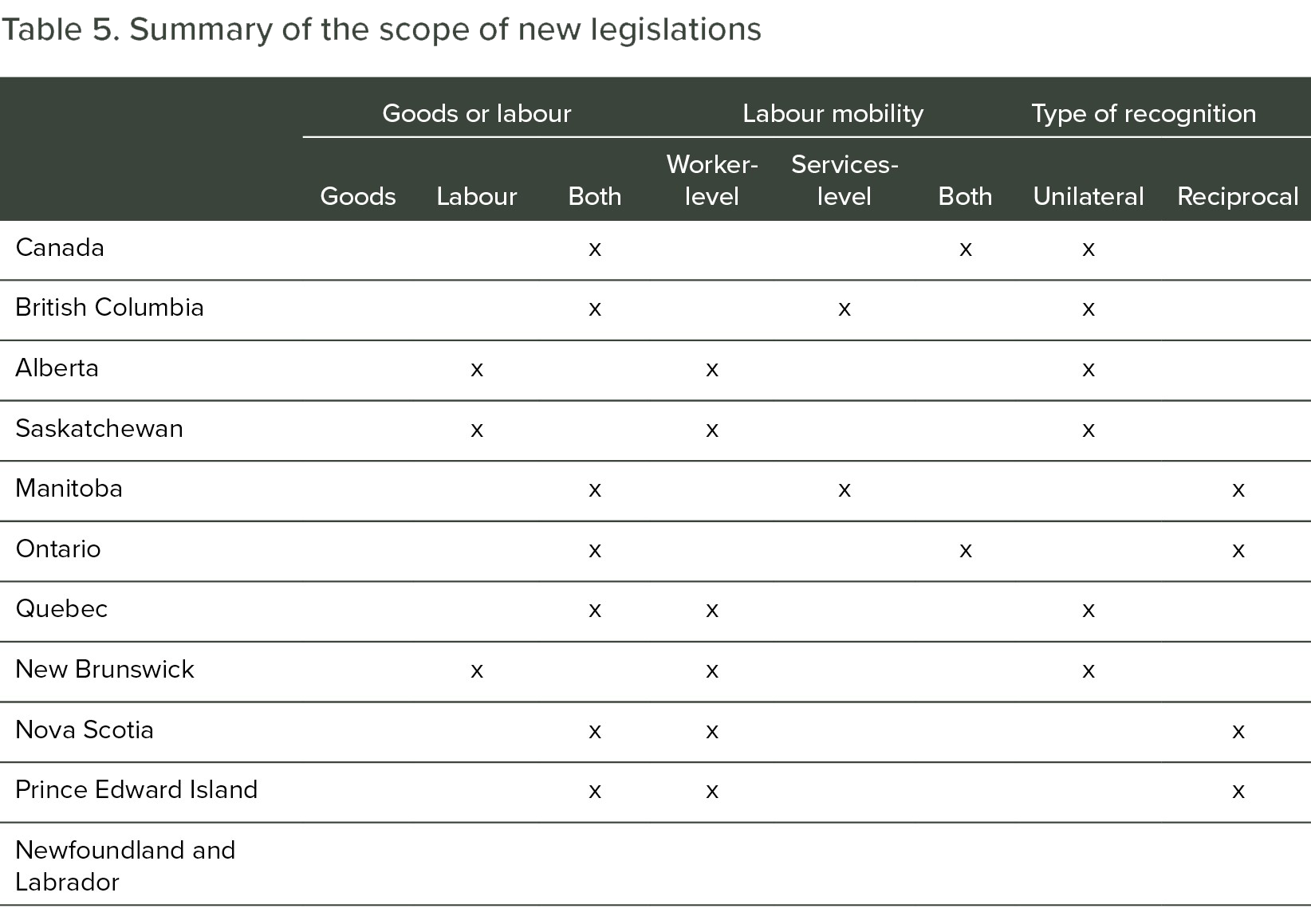
Not all recent legislative initiatives have the same coverage. B.C., Manitoba, Ontario, Quebec, Nova Scotia, P.E.I. and the federal government all cover the mobility of goods and labour. Notably, certain of the laws purport to also cover barriers to investment (Ontario, Nova Scotia and P.E.I.) but none of the three offer substantive procedure or guidance to support the mobility of capital flows.
The legislative approaches of other provinces are more limited in coverage. For example, none of New Brunswick, Alberta or Saskatchewan legislatively enshrine the principle of mutual recognition with respect to goods. Their efforts are focused on labour mobility (table 2).

(b) Handling mobility at the worker-level vs. services-level
Among the recent legislative initiatives, the use of mutual recognition to support labour mobility has varied. We can broadly divide the approaches into three camps. The first is that of Nova Scotia, New Brunswick, Alberta, Saskatchewan, Quebec and P.E.I., where labour mobility is solely handled at the worker level. They focus on how a regulatory body accords a licence or certification to a particular individual. The second is that of Ontario and Canada, where labour mobility is addressed both at the individual worker level, as well as at the services level. In Ontario for instance, the legislation is applicable to both people and firms. The third camp is that of Manitoba and B.C., where the core entitlement is the supply of services rather than the certification of a specific individual (table 3).

(c) Unilateral vs. reciprocal mutual recognition
Certain of Canada’s governments have conditioned the availability of mutual recognition to those jurisdictions that enact similar corresponding legislation. (In some cases such as Nova Scotia, even in the absence of similar legislation by another province, “other satisfactory steps” may justify deeming it as reciprocating.) This serves two purposes. From a political perspective, it lets those leaders show their voters that they are “getting something” out of their reforms and staving off a free rider problem. From a unified Canada perspective, it perhaps helps in dragging forward less reform-inclined jurisdictions.
On labour mobility, the unilateral approach has been adopted by B.C., Quebec, Alberta, New Brunswick and Saskatchewan. Provinces pursuing the reciprocity model are Nova Scotia, P.E.I., Ontario and Manitoba. Of the latter camp, it is unclear which provinces have deemed others as reciprocating (table 4).
No two legislative approaches are the same, which will challenge efforts to determine whether government-pairs have enacted “similar” legislation. One key open question: how brittle are declarations of reciprocity?

(d) Relationship of New legislation with existing home legislation
Another item that trips up even the most ardent internal trade policy wonks is the connectivity between a government’s recent internal trade legislation and its earlier laws that predate Trump 2.0.
For instance, in order to understand the full framework of Ontario’s approach to labour mobility, one must gain fluency in not only the recent Protect Ontario Through Free Trade Within Canada Act, but also the Ontario Labour Mobility Act (2009), the Fair Access to Regulated Professions and Compulsory Trades Act (2006), and as the Regulated Health Professionals Act (1991). In Ontario and other provinces, much of the recent legislation creates carve-outs for extant legislation, adding to the complexity of the scheme in its totality.
Almost all provinces already have on the books umbrella legislation that broadly applies across a number of provincial regulatory bodies. These include the labour mobility acts of 2009-10 and fair registration practices statutes. Also in existence are laws that govern individual professions. Thus, the recent legislation introduced by Canada’s governments since the start of Trump 2.0 must be considered within the broader province-specific network of interweaving legislation and regulation. And no two FPT schemes are the same (table 5).
Definition of “equivalent”
Several of the statutes rely on the concept of “equivalence” to operationalize mutual recognition of labour (Nova Scotia, P.E.I., Ontario, Manitoba, New Brunswick). Generally, this means that a province should accord a licence to an incoming worker who has an “equivalent” licence from another jurisdiction. But as was noted as far back as 1989 in the Task Force on Access to Professions and Trades in Ontario, the assessment of equivalency is “the stage in the process that is least standardized, most difficult, and most open to abuse” (Cumming et al., 1989, p. xvii). Equivalency may not have the same meaning across professional regulatory bodies within a province, let alone across provinces. None of the new legislation introduced since the start of Trump 2.0 defines “equivalent.”
Neither Alberta nor Saskatchewan relies on the term “equivalent” explicitly, though they rely on the principle of equivalency implicitly. Both state that a regulatory body is to register an incoming applicant if they have registration in another Canadian jurisdiction. The law thus silently requires an exercise of matching between home and other-province registrations.
The federal government’s 2025 “internal trade” legislation (the Free Trade and Labour Mobility in Canada Act) does not rely on the word “equivalent” and instead uses the term “comparable.” From a plain-reading comparison of the two words, “comparable” would seem to communicate a less demanding standard than “equivalent.”
B.C.’s 2009 Labour Mobility Act offers one definition that calls for a regulator to compare the set of jobs between the B.C. and the extra-provincial occupation to determine equivalence. In contrast, the federal government’s definition of comparable calls for a comparison of objectives between the two requirements. The scholarship on mutual recognition supports the latter formation; namely, an emphasis on equivalence in objectives (Mattera, 2005).[2]
Models of recognition
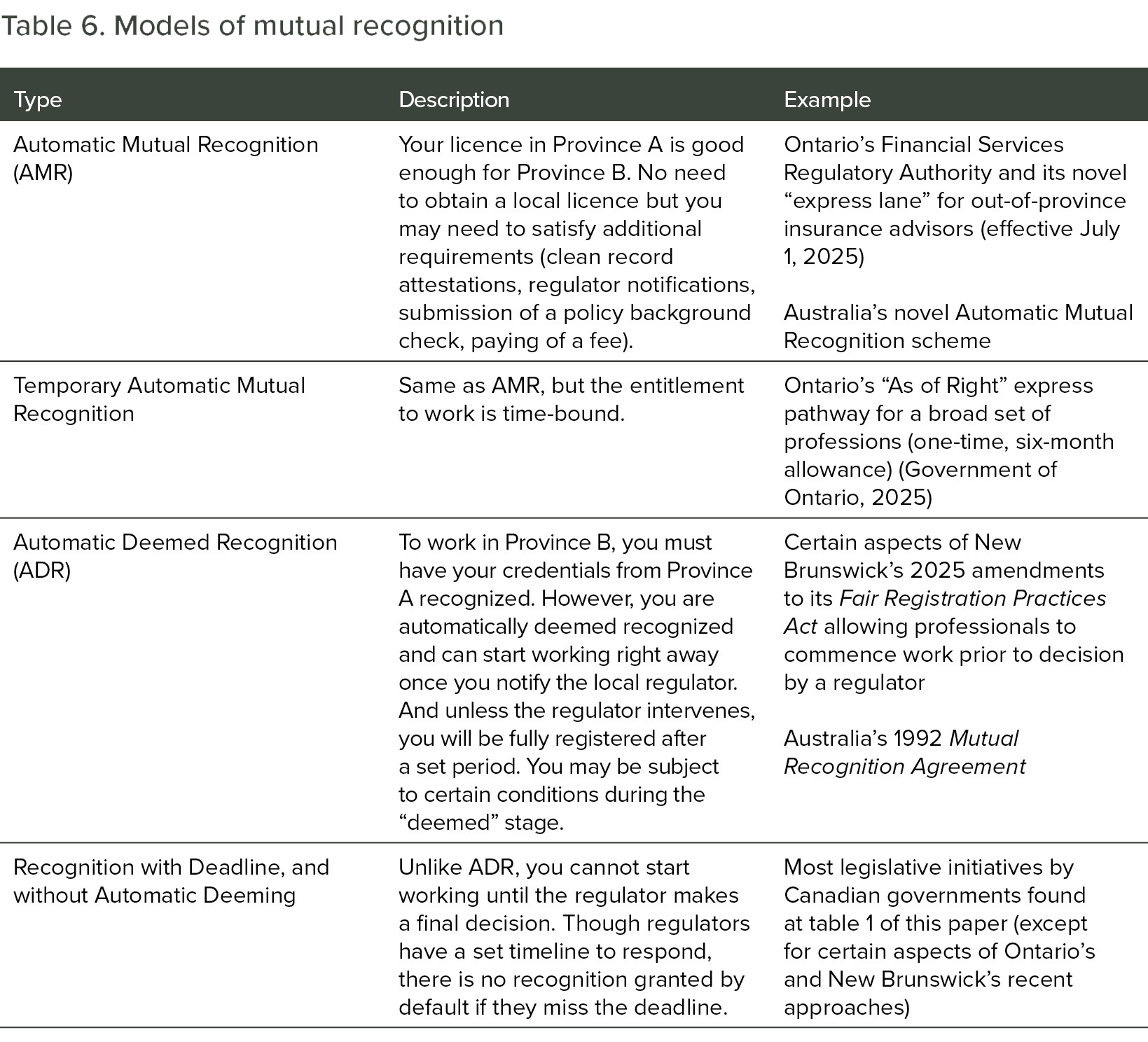
There are four general models of mutual recognition. They are listed in table 6 in descending order of ambition. For the most part, FPT efforts have clustered within the least ambitious model of “Recognition with Deadline, and without Automatic Deeming,” wherein regulators have an explicit deadline to issue a decision, but there is neither 1) automatic deeming upon regulator notification, nor 2) a default to acceptance if the timeline is breached. These were the pillars of the Australian model in its 1992 reforms of its internal market.
Response times
Key to the efficacy of any mutual recognition arrangement are short timelines for regulatory authorities to respond to requests for recognition of labour qualifications. In the ideal world, responses are immediate (i.e., 0 days) or as close to 0 days as possible. The greater the period for a regulator to respond, the greater the harm to internal labour mobility. Simply think of this from the perspective of an owner of a small services business wishing to bid on a contract in another province: the owner needs as simple, short and certain of a process as possible to increase their willingness and ability to submit a proposal. Elongated and cumbersome processes only benefit large, established (and often foreign-owned) enterprises at the expense of Canadian-owned SMEs.
The Committee on Internal Trade (a body of cabinet-level appointees among Canada’s governments) released a communique on July 8, 2025, confirming that all of Canada’s governments were committed to a 30-day service standard (Committee on Internal Trade, 2025). Despite this pan-Canadian commitment to a minimum standard, only a few governments have legislated a timeline, and not all are the same. Nova Scotia and P.E.I. have aligned on a 10 business-day service standard. For Ontario, the general rule is 30 calendar days, with the potential for 10 business days for certain temporary applications. Alberta sits at a 20 business-day standard. New Brunswick’s approach has the potential to be the most ambitious, ostensibly offering near-automatic recognition (labour mobility applicants are deemed registered once the New Brunswick registration authority has issued a receipt of an applicant’s registration documents and before a final determination is made) but this will entirely depend on legislated timelines for the issuance of receipts.
Distinctions between temporary and permanent applicants
Ontario is unique in distinguishing between temporary and permanent labour applicants. It has created an express entry pathway to obtain a six-month licence available for one-time use. This process offers a 10-business day turnaround time for a prescribed list of occupations, rather than the standard 30 calendar days. No other province has introduced this “fast pass” concept for temporary applicants. With that said, the ordinary channels for Nova Scotia and P.E.I. are 10 business days.
Notification and reason-giving
Mutual recognition works when it fosters trust between regulators, heightens procedural certainty and transparency, and streamlines access. These goals are best facilitated when regulatory bodies are required to supply reasons for rejecting or curtailing mutual recognition to both the applicant and the applicable counterpart regulator.
At present, Alberta’s legislation sets the standard as it requires written reasons be supplied to applicants when registration bodies prevent or condition registration of an incoming worker. Ideally, it would also require notice be delivered to the corresponding regulator in the applicant’s home province.
Reporting requirements
The only way for FPTs to monitor and improve upon the implementation of mutual recognition is ongoing data collection. We will want to be able to answer across governments: how many are applying for registration by way of mutual recognition? And how many applications are getting rejected or restricted? Are applicants from certain provinces more likely to get rejected than others? If so, is there a gap in credentialing that can be plugged?
Australia’s Productivity Commission, a federal agency, produces reporting that enables Australia’s governments to learn about and improve upon the progress with respect to its internal market reforms. Many of the statutes introduced in the pre- and even post- Trump 2.0 era speak to reporting, but Canada’s FPT governments must collaborate on the implementation of these legislative obligations to ensure useful and insightful data are available.
Final Remarks
Incredible progress has been made on internal trade barriers with new legislative initiatives enshrining mutual recognition across the country. Canada’s internal trade policy community must now act to rationalize and align the patchwork nature of these statute-based efforts so as to fully realize the potential of mutual recognition. The greater the variation, the harder it is for workers and small businesses to reap the benefits of the recent intense legislative efforts.
The three goals that should guide the efforts of Canadian governments on the implementation of mutual recognition are: 1) coherence for workers and small businesses, 2) inter-regulator trust-building, and 3) reporting for feedback loops.
On coherence — The federal government should collaborate with the provinces on drafting a model legislative framework to get this project back on course. This paper identified a number of key axes relevant to mutual recognition, and the way in which differences have already emerged. The current variability is just the starting point; the patchwork will only worsen over time without conscious intervention. Canada risks failing to capitalize on this once-in-a-generation opportunity to reform our economic union if it cannot reconcile the fragmentation.
On trust-building — Mutual recognition hinges on mutual trust. Trust-building mechanisms are fundamental to any effective mutual recognition regime. This means robust legislative or regulatory mechanisms that force collaboration, information exchange, notifications and timely reason-giving. Alberta’s goes the farthest on this front and comes closest to the mechanisms enshrined in Australian and European measures; other provinces should look to Alberta.
On reporting — The only way to monitor and strengthen the implementation of mutual recognition is with aligned and timely reporting. The federal government should collaborate with provinces and territories to devise a reporting framework, particularly for labour mobility.
The variation in the recent legislative approaches tackling trade barriers via mutual recognition is a beautiful reminder of why trade barriers exist in the first place. A federalist system means that a vibrant economic union is not preordained. Unlike in a unitary state, liberalized domestic trade across internal frontiers requires nurturing and encouragement. Canada is currently experiencing its best chance to renew interprovincial trade since Confederation, and advancing mutual recognition in a manner consistent with this paper places the country firmly on that path to renewal.
Notes
[1] This may soon change. On July 8, 2025, Ontario, along with all other Canadian provinces and territories except for Newfoundland and Labrador, Northwest Territories and Nunavut, signed a memorandum of understanding pledging the release of a framework for cross-border direct-to-consumer alcohol sales by May 2026. It remains unclear when the framework is expected to go into effect.
[2] See generally Janssens (2013).
REFERENCES
Campbell, I. (2025, March 6). Nova Scotia delivers interprovincial ‘game changer’ while feds offer ‘symbolic’ gesture, say observers. The Hill Times. https://www.hilltimes.com/story/2025/03/06/nova-scotia-delivers-interprovincial-trade-game-changer-while-feds-offer-symbolic-gesture-say-observers/453049/
Committee on Internal Trade. (2025, July 8). Communique – July 8, 2025 Committee on Internal Trade Meeting. https://www.cfta-alec.ca/communique-july-8-2025-committee-on-internal-trade-meeting
Cumming, P. A., Lee, E. L. D., & Oreopoulos, D. G. (1989). Access! Task Force on Access to Professional and Trades in Ontario. Ministry of Citizenship.
Government of Canada. (2011, September 16). Speaking notes for the Honourable Jason Kenney, P.C., M.P., Minister of Citizenship, Immigration and Multiculturalism, at the Calgary Chamber of Commerce (as delivered) [Speech]. Immigration, Refugees and Citizenship Canada.
https://www.canada.ca/en/immigration-refugees-citizenship/news/archives/speeches-2011/jason-kenney-minister-2011-09-16.html
Government of Ontario. (2025, September 1). Ontario: Protecting workers by introducing first-in-Canada labour mobility changes [News release]. Government of Ontario.
Janssens, C. (2013). The principle of mutual recognition in EU law. Oxford University Press.
Joannou, A. (2021, October 25). Proposed new labour law could make it easier for professional Canadians to move to Alberta. Edmonton Journal.
https://edmontonjournal.com/news/local-news/alberta-legislature-resumes-2021-fall-sitting
Knox, R. (2010). Who can work where: Reducing barriers to labour mobility in Canada. C.D. Howe Institute.
Manucha, R. (2025). Unlocking Canada’s economy: Why mutual recognition is the key to supercharging internal trade. Macdonald-Laurier Institute.
Mattera, A. (2005). The principle of mutual recognition and respect for national, regional and local identities and traditions. In F. K. Padoa Schioppa (Ed.), The principle of mutual recognition in the European integration process (pp. 1-24). Palgrave Macmillan UK.
Productivity Commission. (2009). Review of mutual recognition schemes. Commonwealth of Australia. https://www.pc.gov.au/inquiries/completed/mutual-recognition-schemes-2009/report/mutual-recognition-schemes.pdf
Tombe, T. (2019, July 17). Alberta is changing the game on internal trade. The Globe and Mail.
https://www.theglobeandmail.com/opinion/article-alberta-is-changing-the-game-on-internal-trade/
Ryan Manucha’s essay examines the legislation in place in the provinces and Ottawa to better understand what is lacking. In particular, he discusses the importance of integrating mutual recognition between provinces. He explains that regulatory differences reduce Canada’s overall competitiveness, limit consumer choice in goods, services and labour, and hinder the positive forces of competition. This essay does more than critically analyze barriers to interprovincial trade: it proposes a comparative framework based on key areas relevant to the implementation of mutual recognition within the federation. The use of this comparative tool offers hope for a coherent path for interprovincial trade — one that offers a viable alternative in a federal system that is too accustomed to heterogeneous and poorly co-ordinated legislative projects.
This essay was published as part of the series Barriers and Bridges: Rethinking Trade Within the Federation published under the direction of Valérie Lapointe by the Centre of Excellence on the Canadian Federation. Editorial co-ordination was done by Étienne Tremblay, proofreading by Zofia Laubitz and production and layout by Chantal Létourneau and Anne Tremblay.
A French translation of this essay is available on the Centre’s website under the title: Un appel à la cohérence : les différences dans les approches législatives récentes visant à abolir les obstacles au commerce intérieur.
Ryan Manucha is a research fellow at the C.D. Howe Institute. He holds a JD from Harvard Law School and a bachelor’s degree in economics from Yale University. He’s a leading expert on interprovincial trade in Canada and is frequently called upon to advise government and agencies. He is a regular media commentator, featured on CBC News, BBC World Service, BNN Bloomberg and CBC Radio. His book Booze, Cigarettes and Constitutional Dust-Ups: Canada’s Quest for Interprovincial Free Trade won the Donner Prize for best in Canadian public policy writing and was a finalist for the Balsillie Prize for Public Policy.
To cite this document:
Manucha, Ryan. (2025). A Call for Coherence: Variation in Recent Legislative Approaches to Remedy Internal Trade Barriers. Institute for Research on Public Policy.
The opinions expressed in this essay are those of the author and do not necessarily reflect the views of the IRPP or its Board of Directors.
If you have questions about our publications, please contact irpp@irpp.org. If you would like to subscribe to our newsletter, IRPP News, please go to our website at irpp.org.
Cover: Luc Melanson