

What Powers Does Quebec Have over Its Internal Constitutional Order? The Constitution of Quebec in a Federal and Comparative Context

 |
|
On October 9, 2025, the Quebec government, through Minister of Justice Simon Jolin-Barrette, tabled Bill 1, entitled the Québec Constitution Act, 2025, in the National Assembly. This unilateral action was taken against the backdrop of a deadlock in the multilateral process of negotiating amendments to the Canadian Constitution and reflects a recent trend toward constitutional unilateralism that is developing not only in Quebec but also elsewhere in the country.
Section 45 of the Constitution Act, 1982 confers on Canadian provinces the power to adopt, if they so wish, a formal, codified provincial constitution — a provincial law containing the word “Constitution” in its title and including some of the most important rules governing its organization and functioning.
The provinces have the power to amend all parts of their own constitutions as long as they comply with specific conditions set out in the Constitution Acts of Canada. To date, only British Columbia has adopted a piece of legislation with the word “Constitution” in its title. However, it is an incomplete constitution act because its design is a rather practical one and it does not contain any solemn wording or convey any great symbolic significance. Some degree of adherence to British constitutionalism therefore seems to be at play here.
That being said, the idea of establishing an official, codified Constitution of Quebec is not new. It has been brought up on a number of occasions in the province’s political history, but it has never found concrete expression.
Internationally, member states in many federal systems have their own internal constitutions. In addition to examining the Canadian context, this study considers examples of other federations, including Australia, Austria, Germany, Switzerland and the United States.
Canada is a special case in that its “provincial constitutions” are scattered across a variety of legal instruments and are partly unwritten. For Quebec, the adoption of a formal, codified provincial constitution appears to be a promising avenue for continuing its progress toward more provincial autonomy given the deadlock in the multilateral process of negotiating constitutional reform.
However, for such a project to be successful, both in substance and in form, it must be approached in a way that allows this new Quebec constitution to reflect a broad consensus and ensure that all stakeholders can identify with it. The challenge is a daunting one.
Introduction
On October 9, 2025, the Quebec government, through Minister of Justice Simon Jolin-Barrette, tabled Bill 1, entitled the Québec Constitution Act, 2025,1 in the National Assembly. In doing so, the government proposed the adoption of three new statutes2 and a number of amendments to some existing statutes, including the Constitution Act, 1867. The centrepiece of this initiative is undoubtedly the Constitution of Québec, one of the new statutes contained in the Bill.
The move is part of a recent trend toward constitutional unilateralism and assertive actions by certain provinces. This trend, which can be seen not only in Quebec but also elsewhere in the country, is developing in the context of the deadlock in the multilateral process of negotiating amendments to the Canadian Constitution. The current period thus stands in contrast to the federal-provincial negotiations of the 1980s and 1990s, which led to the Meech Lake and Charlottetown constitutional accords (see Guénette et al., 2026).
There are many manifestations of this trend. In Quebec, passage of the Act respecting French, the official and common language of Québec (Bill 963) in 2022 was the first step in this direction. With Bill 96, the provincial government proposed adding two sections to the Constitution Act, 1867, specifically in Title V, “Provincial Constitutions.” These sections state that “Quebecers form a nation” (s. 90Q.1) and that “French shall be the only official language of Québec. It is also the common language of the Québec nation” (s. 90Q.2). Later that year, the Quebec Parliament passed a new statute amending the Constitution Act, 1867, this time to abolish the requirement for members of the National Assembly to swear allegiance to the King of Canada.4 Finally, in June 2024, the Quebec government created the Advisory Committee on Quebec’s Constitutional Issues within the Canadian Federation, with a mandate to recommend measures to protect and promote the collective rights of the Quebec nation, to ensure respect for its distinct social values and distinct identity, to guarantee respect for Quebec’s areas of jurisdiction, and to increase its autonomy within the Canadian federation (Government of Quebec, 2024).
The Committee released its report in November 2024, proposing a number of measures, including the adoption of a codified Quebec constitution (Recommendation 1), framework legislation on the defence and enhancement of Quebec’s constitutional freedom (Recommendation 5), and the creation of a non-judicial constitutional council (Recommendation 7) (Comité consultatif sur les enjeux constitutionnels du Québec au sein de la fédération canadienne, 2024).
Elsewhere in Canada, Alberta and Saskatchewan have also taken steps toward constitutional unilateralism, asserting provincial powers that do not require negotiation with the federal government and other provinces. For example, in 2019, the Alberta government created the Fair Deal Panel, the purpose of which was to consult Albertans on how to improve the province’s situation within Canada. One of the Panel’s recommendations was to hold a provincial referendum on a proposal to abolish equalization. The referendum was held in October 2021, and although the proposal was supported by more than 60 per cent of voters, the Alberta government did not attempt to enter into negotiations with the federal government and other provinces on this issue.5 Then, in 2022, the provincial Legislature passed the Alberta Sovereignty Within a United Canada Act,6 the goal of which is to protect the province from federal actions that it deems unconstitutional or detrimental to Albertans or the province’s economic prosperity. In 2023, Saskatchewan took similar action, passing the Saskatchewan First Act,7 which unilaterally amended the Constitution Act, 1867 — as Quebec had done a year earlier — to reaffirm the province’s autonomy in certain areas, particularly natural resources.
In addition to this constitutional unilateralism and the assertive actions taken by some provinces, there has been increased use of the notwithstanding clause of the Canadian Charter of Rights and Freedoms. The recent tabling of the Québec Constitution Act, 2025 is directly in line with this trend toward unilateralism.
The purpose of this study is not to examine in detail or offer a specific critical perspective on Bill 1 or the proposed Constitution of Québec. Instead, we propose to situate the current debate and the process allowing Quebec to adopt and amend its own constitution in the broader context of Canadian constitutional law (Part 1) and comparative constitutional law (Part 2). This approach is important for gaining a clear understanding of the legal context surrounding the Quebec initiative, the issues it raises, and the limits imposed on its actions. It will also provide a deeper understanding of what distinguishes Quebec from other federated entities in Canada and from other federal systems around the world.
The Constitution of Québec and Canadian Constitutional Law
Quebec, like all Canadian provinces, already has its own constitution. It is diffuse and scattered across Quebec statutes, specific provisions of Constitution of Canada, fundamental constitutional principles, important court decisions, constitutional conventions and other legal instruments. However, the idea of giving Quebec a formal and codified constitution — in other words, an official “Constitution of Quebec” — frequently comes up in public debates and academic research (see Albert & Sirota, 2023). In order to fully understand the historical and legal contours of the issues involved, we will now examine the power of provinces to amend their own internal constitution as well as the evolution and formalization of Quebec’s current constitution.
The power of provinces to amend their own constitution: Historical continuity and vague definitions
In a dynamic specific to British constitutionalism, the power of provinces to amend their own constitution reflects both historical continuity and the diffuse and imprecise nature of that power. Indeed, while the power is now enshrined in the Constitution Act, 1982, its existence predates the actual creation of Canada, as a brief historical review demonstrates. Furthermore, in spite of the fact that provincial constitutions are recognized in the Canadian Constitution, their scope and limits remain unclear, so we need to take the time to define them.
The evolution of the power to amend provincial constitutions: A clear continuity
To examine the power of Canadian provinces to amend their own constitutions, we must first define what a constitution is in general terms. Nicole Duplé provides some answers to this question by stating that the term “constitution,” derived from the Latin word constitutio, refers to the organization and functioning of a whole entity (Duplé, 2018, p. 24). She goes on to point out that, in public law, the term “refers to the set of rules that provide for the organization and functioning of the State.” She adds that these rules may be of various kinds and that they “have the goal and effect of distributing state functions among bodies that will be empowered, on behalf of the State, to make decisions within their respective areas of competence” (Duplé, 2018, pp. 24-25, our translations). Thus, for a society such as Quebec, the “provincial constitution” refers to the set of norms that govern the organization and functioning of the State, including the structure of institutions, the separation of powers, and the protection of rights.
Every society necessarily has a constitution, but the form it takes can vary. Generally speaking, when we think of a constitution, we think of a written document, often drafted at a decisive moment in a society’s history and imbued with very high symbolic value. The United States Constitution and the 1789 Declaration of the Rights of Man and of the Citizen in France are eloquent examples. These written constitutions usually have what is known as “supra-legislative” value in that they take precedence over all other rules of law in a society. As an illustration of this overriding value, section 52(1) of Canada’s Constitution Act, 1982 states: “The Constitution of Canada is the supreme law of Canada, and any law that is inconsistent with the provisions of the Constitution is, to the extent of the inconsistency, of no force or effect.” Such a constitution thus takes precedence over all other legal norms in a society.
However, in some systems, the constitution takes on a more vague and imprecise form. This is the case in the United Kingdom, where there is no formal, written constitution that supersedes all other legislation. The British constitution is an aggregate of scattered norms consisting of laws, case law decisions, unwritten principles, conventions, customs, and practices. The diffuse nature of this constitution does not prevent it from playing a role similar to the constitutions of other states: it provides a framework for the organization and functioning of society.
Even before the creation of modern Canada in 1867, the British colonies already had their own constitutions and some degree of power to amend them. In fact, as early as 1865, the British Parliament passed the Colonial Laws Validity Act, which provided that each representative legislature would have, and would be “deemed at all times to have had, full power to make laws respecting the constitution, powers, and procedure of such legislature” (s. 5). The wording of the section is important here, since it did not provide for the creation or establishment of the power concerned but instead recognized that it already existed, since the colonies were deemed to have had, at all times, full power to enact laws concerning their constitution.
It is therefore not surprising to find that the power was renewed two years later in the British North America Act (s. 92(1)). The Act conferred on provincial legislatures the ability to make laws relating to “Amendment from Time to Time, notwithstanding anything in this Act, of the Constitution of the Province, except as regards the Office of Lieutenant Governor.” Moreover, this provincial power, in what would later become Canada, was already enshrined in the 72 Quebec resolutions that were negotiated in 1864 with the aim of uniting the colonies of British North America (Resolution 42).
In the 1982 Patriation of the Canadian Constitution, section 92(1) of the British North America Act — which had been renamed the Constitution Act, 1867 — was repealed and the power conferred by it was moved to section 45 of the Constitution Act, 1982, which reads as follows: “Subject to section 41, the legislature of each province may exclusively make laws amending the constitution of the province.”
In short, since 1865, the power of Canadian provinces (previously individual British colonies) to amend their own constitutions has undergone three distinct stages or different formulations. However, the continuity between the three sections discussed above leaves no room for doubt. Henri Brun, Guy Tremblay and Eugénie Brouillet draw the following conclusion:
The replacement of subsection 92(1) by section 45 in 1982 was not intended to change the scope of this provincial power, but simply to incorporate all provisions relevant to constitutional amendment in the same part of the 1982 Act. As a general rule, the case law relating to subsection 92(1) therefore continues to apply for the purposes of section 45. (Brun et al., 2014, p. 218, our translation)
The late Benoît Pelletier shared this view. Commenting on section 45 of the Constitution Act, 1982, he stated: “It can be seen that this new provincial constituent power essentially matches the scope of the former subsection 92(1) of the Act of 1867. To clearly establish this legal continuity, the 1982 Act formally repealed subsection 92(1)” (Pelletier, 1996, p. 117, our translation; see also Grammond, 1997, p. 577). Thus, there is no doubt that provinces have the power to amend their constitutions. However, the concept of provincial constitutions is somewhat vague and needs to be clearly defined.
Provincial constitutions: A vague concept derived from diffuse sources
Provincial constitutions necessarily exist in Canada, since the Canadian Constitution enshrines the power to amend them, but it is still difficult to define precisely what they are. As Benoît Pelletier stated, “The term ‘provincial constitution’ is not defined anywhere in the Constitution of Canada. In fact, neither the 1867 Act nor the 1982 Act refers to it” (Pelletier, 1996, p. 119, our translation). Our first task, therefore, is to define the legal concept of provincial constitutions in Canada in order to better understand what the power to amend them applies to.
However, this is not an easy or straightforward undertaking since, in the spirit of the British constitutional tradition, provincial constitutions are diffuse objects derived from different sources of law with different normative force. Indeed, as noted by Pelletier, “the constitutions of the Canadian provinces, like the ‘Constitution of Canada’ in the broad sense, are contained in a variety of legal instruments: British laws, provincial organic laws, constitutional conventions, and rules of common law” (Pelletier, 1996, p. 119, our translation).
Without attempting to provide a comprehensive overview, we will list a number of the foundational sources of Quebec’s current provincial constitution, using the categories mentioned by Pelletier. These include, first and foremost, British laws and, more significantly, the Constitution Act, 1867. This is because the creation of modern Canada through the passage of the British North America Act was the result of two simultaneous processes — association and dissociation. On the one hand, existing British colonies — the Province of Canada, Nova Scotia and New Brunswick — were brought together in a formal union and, on the other, the provinces of Ontario and Quebec were created by dividing the Province of Canada.
The British North America Act includes Title V, entitled “Provincial Constitutions” (ss. 58-90). While some of the provisions in it were meant to apply to all provinces of Canada,8 the vast majority of the sections in Title V concerned Ontario and Quebec. The reason is simple: for Nova Scotia and New Brunswick, two sections simply stated that existing institutions were maintained,9 while for Ontario and Quebec, new legislative and executive institutions had to be created to replace those that existed under the Act of Union of 1840. For example, sections 69 to 87 deal exclusively with the new legislatures of Quebec and Ontario. By necessity, a number of these sections are therefore part of the constitution of these two provinces.10
Much of Quebec’s provincial constitution is also found in what Pelletier referred to as “provincial organic laws.” The use of this term is interesting in that organic laws are usually designed to clarify and implement constitutional provisions governing the organization of the State and its powers. However, in systems such as those of France (Cartier, 2020) and Belgium (Hachez & Neven, 2020), “organic” or “special” laws are a category of norms that fall somewhere between a formal constitution and ordinary laws. In other words, organic laws must comply with constitutional provisions, but they take precedence over ordinary laws passed by an ordinary legislature.
No such category of norms exists in Canada. It should therefore be understood that the term “provincial organic laws” refers here to laws that deal with the organization and functioning of the State but are not supra-legislative. A number of Quebec statutes fall into this category, including the following:
- Act respecting the National Assembly11
- Executive Power Act12
- Courts of Justice Act13
- Charter of Human Rights and Freedoms14
- Charter of the French Language15
- Election Act16
- Referendum Act17
The titles of these statutes alone show why they are part of Quebec’s provincial constitution: they deal with the functioning of the State, including the separation and organization of powers, public participation in state processes and the protection of rights.
The last category of sources that make up provincial constitutions is more diffuse and multifaceted: it encompasses unwritten norms of various kinds, such as common law rules inherited from the United Kingdom, underlying constitutional principles (including democracy and the protection of minorities18), and constitutional conventions governing the functioning of the parliamentary system.19 All the political rules that allow for the formation of federal or provincial governments fall into this category.
In short, provincial constitutions are diffuse in nature, as the Supreme Court of Canada itself noted in 1987 in the OPSEU decision,20 stating that “The constitution of Ontario, like that of the other provinces and that of the United Kingdom, but unlike that of many states, is not to be found in a comprehensive, written instrument called a constitution” (see also Cauchon & Taillon, 2020). To some extent, this complicates the issue of amending provincial constitutions. What rules must be followed to amend the content of such a scattered constitution? What are the effects of the diffuse nature of provincial constitutions on the amendment procedure?
Amending the Quebec constitution: Between evolution and formalization
We will now focus on two distinct scenarios for amending provincial constitutions. First, we will examine the current situation regarding the amendment of provincial constitutional norms, including previous examples of amendments to the Quebec provincial constitution and some ongoing debates on the matter. Secondly, we will turn our attention to a specific scenario for amending a provincial constitution: the formalization and codification of a constitution through the adoption, for example, of an actual Constitution of Quebec.
The limits of, and uncertainties surrounding, provinces’ power to amend their constitution
As we mentioned earlier, section 45 of the Constitution Act, 1982 begins with a restriction: “Subject to section 41.” The implication is that the power of the provinces to amend their constitutions cannot apply to the matters listed in that section. In the case of a provincial constitution, these matters are the office of lieutenant governor and the power of legislatures to amend their own provincial constitutions. It is therefore impossible for provinces to amend their constitutions in a way that would change either of these two matters.
Another limit on the constituent power of the provinces is found in the bilateral procedure (section 43 of the Constitution Act, 1982). Since this procedure explicitly refers to “any provision that relates to the use of the English or the French language within a province,” any such provisions of the Constitution of Canada cannot be amended simply by passing provincial legislation, even though they are part of the “constitution” of the provinces. This restriction applies to Quebec’s obligation to enact and publish its laws in English and French (section 133 of the Constitution Act, 1867) — an obligation that is therefore beyond the scope of the province’s power to amend its own constitution.
Finally, parts of provincial constitutions are found in the Constitution Acts of Canada, including the Constitution Act, 1867. Although there is some debate on this point, it can therefore be assumed that the provinces have the power to amend all parts of their constitutions, regardless of the legal instruments containing them, including the Constitution Acts of Canada, provided that they comply with the restrictions referred to earlier (office of lieutenant governor and use of English or French).
To illustrate the above, we will use a few examples that we will group into three categories. The first concerns Quebec statutes that are constitutional in nature but do not affect the provisions of Canada’s Constitution Acts. These include the Act respecting the National Assembly, the Charter of Human Rights and Freedoms and the Election Act. As discussed earlier, these statutes are part of Quebec’s “provincial constitution.” There is no doubt about Quebec’s ability to amend them or pass similar legislation or about the appropriate procedure for doing so: all it has to do is pass an ordinary law, following the usual parliamentary procedure. Since Quebec itself passed these statutes, it can amend them as it sees fit, even if it must comply with certain rules in the Canadian Constitution.
Over time, certain practices for amending ordinary laws have become established with a view to obtaining a higher degree of consent. For example, for a long time, amendments to the Charter of Human Rights and Freedoms were adopted by consensus in the National Assembly, even though the Charter could easily have been amended by a simple majority, like all other Quebec statutes. Although this practice has not always been followed in recent years (Bourgeois & Leckey, 2024), it remains an ideal to strive for when amending a statute as foundational as the Charter.
Similarly, the voting system used in provincial elections, as set out in Quebec’s Election Act, can also be amended by an ordinary law. However, when Quebec was considering steps to reform its voting system in 2019-20, the bill tabled for that purpose made the implementation of such a reform conditional on its approval in a referendum,21 reflecting a desire to raise the threshold for amending certain statutes. While reform of the voting system in Quebec was abandoned before being put to a popular vote, referenda were held in other provinces specifically on this issue (Verville, 2020). This illustrates a willingness, in dealing with certain issues, to amend Quebec statutes that are part of the “provincial constitution” while at the same time requiring a higher level of support than a simple parliamentary majority.
The second category includes amendments to Quebec’s provincial constitution that interact with provisions in the Constitution of Canada. The most striking example of this scenario is undoubtedly the abolition of the Legislative Council of Quebec in 1968. Until then, the Quebec Parliament was bicameral, consisting of a lower house called the Legislative Assembly of Quebec and an upper house called the Legislative Council of Quebec. Quebec was also the last province to have an upper house.22 However, the existence of the Legislative Council of Quebec was provided for in sections 71 to 79 of the Constitution Act, 1867, which is part of the Constitution of Canada. Despite this, Quebec abolished the Council in 1968 by passing a simple provincial law — with the approval of the Council itself.23 Although abolition came into effect on January 1, 1969, the corresponding sections of the Constitution Act, 1867 were never repealed.
The third category of amendments that section 45 of the Constitution Act, 1982 allows provinces to make to their constitutions is more recent. It has been a subject of considerable debate, particularly within the academic community. The category covers provincial laws designed to amend the Constitution of Canada directly by adding new provisions that will become part of a provincial constitution. This doctrinal proposal, developed by Hubert Cauchon and Patrick Taillon (2020), was taken up by the Quebec government in 2021, when it introduced Bill 96, the Act respecting French, the official and common language of Quebec.
The Bill contained two sections that were added to the Constitution Act, 1867, concerning the Quebec nation (section 90Q.1) and its official language (section 90Q.2). Justin Trudeau, Prime Minister of Canada at the time, considered that such an amendment was permissible (Marquis, 2021), and the House of Commons of the Canadian Parliament passed a resolution by 281 votes to 2, recognizing Quebec’s power to use such a procedure.24 The legislation was passed in June 2022.
Although a number of experts have expressed reservations about the procedure and its actual effects (Macfarlane, 2023; Morin, 2022; St-Hilaire, 2022), the same procedure would be followed again. In 2022, the Quebec Parliament passed another bill amending the Constitution Act, 1867: the Act to recognize the oath provided in the Act respecting the National Assembly as the sole oath required in order to sit in the Assembly. This bill sought to abolish the requirement for members of the National Assembly to swear allegiance to the King or Queen of Canada. After the bill passed, members were able to perform their duties without taking the oath.
Drawing on the same approach, Saskatchewan amended the Constitution Act, 1867 in 2023 by passing the Saskatchewan First Act. Interestingly, the Act specifies that its new section 90S.1 is to be inserted immediately after the amendment made by Quebec: “The Constitution of Saskatchewan is amended by adding the following section after section 90Q.2 of the Constitution Act, 1867.”
Thus, despite the limitations in section 45 of the Constitution Act, 1982, and the criticism levelled by some experts, it appears that, to date, the provinces’ unilateral power to amend has been exercised on a few occasions to add sections to their “provincial section” of Canada’s Constitution Acts, specifically the Constitution Act, 1867. Although it is only an administrative codification and not an official version of Canada’s Constitution Acts, it is noteworthy that the Department of Justice of Canada has added these new sections to its online version of the Constitution Act, 1867.
Formalization and codification of “provincial constitutions” in Canada
Another power that section 45 of the Constitution Act, 1982 confers on Canadian provinces is the power to adopt, if they so wish, an official and codified provincial constitution — a provincial law bearing the title “Constitution” and including some of the most important rules governing its organization and functioning.
While there is no doubt that this power exists, it may seem surprising that only one province has exercised it to date. That province is British Columbia, which stands out for having adopted its Constitution Act at the very moment it joined Canada in 1871. Although the statute has evolved over time (Sharman, 1984), it has remained a constant in the province’s constitutional landscape. However, a few clarifications are in order.
First, the Constitution Act of British Columbia uses the concept of “constitution act” in the spirit of British common law constitutionalism, not that of the continental European tradition. Thus, as Campbell Sharman pointed out, even “this name reflects an accident of history rather than any substantive difference between the British Columbia Constitution Act and statutes covering similar topics in the other provinces” (Sharman, 1984, p. 91). In support of his argument, Sharman presented the laws of the nine other Canadian provinces governing the organization of legislative and executive powers. He stressed the fact that the Constitution Act of British Columbia was, other than in name, not very different in content from other ordinary provincial laws that formed part of their “provincial constitution.”
In the same vein, Erin Crandall points out that “British Columbia’s Constitution Act does not contain the entirety of the province’s constitution and what may be missing from the Act is not necessarily clear” (Crandall, 2022, p. 179). It follows that the Constitution Act is to some extent an incomplete constitution, and several elements must be added to it to provide a more complete picture of the “provincial constitution.” There is thus a clear parallel between the Constitution Act of British Columbia and the Constitution Acts of Canada, which are also incomplete in several respects (Guénette, 2015). The Constitution Act, 1867 provides for the organization of Canada’s executive and legislative powers; the Constitution Act of British Columbia does the same for that province. Some degree of adherence to the same type of British constitutionalism therefore seems to be at play here. Furthermore, both constitution acts do not share the great symbolic significance or solemn wording usually associated with the constitutions of continental European countries. Instead, their design is practical.
However, in Quebec, where the civil law tradition prevails, the idea of giving the province a real constitution that would be codified and more comprehensive and have greater symbolic value has been around for a long time. This idea is consistent with the constitutional culture of continental Europe and thus differs from the Constitution Acts of Canada and the Constitution Act of British Columbia. Obviously, this does not involve the adoption of a formal constitution for a sovereign Quebec — which nevertheless remains a possibility — but rather the formalization and codification of the most important constitutional norms of the province of Quebec in a document that would be consistent with the Canadian Constitution but would have symbolic value for Quebec.
Without retracing the history of this idea (see, for example, Turp, 2013, for more background), we can say that it seems to date back at least to 1858, when Joseph-Charles Taché proposed the “adoption of a written constitution for each province, requiring the legislature concerned to obey it on pain of having its laws declared null and void by a court” (Taché, 1858, cited in Turp, 2008, p. 136, our translation). The idea became really popular a century later, when it was taken up in the 1960s by various political parties, including the Union nationale and the Quebec Liberal Party (Turp, 2008, p. 136 et seq.). After the 1982 Patriation of the Constitution, even the Parti Québécois toyed with the idea of proposing an internal constitution for Quebec, and PQ minister Jacques-Yvan Morin was one of the people who developed and championed the proposal. Then, after the failure of the 1995 referendum, PQ MNA Daniel Turp tabled two draft constitutions for Quebec in the National Assembly.25
However, while the idea has always attracted support in certain quarters, it has never found concrete expression, at least not until now. Things may change, as the Quebec government recently introduced Bill 1, the Québec Constitution Act, 2025, which includes a new draft Constitution of Québec. The government’s move obviously raises several questions about the possible adoption of a formal, codified Quebec Constitution. For example, with respect to the process of adopting and amending such a constitution, should approval of the new constitution be put to a referendum? Should any amendment require the support of a qualified majority in the National Assembly rather than a simple majority? How can Quebecers be involved in the process of drafting the constitution?
Beyond the issue of process, other major questions arise. These include the place of this constitution in the hierarchy of norms: a Quebec Constitution would certainly have to comply with the Canadian Constitution, but how could it take precedence over other Quebec laws? Similarly, what should the content of such a constitution be? What are the constraints on internal constitutions and what powers can a Quebec Constitution include? A comparative analysis can provide some answers to these questions.
Provincial Constitutions in Canada and Comparative Constitutional Law
In order to better understand the case of Canada, it is useful to take a broader perspective and examine internal constitutional orders in a federal context. We will therefore first examine internal constitutions and the processes for adopting or amending the constitutional texts of the components of a federal system before turning to other fundamental issues concerning internal constituent powers in federal societies.
Internal constitutional orders in a federal context: Ubiquity, adoption, and amendment
In federal systems, federated entities such as Canadian provinces usually have their own constitutions. In fact, this is the rule rather than the exception. That said, it is important to examine how these internal constitutional orders in a federal context are adopted and how they can be amended.
The “standard” for the components of a federal system: Having their own constitution
The first point to be made is that it is normal for the member states of a federal system (or a quasi-federal system, such as Spain and Italy) to have their own “internal constitution” and their own power to amend the content of that constitution — a power commonly referred to as “constituent power.” James Gardner offers a simple formula to explain what these internal constitutional documents are and what process they are part of: “Sub-national constitutionalism is nothing more than the application of principles of constitutionalism to sub-national documents” (Gardner, 2008, p. 327).
The internal constitutional order necessarily complements that of the federal society as a whole. Accordingly, in any given entity (province, canton, Land, region, autonomous community, etc.), two constitutional orders coexist: the overarching one and the specific one. This is not so different from the duplication of political systems and their institutions in any federal society: one system is provincial, with its government, parliament and code for protecting fundamental rights, and the other is federal, with the same components. It follows that an internal constitution is similar to the constitution of a sovereign state, with the necessary adjustments required by the fact that the internal constitution is part of a context that transcends it: it is part of a whole.
The constituent power of the components of a federal system may be defined as the power of a federated entity to adopt (and amend), within the limits set by the federal constitution, a federated constitution, that is, a text characterized by a degree of rigidity and enjoying supremacy over other federated rules and policies (Peiffer, 2017, p. 8). In other words, the “internal” constituent power of a member state is directly related to the degree of control it can exercise over the substance of its internal constitutional order: the greater the degree of control, the greater its constituent power. The opposite is also true: the less control that member states in a federal system can exercise over the content of their own internal constitutional order, the more limited their constituent power will be.
There is an obvious conclusion to be drawn here: in any federal society, member states will necessarily have “internal constitutional norms,” but they will not necessarily have “internal constituent power.” Indeed, in a federal system, a normative framework will govern, for example, how the institutions specific to each order of government are organized, how the members of the legislative branch of a federated entity are elected, etc. (Brouillet, 2003, p. 97; Guénette, 2023, p. 16; Laforest, 2014, p. 130). Thus, member states necessarily have “internal constitutional norms.” However, if they have no control over their content and have no way of directly influencing the process of amending them, then we must conclude that member states do not have “internal constituent power.”
In other words, while constitutional norms are needed to organize the functioning of the member states of a federal society, the same member states may not enjoy the power to unilaterally amend the constitutional norms that concern them exclusively. When this is the case, we must conclude that a member state does not have “internal constituent power.”
As mentioned in the introduction to this section, it is normal for member states in a federal society to have their own internal constitution and their own constituent power. Clearly, the constituent power of a member state in a federal system cannot be unlimited, since this would result in it becoming a truly sovereign state. It is therefore accepted that there are limits and constraints on the constituent power of member states, as long as they are able to influence the content of some of their internal constitutional norms. Similarly, the constitutional order of a member state is necessarily limited to issues that apply only to it: it cannot extend to the powers of another order of government, to issues specific to federalism, to shared institutions, etc.
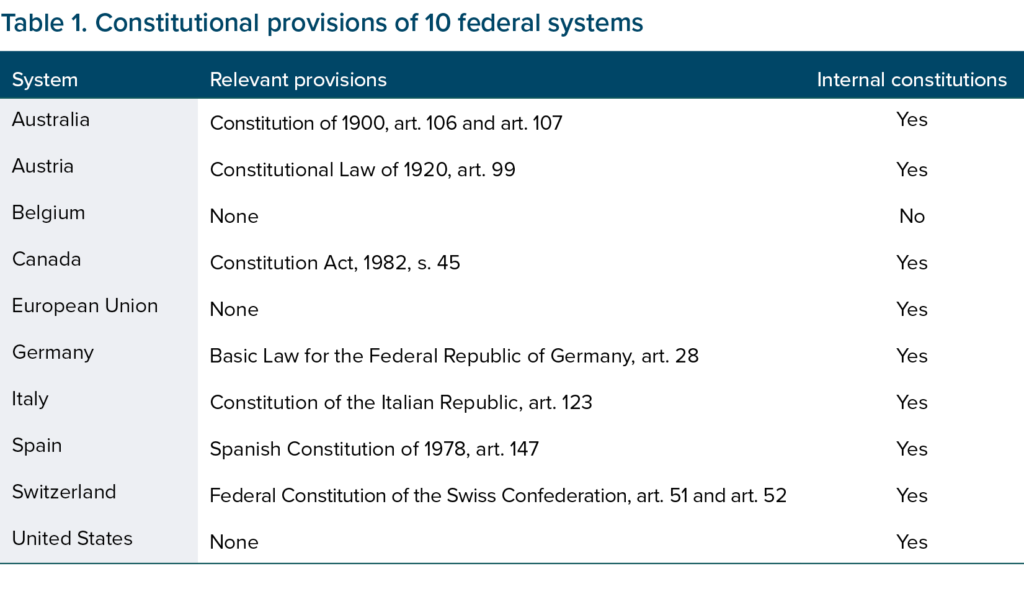
A brief comparative examination shows, for example, that in the United States (Gardner, 2021), Switzerland (Belser, 2021), Austria (Gamper, 2021), Australia (Aroney, 2021) and Germany (Reutter, 2021), the member states all have internal constitutions. Canada shares the same dynamic, as we saw earlier, except that “provincial constitutions” in Canada are diffuse and partially unwritten. The constitutions of Spain and Italy both specify that their autonomous communities (Colino, 2009) and regions (Palermo, 2008) have autonomous statutes. Although they are called differently, these autonomy statutes also take the form of “internal constitutions.”
The exception that proves the rule here is Belgium. In this relatively young federal state, neither the regions nor the communities (the two types of federated entities found there) can adopt their own constitution (Peiffer, 2017, p. 8). As Wouter Pas notes, “Contrary to the general rule in almost every federal state, the Belgian federated entities have no proper constitutions of their own. The institutions of the communities and regions are laid down in the federal constitution and statutes” (Pas, 2004, p. 168). In other words, there are constitutional norms that govern the constitutional life of Belgian federated entities, but the regions and communities have no power to amend them; they therefore have no internal constituent power.
In a recently published book, we looked at the issue of internal constitutional orders in 10 federal systems as part of a broader study of constitutional change in these systems (Guénette, 2025). The cases studied were Australia, Austria, Belgium, Canada, the European Union, Germany, Italy, Spain, Switzerland and the United States.26 Of all these entities, only Belgium does not have a system of internal constitutions. Table 1, taken from our 2025 study, highlights this difference by indicating the relevant constitutional provisions for each country and the European Union:
Adoption and amendment of internal constitutional orders
Regarding the adoption and amendment of an internal constitution, two distinct aspects must be examined in depth. First, we must consider the procedural requirements for adopting or amending an internal constitutional order. Second, we must consider whether the internal constitution is adopted and amended unilaterally or whether it is done bilaterally, in which case the central government must be involved.
In Switzerland, the relevant procedure is fully codified in the Federal Constitution of the Swiss Confederation. Article 51(1) states: “Each Canton shall adopt a democratic constitution. This requires the approval of the People and must be capable of being revised if the majority of those eligible to vote so request.” The situation is therefore very simple: the cantons must adopt a constitution and allow it to be amended, and in both instances a referendum and the consent of a majority of the canton’s voters is required. The process is therefore unilateral. As for procedural requirements, the only constraint is voters’ approval of the new constitution or any amendment.
In the Austrian Constitution (art. 99) too, the procedure for amending the internal constitution of a member state is clearly stated: “A Land Constitutional Law may be adopted only in the presence of one-half of the members of the Land legislature and with a majority of two-thirds of the votes cast.” In Italy, the procedure is even more detailed, as can be seen from article 123 of its constitution:
Each Region shall have a statute which, in compliance with the Constitution, shall lay down the form of government and basic principles for the organization of the Region and the conduct of its business. […]
Regional statutes are adopted and amended by the Regional Council with a law approved by an absolute majority of its members, with two subsequent deliberations at an interval of not less than two months. […]. The Government of the Republic may submit the constitutional legitimacy of the regional statutes to the Constitutional Court within thirty days of their publication.
The statute is submitted to popular referendum if one fiftieth of the electors of the Region or one fifth of the members of the Regional Council so request within three months from its publication. The statute that is submitted to referendum is not promulgated if it is not approved by the majority of valid votes.
The situation is different in Spain, where the Constitution gives autonomous communities some latitude, simply stating that “Amendment of Statutes of Autonomy shall conform to the procedure established therein and shall in any case require approval of the Cortes Generales through an organic act” (Spanish Constitution, art. 147 (3)). The autonomous communities are thus free to determine the process for amending their autonomy statutes. Note, however, that the process is bilateral, since the Spanish Parliament must approve the amendment.
In other systems, such as in the United States, the Constitution is silent on the process of adopting or amending internal constitutions. U.S. states have some leeway in adopting practices. As Gardner points out, the “US Constitution makes no mention at all of subnational constitutions; the power of states to adopt such constitutions was not only well established by 1789, but was viewed as inherent in the sovereignty possessed by the original states. As a result, the procedures for adoption and amendment of state constitutions are regulated entirely by the states themselves in their own constitutions” (Gardner, 2021, p. 299). The situation is similar in Germany with regard to the constitutions of the Länder (Reutter, 2021, p. 151).
In Canada, as we saw earlier, it is section 45 of the Constitution Act, 1982 that confers provincial power to adopt and amend, and it does so in very simple terms: “Subject to section 41, the legislature of each province may exclusively make laws amending the constitution of the province.” Since it is the legislature of the province concerned that has jurisdiction, this implies that it must proceed by passing an ordinary law. The amendment procedure is thus provided for in the Canadian Constitution and is the same as the one to be followed in the ordinary legislative process. Note also that this jurisdiction is “exclusive,” meaning not only that the process is unilateral but also that the Canadian Parliament has no jurisdiction to intervene in it. In this regard, the situation in Canada is similar to that in Australia (Aroney, 2021, p. 41).
Table 2, based once again on data from our recent publication (Guénette, 2025), shows the degree of control that member states have over amendments to their internal constitutions in 10 different federal systems:
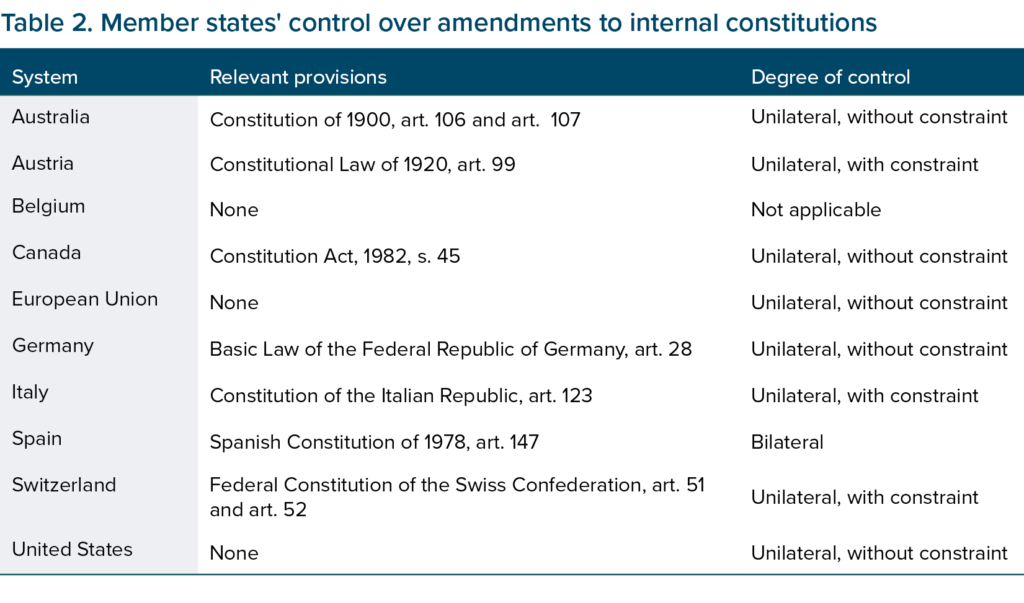
There is therefore a spectrum ranging from extensive control by the components of a federal state over changes to their internal constitutional order, on the one hand, to very limited control, on the other. The data show that Canadian provinces do indeed enjoy considerable leeway to change constitutional norms that concern them alone — a fact that is also supported by the first part of this paper.
Other fundamental issues concerning internal constitutional orders in federal societies
Beyond the fact that they have their own internal constitution and exercise varying degrees of control over its amendment, several other issues surrounding internal constitutional orders in federal societies are of great importance. We will first examine the form and place of internal constitutions in the hierarchy of norms before turning to the opportunities and constraints facing member states with regard to the content of their constitution.
The form and place of internal constitutions in the hierarchy of norms of federal societies
In most federal systems allowing internal constitutions for their member states, such a constitution takes the form of a written document in which all constitutional norms are codified. Examples include the Constitution of California (United States), the Constitution of the Republic and Canton of Geneva (Switzerland), the Constitution of the Free State of Bavaria (Germany), the Statute of Autonomy of Catalonia (Spain), and the Special Statute for Trentino-Alto Adige (Italy). Let us look at two of these examples.
The Constitution of California contains a preamble and some 30 articles, including a declaration of rights (art. I), an article on the legislative branch (art. IV), an article on the executive branch (art. V), an article on the judicial branch (art. VI), an article on local government (art. XI), and an article on amending and revising the Constitution (art. XVIII).
The Constitution of the Republic and Canton of Geneva contains more than 200 articles, including the following: “The Republic of Geneva is a democratic state based on freedom, justice, accountability, and solidarity” (art. 1); “Sovereignty resides in the people, who exercise it directly or through elections” (art. 2); “The State is secular” (art. 3); and “The official language is French” (art. 5, our translations). Other articles cover fundamental rights (art. 14 et seq.), political rights (art. 44 et seq.), legislative power (art. 80 et seq.), executive power (art. 101 et seq.), and judicial power (art. 116 et seq.).
These two examples illustrate in particular (1) the form that internal constitutional orders can take, and (2) the proximity between the internal constitutional orders and the overarching constitutional order of the national State. Indeed, in some respects the Constitution of California resembles that of the United States in both form and substance. The same is true of the Constitution of the Republic and Canton of Geneva, which incorporates a number of elements of the Swiss Constitution.
Elsewhere, in a State such as the United Kingdom, where there is no formal, supra-legislative constitution, constituent nations such as Scotland and Northern Ireland do not have a constitution that would fit into a single written document. Instead, a constitution such as Scotland’s “is to be found in a mixture of statutes — the most important of which is the Scotland Act 1998, which established the legislative and executive institutions of devolved government — judicial decisions, constitutional conventions, that is, non-legal rules of political behaviour, and soft-law instruments” (Page, 2020, p. 137). However, the nature of the Scottish constitution in no way diminishes its existence and role as an internal constitution, bringing together the legal and political norms that frame the constitutional life of Scotland. In this sense, the Scottish constitution is similar to the current constitution of Quebec: it is diffuse and found in various sources. There is also a clear similarity between the Scottish and Quebec constitutions and the constitutions of the states of which Scotland and Quebec are a part: the British and Canadian constitutions. Note also that the possibility of giving Scotland its own codified constitution is raised from time to time (Page, 2020), as is the case for Quebec.
The place of internal constitutions in the hierarchy of norms is a different issue. Indeed, if such constitutions exist in a federal society, which norms must they comply with and over which norms do they exercise primacy? Here too, without attempting to provide an exhaustive or systematic review, we will give a few examples of the situation in specific federal societies, thereby highlighting the relevance of this issue to the Canadian and Quebec context.
In the case of Switzerland, the Swiss Constitution provides that “each cantonal constitution shall require the guarantee of the Confederation. The Confederation shall guarantee a constitution provided it is not contrary to federal law” (art. 51 (2)). In other words, cantonal constitutions must comply not only with the Constitution of the Confederation but also with all federal laws.27 The same is true in the United States, owing to the Supremacy Clause, which states that the Constitution, federal laws, and international treaties constitute “the supreme Law of the Land”28 and therefore take precedence over state law, including states’ internal constitutions.
Article 147(1) of the Spanish Constitution states that “Statutes of Autonomy shall be the basic institutional rule of each Autonomous Community.” As a result, they take precedence over the rest of the laws in those communities. However, they still have to comply with the Spanish Constitution, as they require approval through the adoption of an organic law (articles 147(3) and 81) and are therefore subordinate to the Spanish Constitution.
In systems such as those of Canada and the United Kingdom, where internal constitutional orders are scattered across multiple sources, their place in the hierarchy of norms will therefore vary according to those same sources. In Canada, provincial constitutional norms are included in laws to which the Constitution grants precedence over all other norms, as illustrated in Title V of the Constitution Act, 1867, entitled “Provincial Constitutions,” but also in the Manitoba Act, 1870, the Alberta Act, and the Saskatchewan Act.
Other sources of provincial constitutions can be found in ordinary laws. In the case of Quebec, examples include the Charter of Human Rights and Freedoms, the Act respecting the National Assembly and the Executive Power Act. These statutes do not have constitutional value and must therefore comply with the Canadian Constitution.29 However, the Quebec legislature may rule that specific Quebec laws will take precedence over other Quebec laws, as is the case with part of the Quebec Charter. Section 52 of the Charter provides as follows: “No provision of any Act, even subsequent to the Charter, may derogate from sections 1 to 38, except so far as provided by those sections, unless such Act expressly states that it applies despite the Charter.” This provision gives the Quebec Charter a “quasi-constitutional” status. In other words, it remains an ordinary law, but it contains an interpretative provision indicating to the courts that, in the event of a conflict with another ordinary law of Quebec, the rights protected under sections 1 to 38 of the Quebec Charter must prevail.
The Quebec Charter is therefore not formally a constitutional law that automatically takes precedence over other ordinary laws — hence its “quasi-constitutional” status. Through its draft Constitution Act, 2025, the Quebec government plans to give the same status to the Constitution of Québec.
Opportunities and constraints regarding the content of internal constitutions
The content of internal constitutional orders is more strictly regulated in some federal systems than in others. Some constitutions require specific content (name, territory, structure of institutions), a specific form, or specific procedures, thereby imposing significant constraints on the components of a federal system. Others expressly prohibit certain actions (modifying an institution, defining oneself in a specific way), while leaving considerable leeway with regard to the content of internal constitutions.
The Spanish Constitution is very clear on certain required components of statutes of autonomy, as stipulated in article 147(2):
Statutes of Autonomy must contain:
a) The name of the Community which best corresponds to its historic identity.
b) Its territorial boundaries.
c) The name, organization and seat of its own autonomous institutions.
d) The powers assumed within the framework laid down by the Constitution and the basic rules for the transfer of the corresponding services.
This last point also presents an opportunity, since article 148 of the Spanish Constitution states that autonomous communities may assume jurisdiction over matters chosen from a list and to be specified in their statutes of autonomy.
As we saw earlier, the Swiss Constitution stipulates that a cantonal constitution can only be adopted or amended with the support of the population of the canton concerned (Swiss Constitution, art. 51). The Austrian Constitution also provides for a specific amendment procedure requiring a qualified majority in the parliament of the member state concerned (Austrian Constitution, art. 99). The Italian Constitution sets out a whole framework for what statutes of autonomy must provide for. This includes laying down “the form of government and basic principles for the organisation of the Region and the conduct of its business,” regulating “the right to initiate legislation and promote referenda,” and providing for a specific amendment procedure (Constitution of the Italian Republic, art. 123).
In Canada, as noted earlier, constraints on the provincial constitutional amendment procedure include prohibiting changes to the office of lieutenant governor (Constitution Act, 1982, s. 41 (a)) and requiring provinces to follow the ordinary legislative process (Constitution Act, 1982, s. 45). The opportunities afforded by the procedure are currently the subject of debate in Canada, particularly with regard to the ability of provinces to formally amend the texts of Canada’s constitutional statutes. One thing is clear, however: the procedure for amending provincial constitutions in Canada is fairly permissive.
As we can see, internal constitutional orders come in a wide variety of forms and with a variety of amendment procedures, constraints, and opportunities. This diversity is instructive in that it enables us to place the current debates in Quebec and Canada in the broader context of a situation that cuts across federal societies in general.
Conclusion
Quebec already has its own provincial constitution. This constitution is built on a number of sources — formally constitutional and supra-legislative norms, ordinary laws that are materially constitutional, unwritten principles, constitutional conventions, common law rules, etc. — in a variety of loci, including British constitutional acts, Quebec laws, case law decisions and political practices.
Canadian constitutional law allows provinces to unilaterally and autonomously amend the vast majority of norms relating to their provincial constitutions. As the detailed examination of the Canadian case (Part 1) and the comparative study (Part 2) in this paper have shown, the power of provinces to amend constitutional norms is very broad and even allows a province to adopt a formal, codified provincial constitution. British Columbia already has a Constitution Act, but it reflects a British conception of constitutionalism: although it deals with matters that are effectively constitutional in nature, it remains incomplete as a constitutional act, does not provide for precedence over other provincial laws, and carries no particular symbolic significance.
The idea of giving Quebec a formal, codified provincial constitution is based on a completely different approach. In particular, it aims to highlight Quebec’s distinct character through a constitution that is more in line with traditional continental European constitutionalism. The approach also aims to paint a more complete picture of the components of a Quebec constitution — one that possesses significant symbolic value, particularly through more solemn wording and a preamble reflecting Quebec’s historical and distinct reality within Canada.
Quebec’s approach to the adoption of a formal, codified constitution is reminiscent of the process of adopting a new statute of autonomy in Catalonia in 2006 (Alberti, 2007)30 and recent debates on the possibility of adopting a constitution in Flanders (Peiffer, 2017,
p. 54). Minority or historically marginalized nations therefore seem to share a common goal of enshrining their existence and foundations in their own written constitution.
Quebec has long sought to enter the Canadian constitutional arena in order to gain recognition for its unique status but has suffered a number of constitutional disappointments, including the 1982 Patriation of the Canadian Constitution and the failure of the Meech Lake and Charlottetown accords. As a result, Quebec has also attempted a diametrically opposite course of action on two occasions, organizing referenda on secession from the rest of the federation. Faced with the deadlock in Canada’s multilateral constitutional process, other provinces have recently resorted to constitutional unilateralism. In other words, with progress on the Canadian constitutional front blocked, these provinces have chosen the provincial constitutional front.
For Quebec, the adoption of a formal, codified provincial constitution appears to be a promising avenue for achieving more provincial autonomy in the constitutional arena. However, for such a project to be successful, both in substance and in form, it must be approached in a way that allows this new Quebec constitution to reflect a broad consensus and ensure that all stakeholders can identify with it.
It is frequently and correctly pointed out that Quebec did not sign the Constitution Act, 1982, and that Quebecers never had a say in the adoption of British laws that are now imposed on them as the Constitution Acts of Canada, with the result that these laws suffer from a significant lack of legitimacy. It is important to ensure that the same criticisms cannot be levelled at a future Quebec constitution.
Ensuring legitimacy is a major challenge, since it means making this goal a priority and giving it the importance and time it deserves in a context where constitutional issues do not seem to be a priority for the public at large. But the possible consequences of skipping this step are just as great: Quebec’s constitution could end up being trivialized, too easily amended or even repealed by a new parliamentary majority. Thus, in our humble opinion, the ultimate success of Quebec’s constitutional endeavours will depend in large part on the process by which such a constitution is drafted and adopted.
Notes
- Bill 1, Québec Constitution Act, 2025, 43rd Legislature, 2nd Session (Introduction, October 9, 2025).
- The Constitution of Québec, the Act respecting the constitutional autonomy of Québec, and the Act respecting the Conseil constitutionnel.
- Act respecting French, the official and common language of Québec, SQ 2022, c. 14.
- An Act to recognize the oath provided for in the National Assembly Act as the only oath required to sit in the National Assembly, SQ 2022, c. 30.
- Such an amendment would have required the support of both houses of the Parliament of Canada and the legislative assemblies of seven provinces representing at least 50 per cent of the total population of the 10 provinces.
- Alberta Sovereignty Within a United Canada Act, S.A. 2022, c. A-33.8.
- Saskatchewan First Act, S.S. 2023, c. 9.
- One example is section 58: “For each Province there shall be an Officer, styled the Lieutenant Governor, appointed by the Governor General in Council by Instrument under the Great Seal of Canada.”
- See section 64: “The Constitution of the Executive Authority in each of the Provinces of Nova Scotia and New Brunswick shall, subject to the Provisions of this Act, continue as it exists at the Union until altered under the Authority of this Act.” See also section 88: “The Constitution of the Legislature of each of the Provinces of Nova Scotia and New Brunswick shall, subject to the Provisions of this Act, continue as it exists at the Union until altered under the Authority of this Act.”
- Note that, for the other provinces, the instruments providing for their joining Canada or their creation contain similar provisions. See the Manitoba Act, 1870, the British Columbia Terms of Union (1871), the Prince Edward Island Terms of Union (1873), the Alberta Act (1905), the Saskatchewan Act (1905), and the Newfoundland Act (1949).
- Act respecting the National Assembly, CQLR, c. A-23.1.
- Executive Power Act, CQLR, c. E-18.
- Courts of Justice Act, CQLR, c. T-16.
- Charter of Human Rights and Freedoms, CQLR, c. C-12.
- Charter of the French Language, CQLR, c. C-11.
- Election Act, CQLR, c. E-3.3.
- Referendum Act, CQLR, c. C-64.1.
- Reference re Secession of Quebec, [1998] 2 S.C.R. 217.
- Resolution to Amend the Constitution, [1981] 1 S.C.R. 753.
- Attorney General of Ontario OPSEU, [1987] 2 S.C.R. 2, para. 83.
- Bill 39, An Act to establish a new electoral system, 42nd Legislature, 2nd Session (adoption of principle, October 8, 2020).
- Nova Scotia was the second last province to abolish its legislative council, in 1928.
- Act respecting the Legislative Council, SQ 1968, c. 9.
- House of Commons, Debates, 2nd Session, 43rd Legislature, June 16, 2021, Vote 146.
That the House agree that section 45 of the Constitution Act, 1982, grants Quebec and the provinces exclusive jurisdiction to amend their respective constitutions and acknowledge the will of Quebec to enshrine in its constitution that Quebeckers form a nation, that French is the only official language of Quebec and that it is also the common language of the Quebec nation. - See Bill 191, Constitution of Québec, 38th Legislature, 1st Session (Introduction, May 22, 2007) and Bill 196, Québec Constitution, 38th Legislature, 1st Session (Introduction, October 18, 2007).
- The case of the European Union is less relevant here, since it is clear that its member states all have their own constitutions. Nevertheless, in the context of our 2025 publication, the EU was still relevant for studying the rest of the amendment procedure in the federal systems under consideration.
- However, the federal guarantee also implies that the Confederation must protect the constitutional orders of the cantons. See Swiss Constitution, art. 52: “(1) The Confederation shall protect the constitutional order of the cantons. (2) It shall intervene when public order in a Canton is disrupted or under threat and the Canton in question is not able to maintain order alone or with the aid of other Cantons.”
- Constitution of the United States, art. VI (2): “This Constitution, and the Laws of the United States which shall be made in Pursuance thereof; and all Treaties made, or which shall be made, under the Authority of the United States, shall be the supreme Law of the Land; and the Judges in every State shall be bound thereby, any Thing in the Constitution or Laws of any State to the Contrary notwithstanding.”
- Note that the Canadian Charter of Rights and Freedoms is part of the Canadian Constitution. Therefore, a codified Quebec constitution would have to comply with it. However, it would still be possible to use the notwithstanding clause in the Canadian Charter (provided for in section 33) to exempt a Quebec law (including a Quebec constitution) from sections 2 and 7 to 15 of the Canadian Charter.
- Many of the provisions of this new autonomous status were declared unconstitutional by the Spanish Constitutional Court in 2010.
References
Albert, R., & Sirota, L. (2023). A written constitution for Quebec? McGill-Queen’s University Press.
Alberti, E. (2007). Le nouveau statut d’autonomie de la Catalogne. Revue française d’administration publique, 121-122, 145-159.
Aroney, N. (2021). Subnational constitutionalism in Australia: State autonomy in a uninational federation. In P. Popelier, G. Delledonne, & N. Aroney (Eds.), Routledge handbook of subnational constitutions and constitutionalism. Routledge.
Belser, E. M (2021). Subnational constitutionalism in Switzerland: A Sleeping Beauty waiting to be kissed. In P. Popelier, G. Delledonne, & N. Aroney (Eds.), Routledge handbook of subnational constitutions and constitutionalism. Routledge.
Bourgeois, O., & Leckey, R. (2024). La modification de la Charte des droits et libertés de la personne en débats. Les Cahiers de droit, 65(2), 347-382.
Brouillet, E. (2003). L’identité culturelle québécoise et le fédéralisme canadien [Doctoral thesis, Université Laval].
Brun, H., Tremblay, G., & Brouillet, E. (2014). Droit constitutionnel (6th ed.). Éditions Yvon Blais.
Cartier, E. (2020). Les lois organiques en France: une déclinaison temporelle ambiguë du moment constituant. In D. Guénette, P. Taillon, & M. Verdussen (Eds.), La révision constitutionnelle dans tous ses états (pp. 515-534). Éditions Yvon Blais et Anthémis.
Cauchon, H., & Taillon, P. (2020). La constitution formelle des États fédéral et fédérées au Canada. In D. Guénette, P. Taillon, & M. Verdussen (Eds.), La révision constitutionnelle dans tous ses états (pp. 273-310). Éditions Yvon Blais et Anthémis.
Colino, C. (2009). Constitutional change without constitutional reform: Spanish federalism and the revision of Catalonia’s statute of autonomy. Publius: The Journal of Federalism, 39(2), 262-288.
Comité consultatif sur les enjeux constitutionnels du Québec au sein de la fédération canadienne [Advisory Committee on Quebec’s Constitutional Issues within the Canadian Federation]. (2024). Rapport. Government of Quebec.
Crandall, E. (2022). Amendment by stealth of provincial constitutions in Canada. University of Manitoba Law Journal, 45(1), 173-197.
Duplé, N. (2018). Droit constitutionnel: principes fondamentaux (7th ed.). Wilson & Lafleur.
Gamper, A. (2021). Subnational constitutionalism in Austria: The pluralization of homogeneity. In P. Popelier, G. Delledonne, & N. Aroney (Eds.), Routledge handbook of subnational constitutions and constitutionalism. Routledge.
Gardner, J. A. (2008). In search of sub-national constitutionalism. European Constitutional Law Review, 4, 325-343.
Gardner, J. A. (2021). Subnational constitutionalism in the United States: Powerful states in a powerful federation. In P. Popelier, G. Delledonne, & N. Aroney (Eds.), Routledge handbook of subnational constitutions and constitutionalism. Routledge.
Government of Quebec. (2024). Comité consultatif sur les enjeux constitutionnels du Québec au sein de la fédération canadienne [Advisory Committee on Quebec’s Constitutional Issues within the Canadian Federation]. Government of Quebec.
Grammond, S. (1997). Une province peut-elle subordonner l’approbation d’une modification constitutionnelle à la tenue d’un référendum? Les Cahiers de droit, 38(3), 569-605.
Guénette, D. (2015). Le silence des textes constitutionnels canadiens — Expression d’une Constitution encore inachevée. Les Cahiers de droit, 56(3-4), 411-446.
Guénette, D. (2023). Le fédéralisme consociatif et la révision constitutionnelle — Perspective comparative sur la Belgique, le Canada et la Suisse. Presses de l’Université Laval.
Guénette, D. (2025). Fédéralisme comparé et modification constitutionnelle. University of Toronto Press.
Guénette, D., Mathieu, C., & Mathieu, F. (Eds.) (2026) From multilateral failures to unilateral successes? New trends in formal constitutional amendments. McGill-Queen’s University Press.
Hachez, I., & Neven, D. (2020). Les lois spéciales: formellement infra-constitutionnelles, et pourtant…. In D. Guénette, P. Taillon, & M. Verdussen (Eds.), La révision constitutionnelle dans tous ses états (pp. 465-494). Éditions Yvon Blais et Anthémis.
Laforest, G. (2014). Un Québec exilé dans la fédération. Essai d’histoire intellectuelle et de pensée politique. Québec Amérique.
Marfarlane, E. (2023). Provincial constitutions, the amending formula, and unilateral amendments to the constitution of Canada: An analysis of Quebec’s Bill 96. Osgoode Hall Law Journal, 60(3), 655-697.
Marquis, M. (2021, May 18). Québec pourra modifier sa section de la Constitution, estime Trudeau. La Presse. www.lapresse.ca/actualites/politique/2021-05-18/projet-de-loi-96/quebec-pourra-modifier-sa-section-de-la-constitution-estime-trudeau.php
Morin, M. (2022). Une province peut-elle modifier la partie V de la Loi constitutionnelle de 1867 portant sur les constitutions provinciales? Une analyse historique. In G.-A. Berthold & B. Lefebvre (Eds.), Mélanges en l’honneur du professeur Pierre-Claude Lafond (pp. 767-801). Yvon Blais.
Page, A. (2020). The Scottish constitution. In M. Keating (Ed.), The Oxford handbook of Scottish politics (pp. 137-155). Oxford University Press.
Palermo, F. (2008). Implementation and amendment of the autonomy statute. In J. Woelk, F. Palermo, & J. Marko (Eds.), Tolerance through law: Self-governance and group rights in South Tyrol (pp. 143-160). Martinus Nijhoff Publishers.
Pas, W. (2004). A dynamic federalism built on static principles: The case of Belgium. In G. A. Tarr, R. F. Williams, & J. Marko (Eds.), Federalism, subnational constitutions, and minority rights (pp. 157-175). Praeger.
Peiffer, Q. (2017). L’autonomie constitutive des entités fédérées. Courrier hebdomadaire du CRISP, 2350-2351, 5-64.
Pelletier, B. (1996). La modification constitutionnelle au Canada. Carswell.
Reutter, W. (2021). Subnational constitutionalism in Germany: Constitutional autonomy, unitarian federalism and intertwined policymaking. In P. Popelier, G. Delledonne, & N. Aroney (Eds.). Routledge handbook of subnational constitutions and constitutionalism. Routledge.
Sharman, C. (1984). The strange case of a provincial constitution: The British Columbia Constitution Act. Canadian Journal of Political Science, 17(1), 87-108.
St-Hilaire, M. (2022). Exposing a bad trick: Why Quebec’s Bill 96 cannot amend the Canadian constitution. Supreme Court Law Review (2nd Series), 106, 437-443.
Taché, J.-C. (1858). Des provinces de l’Amérique du Nord et d’une union fédérale. Brousseau.
Turp, D. (2008). Une constitution du Québec. In P. Noreau & L. Rolland (Eds.), Mélanges Andrée Lajoie (pp. 133-176). Éditions Thémis.
Turp, D. (2013). La Constitution québécoise. Essais sur le droit du Québec de se doter de sa propre loi fondamentale. Éditions JFD.
Verville, J. (2020). La réforme du mode de scrutin au Québec. Trajectoires gouvernementales et pistes de réflexion. Presses de l’Université du Québec.
This study was published under the direction of Valérie Lapointe. The manuscript was proofread by Zofia Laubitz, editorial co-ordination was by Étienne Tremblay, production was by Chantal Létourneau and art direction was by Anne Tremblay.
This text was translated from French by John Detre. The original French version of this text is available under the title Quels pouvoirs le Québec détient-il sur son ordre constitutionnel interne ? La Constitution du Québec en contexte fédéral et comparé.
Dave Guénette is professor at the Faculty of Law at the University of Sherbrooke, where he is the director of the Observatoire de recherche sur les enjeux constitutionnels du Québec au sein de la fédération canadienne. He is also a member of the Groupe de recherche sur les sociétés plurinationales (GRSP), the Centre d’analyse politique: constitution et fédéralisme
(CAP-CF) and the Centre de recherche société, droit et religions de l’Université de Sherbrooke (SoDRUS).
This study is part of the Centre of Excellence on the Canadian Federation’s “L’idée fédérale” series, which aims to better understand and analyze Canadian federalism from a Quebec perspective.
To cite this document:
Guénette, D. (2026). What powers does Quebec have over its internal constitutional order? The Constitution of Quebec in a federal and comparative context. Institute for Research on Public Policy. https://doi.org/10.26070/awz9-x287
The opinions expressed in this study are those of the author and do not necessarily reflect the views of the IRPP or its Board of Directors.
IRPP Study is a refereed monographic series that is published irregularly throughout the year. Each study is subject to rigorous internal and external peer review for academic soundness and policy relevance.
If you have questions about our publications, please contact irpp@irpp.org. If you would like to subscribe to our newsletter, IRPP News, please go to our website, at irpp.org.
Photo: The Canadian Press, modified by Elyssa Khoury
ISSN 1920-9436 (Online)