


Not all immigration paths are equal: Some immigrants thrive, while others struggle, in Canada’s two-step system

 |
Canada’s Changing Immigration Landscape |
| Immigration policy is central to the future of the federation. This series explores recent challenges and opportunities, turning complex issues into clear, actionable insights. |
Canada’s immigration system has increasingly shifted toward a two-step model, in which most economic immigrants first arrive on temporary permits before transitioning to permanent residence. This approach is often justified on the grounds that Canadian work or study experience improves long-term labour-market outcomes. But not all temporary pathways are equal. This policy brief shows that the type of temporary permit held before becoming a permanent resident strongly shapes who succeeds — and who struggles — in Canada’s labour market.
Focusing on Canada’s International Mobility Program (IMP), the analysis reveals deep inequalities across temporary permit categories. While some groups, such as post-graduation work permit (PGWP) holders and intra-company transferees (ICTs), enter the labour market with relatively high earnings and experience strong or stable income trajectories, others — notably working holidaymakers (WHMs) and many spousal open work permit (SPOU) holders — face persistently low wages and limited upward mobility, even after obtaining permanent residence.
These disparities are not explained by Canadian work experience alone. Instead, they reflect structural differences embedded in permit design: eligibility rules, work rights, job mobility, access to settlement supports and clarity of pathways to permanent residence. Permit conditions shape not only initial job quality but also exposure to risk, precarity and long-term economic security. Gender further compounds these effects, with women earning less than men across all permit types and experiencing flatter earnings growth over time.
Using longitudinal administrative tax and immigration data, this policy brief demonstrates that Canada’s two-step immigration system produces stratified outcomes that mirror broader patterns of global inequality and labour-market segmentation. Without targeted reforms, recent policy changes that restrict both temporary admissions and permanent resident targets risk intensifying competition, deepening precarity and amplifying inequities among temporary residents already in Canada.
To address these challenges, the brief calls for:
- Better data for better evaluation
- An expansion of settlement services eligibility to temporary residents on a path to permanent residence
- A strengthening of the post-graduation work permit pipeline
- And an expansion of permanent residence to go along with a modernization of selection for equity and growth
Together, these steps would help ensure that Canada’s two-step immigration system supports equitable integration and long-term economic prosperity.
Introduction
Over the past two decades, Canada’s immigration system has shifted from one that directly selects permanent residents from abroad to one that is largely two-step. Most economic immigrants seeking permanent resident (PR) status today first hold one or more temporary permits before applying (Hou, 2025). This selection model rests on the premise that prior Canadian work or educational experience improves long-term labour-market outcomes.
In this context, the pathway to permanent residence matters. Whether through the direct one-step route or the various two-step pathways, selection signals and constraints can shape post-landing economic outcomes. Two-step pathways are highly heterogeneous, depending on the temporary permits held before transitioning to PR.
Temporary work permits fall into two broad programs: the Temporary Foreign Worker Program (TFWP), which requires a labour market impact assessment (LMIA), and the International Mobility Program (IMP), which does not.
While the TFWP has long been scrutinized by researchers, journalists and policymakers for issues such as worker exploitation, wage suppression and weak enforcement, the IMP has received comparatively little critical attention (for an exception, see Vosko, 2025). Encompassing more than 90 subcategories, the IMP has far surpassed the TFWP in size and scope. Crucially, it offers clearer pathways to permanent residence than the TFWP, making it a central but underexamined pillar of Canada’s two-step immigration system.
At the same time, the broader immigration policy context has also undergone recent shifts. In 2024, in response to growing concerns about housing affordability, strained public services and labour market pressures, the federal government introduced a series of measures to scale back both temporary admissions and permanent resident targets. These included caps on international student permits, curtailed eligibility for post-graduation work permits, stricter rules around spousal work permits and new limits on open work permits. Concurrently, reduced admissions in economic, family and humanitarian streams further narrowed access to PR status.
These policy shifts have further entrenched Canada’s multi-step immigration system, while simultaneously narrowing access to its transition points. As a result, competition among temporary residents has intensified, exacerbating precarity and amplifying inequalities across migrant groups. Canada’s temporary-to-permanent immigration system thus creates structural vulnerabilities — exposure to risk and harm produced by institutional rules and power asymmetries created by permit rules.
These dynamics are evident in two key outcomes: marked differences in PR transition rates across permit types and divergent post-landing earnings trajectories among those who attain PR through temporary streams, relative to one-step immigrants.
An article in Canadian Public Policy (Banerjee & Lam, 2024) focused on the second outcome: divergent post-landing earnings outcomes by permit stream. We found that while some temporary permit-holders transition into relatively well-paid employment, others remain in low-wage positions with limited upward mobility.
There are several steps the federal government can take to deal with these issues: create better data-collection systems; strengthen settlement services for new arrivals; make it easier for international students on post-graduation work permits to apply for PR; and modernize PR selection for equity and growth.
The Policy Landscape: Structure and Dynamics of the International Mobility Program
The IMP was created in 2014 amid growing concern about the rapid expansion of the TFWP. Although the TFWP was ostensibly designed to address short-term labour gaps, it had expanded rapidly by the early 2000s and was being used to fill ongoing, permanent roles. Public scrutiny followed high-profile reports of employer abuse, unsafe working conditions and the exploitation of low-wage temporary foreign workers (e.g., Tomlinson, 2013). Media coverage increasingly questioned the ethical treatment of migrant workers, the potential displacement of Canadian workers and the erosion of labour standards.
In response, the federal government implemented a series of reforms aimed at tightening oversight of the TFWP. These included capping permit numbers, strengthening labour market testing through the LMIA process and enhancing enforcement mechanisms to reduce abuse.
A pivotal change came in 2014 when the federal government formally split the temporary foreign worker system into two distinct streams: the TFWP, with permits requiring an LMIA, and the new IMP, which consolidated all LMIA-exempt work permits under a separate administrative and policy framework. This restructuring reflected a regulatory response to concerns over low-wage labour immigration and signalled an effort to differentiate “desirable” forms of mobility — typically associated with high-skilled or bilateral arrangements — from more contested forms of temporary labour.
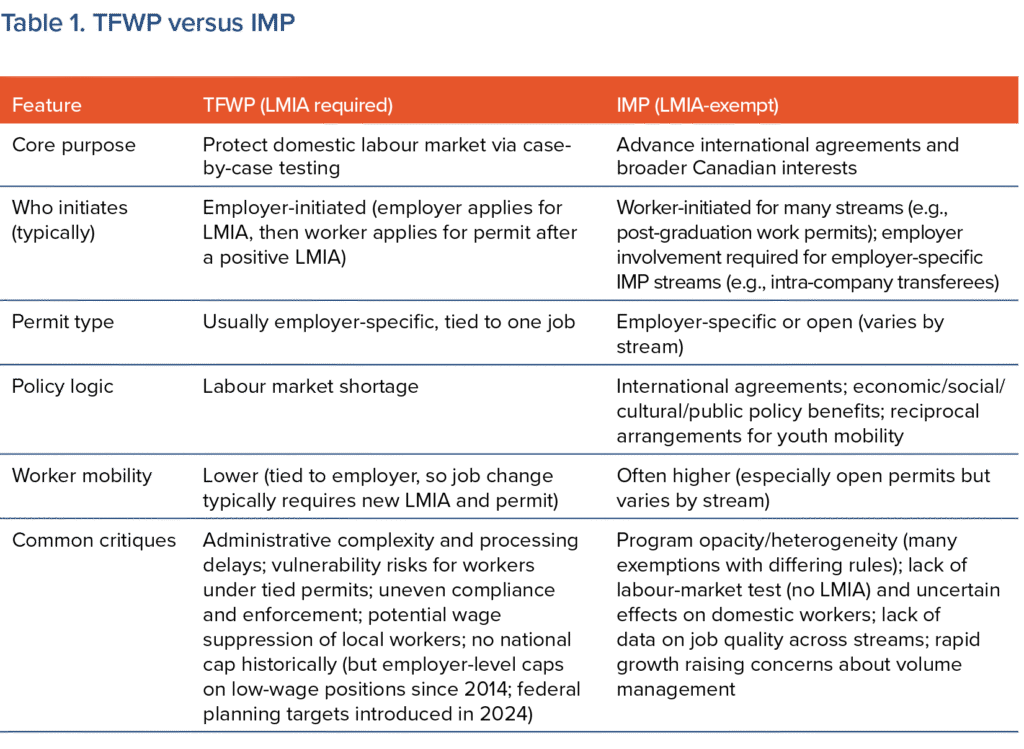
For permits that require an LMIA, employers must advertise the position, document their recruitment efforts and demonstrate that no qualified Canadians or permanent residents are available. Permits are usually employer-specific and the overarching goal is to protect the domestic labour market. By contrast, LMIA-exempt permits are granted when the “public interest” justifies bypassing this labour-market test.
Table 1 compares the features of TFWP and IMP permits.
The IMP organizes LMIA-exempt permits under three rationales: international agreements (e.g., the Canada-United States-Mexico Agreement [CUSMA] and the Comprehensive Economic and Trade Agreement [CETA]); Canadian interests (economic/public policy/significant benefits); and other programmatic permits (protection for vulnerable workers and bridging open permits, plus select pilots). While this tripartite framework may be descriptively useful, most of the IMP’s size, policy salience and internal heterogeneity lies within the Canadian interests stream, which bundles diverse sub-pathways with distinct objectives, eligibility requirements and work rights, and it is subject to frequent policy changes.
Table 2 outlines examples and design features of the IMP permit categories.

Figure 1 presents a simplified overview of selected streams within the IMP, organized into its three core categories. It highlights commonly used LMIA-exempt permits, such as intra-company transferees authorized under trade agreements; spouses of skilled workers and international students; post-graduation work permit-holders; and working holidaymakers under the international experience Canada program. While not exhaustive, the figure focuses on select pathways to illustrate the varied logics underpinning the IMP.

Although the IMP is often presented as facilitating the entry of highly skilled professionals, the reality is more complex. Permit-holders may include an intra-company transferee software engineer arriving to lead a product rollout, or a youth working holidaymaker or a spouse on an open work permit in a precarious hospitality or retail role with variable hours and limited security (on precarious employment conditions confronting spouses, holidaymakers, and postgraduates, see Vosko, 2026, in this series).
IMP permit-holders also have limited or no eligibility for publicly funded settlement and employment services. This shifts the burden of integration onto the immigrants themselves and further amplifies vulnerability during a period when targeted support is most consequential. Beyond paid work, many IMP permit-holders, particularly dependent spouses, also provide unpaid care and family support with little to no settlement help.
Figure 2 illustrates the growth of various IMP subcategories from 2000-22. The post-graduation work permit stream has experienced the most dramatic expansion, particularly since 2015, reaching nearly 300,000 permit-holders by 2022. The number of spouses of students and skilled workers has also risen steadily since 2014, now representing a substantial share of IMP permit-holders. In contrast, reciprocal agreements, which include working holidaymakers, and the significant benefit and agreement categories, which include inter-company transferees, have remained relatively stable or declined in recent years. We clearly see how Canada’s temporary migration landscape has shifted decisively toward post-graduation work and spousal permits as dominant entry pathways.

Permit-holders experience vastly different levels of stability, rights and access to permanent residency depending on category. For example, post-graduation work permit-holders and spouses of high-skilled workers are well-positioned for transition to PR status through express entry or provincial nomination programs, while working holidaymakers face more limited pathways (Li & Haan, 2023).
Additionally, although many of these permits fall under a common LMIA-exempt umbrella, they are governed by distinct policy rationales, institutional arrangements and employer obligations. These differences matter. They shape migrants’ employment trajectories, their social protections and prospects for long-term economic security.
The complex and dynamic nature of two-step migration
Our analysis draws on the longitudinal immigration database (IMDB), which links immigrant landing records to annual tax data for all immigrants who file taxes in Canada. A key feature of this analysis is the integration of the temporary resident permit-level dataset, which provides detailed administrative records on the issuance of temporary permits over time. This unique dataset allowed us to track permit types and transitions of permit-holders prior to obtaining permanent residency, capturing the complex and dynamic nature of two-step migration. This approach enabled us to examine how the initial permit type and transitions within the IMP influence earnings trajectories, utilizing comprehensive administrative data encompassing more than 200,000 newcomers.
We compared two main groups:
Two-step migrants: Individuals who first entered Canada on a temporary work or study permit, reported employment earnings and later transitioned to economic permanent residency.
Our specific interest was in the IMP, where we focus on four key permit subcategories of two-step immigrants:
- post-graduation work permits (PGWP)
- spousal open work permits (SPOU)
- working holidaymakers (WHMs)
- intra-company transferees (ICTs)
Using classification variables from the permit-level dataset, we tracked these subcategories over time, allowing us to capture the complex dynamics of changes across years.
One-step immigrants: Economic immigrants who became permanent residents directly, without any prior Canadian work or study experience.
To ensure a fair comparison, we limited our sample to those who obtained permanent residency through the federal skilled worker program or the provincial nominee program because these are the two key economic streams accessible to both one-step and two-step migrants.
To assess how permit type influences immigrant earnings over time, we analyzed the administrative tax data using a longitudinal approach that tracks individual earnings year by year. We used growth curve modelling — a method designed specifically for analyzing repeated measures over time — to model how each individual’s earnings changed after arrival and to compare growth patterns across different permit types.
Our models account for both time-varying factors, such as changes in permit status, and fixed characteristics, such as country of origin and age at arrival. Analyses were conducted separately for men and women to capture gender differences.
Our analysis focused on newcomers who arrived in Canada as either temporary or permanent residents across five arrival cohorts: 2002, 2005, 2008, 2011 and 2014. Our dataset drew on salary information from T4 tax records, tracking earnings up to 2021. The analysis was restricted to individuals in their prime working years (aged 25 to 54) at the start of their first permit.
Our models controlled for a range of variables, including total number of permits held, average permit duration (in days), age at arrival, year of landing, country of birth, entry cohort, admission category, marital status, province and census metropolitan area (CMA) of residence. All analyses were conducted separately for men and women.
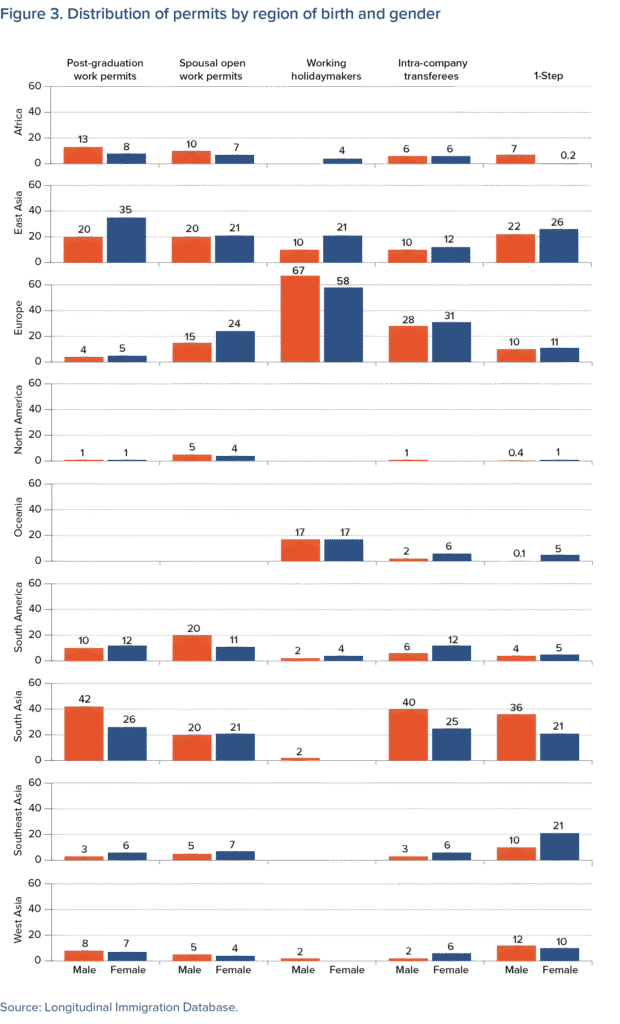
Our descriptive results shown below reveal that entry pathway strongly shapes who immigrates, how long they remain on temporary status and how they move to permanent residence, with distinct gendered patterns.
Regional origins
As figure 3 shows, working holidaymakers, particularly men, are drawn overwhelmingly from Europe and Oceania (Australia and New Zealand), reflecting that this stream largely serves citizens of affluent, white-majority countries. By contrast, South Asian and East Asian immigrants dominate the other major pathways such as PGWP, SPOU and ICT for both men and women, although women in the latter category show a slightly higher share from Europe. SPOU permit-holders are the most regionally diverse, spanning every world region.
Permit dynamics
Permit experiences also differ. PGWP holders of both genders hold the most permits over time, signalling multiple renewals or status extensions, while ICTs hold the longest-duration permits on average (figure 4).

Pathways to permanence
Finally, routes to permanent residence diverge sharply. WHM, SPOU and PGWP permit-holders rely heavily on provincial nomination, whereas ICTs and one-step immigrants most often transition through the federal skilled worker program (figure 5).
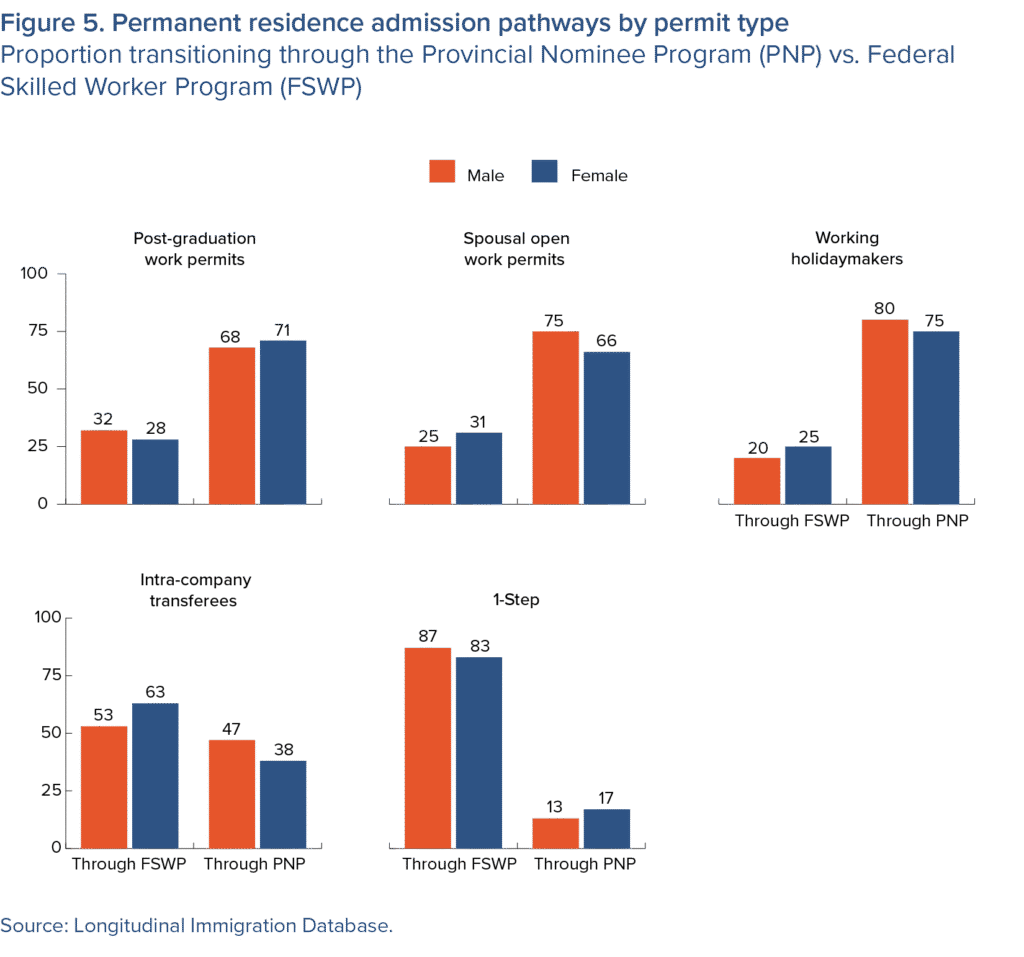
Taken together, these patterns show that permit-type structures not only reflect migrants’ geographic origins but also their temporary and permanent trajectories, with notable gendered variation. This broadly confirms established patterns of global migration privilege and stratification.
How Permit Type Shapes Earnings Trajectories
Both initial earnings and growth patterns depend on permit type.
Permit type plays a critical role in determining the initial earnings of two-step immigrants compared to those who arrive directly as permanent residents. Figure 6 illustrates these differences: ICT and PGWP holders consistently enter the Canadian labour market with significantly higher starting earnings. ICT holders earn 47 per cent more (men) and 78 per cent more (women) than one-step immigrants at entry, while PGWP holders earn 11 per cent more (men) and 40 per cent more (women). In contrast, WHMs typically begin with earnings 60 to 70 per cent lower than those of one-step immigrants. SPOU permit-holders exhibit mixed outcomes: men start with much lower earnings than one-step immigrants, while women enter the workforce with only a slight disadvantage.

Permit type is not only related to initial earnings but also influences longer-term earnings. Controlling for education, PGWP holders, particularly men, demonstrate sustained earnings growth after entry, suggesting successful career progression. In contrast, ICTs maintain their initial earnings advantage, with high but stable incomes that do not increase substantially over time. WHMs, while starting with significantly lower earnings, experience faster growth relative to their starting point, yet remain at a disadvantage for many years. SPOU holders show limited earnings growth overall, with women seeing slower advancement after initially entering slightly ahead of one-step immigrants.
Gender gaps persist across all permit types
Women earn consistently less than men across all permit categories. These gender gaps are especially pronounced among ICTs and WHMs. Although women in the PGWP and ICT streams benefit from relatively strong initial earnings, their long-term earnings growth is more limited, compared to their male counterparts. This pattern is broadly consistent with evidence on one-step permanent residents. While economic-class principal applicants sometimes exhibit smaller entry-stage gaps, gender pay differentials persist and women’s earnings trajectories remain flatter over time.
Canadian work experience does not ensure equal outcomes
While two-step migration and Canadian work experience can facilitate successful labour market integration for many, outcomes are far from universal. Our analysis shows that the benefits of Canadian work experience for temporary permit-holders who later secure permanent residency are heavily dependent on the permit type. PGWP holders in particular can leverage their Canadian experience into both higher starting wages and sustained earnings growth. However, WHMs and many SPOUs, despite acquiring Canadian work experience, remain concentrated in lower-paying jobs over time. These findings suggest that, while two-step migration can work well for certain groups (Lu and Hou, 2024), it does not consistently deliver equitable outcomes across all pathways.
Understanding the structural barriers behind permit-based disparities
Our analysis does not directly explain why certain permit groups perform better or worse, but several factors likely contribute to the differences. PGWP holders may do well due to their Canadian educational credentials, local networks and clear pathways to permanent residency. ICTs benefit from being recruited directly into positions with established employers, providing relatively higher starting wages and stable employment.
Within the IMP, however, other permits differ fundamentally in intent and design. SPOU holders enter based on family ties. Work authorization is intended to maintain household stability while the primary applicant works or studies, but employment is not the program’s main purpose. WHMs are typically employed in casual or seasonal jobs. Many work in rural or remote locations where limited job opportunities may constrain the development of professional networks and earnings. Their short, non-renewable permits and lack of a clear pathway to permanent residency further compound these disadvantages.
Overall, these program features help explain why, even with Canadian work experience, many SPOU and WHM holders remain in lower-paying jobs and experience slower earnings growth than PGWP holders, ICTs and even some one-step immigrants.
Policy Implications and Recommendations
The tax data show that permit type, not Canadian experience alone, shapes the economic success of two-step immigrants. While high-performing groups — such as PGWP holders and ICTs — enjoy high, growing wages by benefiting from Canadian education or employer-driven entry, others — inc|luding WHMs and SPOU holders — face persistent economic disadvantage. Permit conditions, dependence on a partner for status and concentration in low-wage job sectors or geographically remote jobs likely compound vulnerability for the latter. The lack of transparency and coherence across temporary migration pathways makes these inequalities worse.
Policymakers should respond with co-ordinated actions in the short and medium term, drawing on the mandates of Immigration, Refugees and Citizenship Canada (IRCC) as the federal lead; Statistics Canada, and Employment and Social Development Canada for data and labour-market information; and provincial and territorial governments for post-secondary oversight and settlement programming. Settlement agencies, post-secondary institutions and employer partners are also critical delivery partners.
Consequently, these are the policy tools and actions that should be implemented in the short and medium term.
Short-term actions
Better data for better evaluation
- Collect and publish disaggregated data on earnings, occupations, permit transitions and employment outcomes across all IMP permit types.
- Develop a performance measurement framework to track outcomes within the IMP.
Medium-term reforms
Expand settlement services eligibility to temporary residents on a path to permanent residence
- Provide federally funded language training and employment supports to IMP permit- holders based on length of stay and settlement intent.
- Require post-secondary institutions to offer robust settlement support to international students. These investments will pay future benefits for Canada once students become permanent residents, yielding higher retention and labour market readiness.
- Develop tailored support for current temporary residents and new permanent residents who hold low-earning permits (e.g., SPOU permit-holders and WHMs), addressing barriers to stable employment and human capital investment.
Strengthen the PGWP pipeline
- Rethink across-the-board reductions to study permits. Instead, tie permit allocations to transparent, program-level evidence of educational quality and student supports. Publish outcomes to guide student choice and align growth with quality. Investing in high-quality study programs delivers durable economic returns once students become permanent residents.
- Scale work-integrated learning. Expand co-ops, practicums and paid placements, with incentives for employers, especially small- and medium-sized enterprises (SMEs), so that graduates gain Canadian work experience directly linked to long-term labour-market needs.
- Don’t over-tighten PGWP access. Demand for PGWPs remains high (Keung, 2025) even as eligibility has become more selective, signalling that the pathway is crucial to retaining work-ready graduates. Over-restricting PGWP spots reduces Canada’s ability to keep top alumni, pushes talent to competitor countries and undercuts employer pipelines, especially in SMEs.
Expand permanent residence and modernize selection for equity and growth
- Avoid a two-step bottleneck by expanding PR admissions alongside targeted investments in housing, settlement and infrastructure. Cutting PR numbers strands productive temporary residents in limbo, raising the risk of status loss and talent outflows. It also jeopardizes the conversion of Canadian training and work experience into long-run productivity gains.
- Use Canadian earnings records, not just occupational codes, as a key criterion for PR eligibility. Evidence from Picot et al. (2020) and our own analyses shows that two-step migrants with strong Canadian earnings consistently outperform direct permanent residents in post-landing income growth, regardless of their occupation. Make earnings-based selection fair and sector-sensitive by benchmarking applicants against context-appropriate comparators rather than absolute dollar cut-offs.
- Develop independent PR pathways for spouses and other temporary residents engaged in low-wage, yet socially meaningful, work. The recognition of these experiences should complement earnings-based selection by acknowledging non-wage contributions and reducing the vulnerability associated with family-dependent PR applications.
Conclusion and Next Steps
This analysis focused only on immigrants who successfully transitioned to permanent residency. This excludes many temporary residents who failed or are failing to secure permanent status — a major source of precarity within the IMP. Moreover, our data end in 2014. Since then, the IMP has grown dramatically, particularly through the PGWP stream, and the profile of international students has shifted toward college-level programs with weaker labour-market prospects (on entry of IMP permit holders to 2021 by stream, including the PGWP, see Vosko, 2025).
Recent federal policy changes compound these pressures. Since 2024, PR targets have been reduced and transition rules tightened. Many temporary residents now attempt to manage uncertainty by switching between permit types to extend their stay — a strategy that often disrupts employment and prolongs temporary status. Unless the federal government rebalances the relationship between temporary and permanent immigration, these trends will deepen structural inequities and erode the economic benefits.
The recommendations in this report provide a concrete path forward.
Better data would give IRCC, Statistics Canada and provincial partners the tools to monitor transition rates and labour market outcomes across all IMP streams, including those who fail to transition.
Expanding settlement services eligibility would ensure that temporary residents with settlement intent can invest in language skills, credentials and employment readiness, compounding benefits once they become permanent residents.
Strengthening the PGWP pipeline would protect and enhance a proven high-return pathway by aligning study permit allocations with program quality and by scaling work-integrated learning opportunities that build lasting Canadian work experience.
Finally, expanding permanent residence and modernizing selection for equity and growth would raise PR targets so productive temporary workers can secure permanent status and sustain Canada’s economic growth; prioritize demonstrated Canadian earnings over occupational levels in PR selection; and create independent PR pathways for spouses and others in socially essential but low-paid roles, recognizing non-wage contributions and reducing relational precarity.
These measures form the basis for a focused system review that streamlines IMP subcategories, clarifies each permit’s purpose and recentres the system on timely, equitable transitions to permanent residence rather than prolonged temporary status. Without such co-ordinated action, Canada risks deepening systemic inequities that harm immigrants and weaken the country’s long-term economic and social prosperity.
References
Banerjee, R., & Lam, M. (2024). Paths to permanence: Permit categories and earnings trajectories of workers in Canada’s international mobility program. Canadian Public Policy/Analyse de politiques, 50(2), 142-160.
Hou, F. (2025). From temporary to permanent residency (Data brief no. 3). Institute for Research on Public Policy. https://centre.irpp.org/wp-content/uploads/sites/3/2025/09/From-Temporary-to-Permanent-Residency.pdf
Keung, N. (2025, September 26). Which international students in Canada are getting postgraduate work permits? The list is shrinking. The Toronto Star. https://www.thestar.com/news/canada/which-international-students-in-canada-are-getting-postgraduate-work-permits-the-list-is-shrinking/article_7dfcea28-e55f-45e5-a091-a8d8ff2817be.html
Li, Y., & Haan, M. (2023). From temporary foreign workers to permanent residents: Differences in transition rates among work permit categories. Canadian Ethnic Studies, 55(2), 125-157.
Lu, Y., & Hou, F. (2024). Foreign workers in Canada: Differences in the transition to permanent residency across work permit programs (Catalogue no. 36-28-0001). Statistics Canada: Economic and Social Reports. https://www150.statcan.gc.ca/n1/pub/36-28-0001/2024006/article/00001-eng.htm
Picot, G., Xu, L., Hou, F., & Bonikowska, A. (2020). Which immigration selection factors best predict the earnings of economic principal applicants? Policy Research Branch, Immigration, Refugees and Citizenship Canada. https://www.canada.ca/content/dam/ircc/documents/pdf/english/corporate/reports-statistics/research/immigration-selection-factors-predict-earnings-economic-principal-applicants/r3c-2020_ee_eng.pdf
Tomlinson, K. (2013, April 6). RBC replaces Canadian staff with foreign workers. CBC News.
https://www.cbc.ca/news/canada/british-columbia/rbc-replaces-canadian-staff-with-foreign-workers-1.1315008
Vosko, L. F. (2024). Challenging the global migration/mobility program policy construct: Labour market (in)security under Canada’s “new” International Mobility Program. In C. Kuptch & F. Mieres (Eds.), Temporary labour migration: Towards social justice (pp. 87-105). International Institute for Labour Studies, ILO.
Vosko, L. F. (2025). Migrant work by another name: Differential inclusion and precarity in Canada’s international mobility program. University of Toronto Press.
Vosko, L. (2026). Whither temporary migrant work?: Differential inclusion and precarity in Canada’s International Mobility Program. Institute for Research on Public Policy.
This Policy Brief was published as part of the Canada’s Changing Immigration Landscape series from the Centre of Excellence on the Canadian Federation. The manuscript was copy-edited by Jim Sheppard, proofread by Zofia Laubitz, editorial co-ordination was by Étienne Tremblay, production was by Chantal Létourneau and art direction was by Anne Tremblay.
Canada’s Changing Immigration Landscape is a partnership between the Centre of Excellence on the Canadian Federation at the IRPP, the Institute for Research on Migration and Society at Concordia University (IRMS) and the Centre for Migration Studies at the University of British Columbia (CMS). All publications are under the direction of Charles Breton, Executive Director of the Centre of Excellence on the Canadian Federation, Mireille Paquet, Director of IRMS, and Irene Bloemraad, Co-director of CMS.
Dr. Rupa Banerjee is Professor of Human Resource Management and Organizational Behaviour at Toronto Metropolitan University and holds the Canada Research Chair in Economic Inclusion, Employment, and Entrepreneurship of Canada’s Immigrants. A leading scholar of immigration and labour-market integration in Canada, her research examines how immigration policies, employers, and institutions shape newcomers’ socio-economic outcomes. She also explores international students’ and temporary foreign workers’ experiences and the expanding role of digital technologies in employment trajectories. Her work also extends to second-generation, racially minoritized and gendered outcomes, and to the mechanisms of ethno-racial discrimination in the workplace, with attention to intersectional and institutional dynamics.
A French translation of this text is available under the title Tous les parcours migratoires ne sont pas égaux. Le système canadien en deux étapes cause des réussites comme des embuches.
To cite this document:
Banerjee, R. (2026). Not all immigration paths are equal: Some immigrants thrive, while others struggle, in Canada’s two-step system. Institute for Research on Public Policy. https://doi.org/10.26070/c8kb-tm12