

An “Expedient” Union: Federal Leadership and the Imperative of Internal Trade

Introduction: BACK TO THE FUTURE
An America in turmoil turns its back on its northern neighbours; a lucrative trading relationship is suddenly broken. To compound the problem, add the looming threat of annexation. Shaken out of complacency, a ragtag group of northern neighbours knows it must act: create an economic union or be swallowed whole.
The year? Not 2025, but 1867.
The story of Canada’s economic union has many chapters. But history is a plagiarist: this latest chapter is stolen right from the first one.
Facing trade and security threats from the south, Canada was created in 1867 as a federation — a union of four colonies. The colonies became provinces, and power was divided between the provinces and the new federal government. This “expedient” — according to the very terms of the Constitution Act, 1867 — arrangement protected the colonies and kept the peace, but led to a very imperfect economic union, replete with internal barriers to trade.
Constitutionally speaking, what is creating these internal barriers? And what can the provincial and federal governments do about it?
This essay outlines how barriers to internal trade are the byproduct of our federal constitutional arrangement. The Supreme Court has largely left the problem to be hammered out by governments. To the extent these barriers are a problem, the solution lies with the age-old art of compromise. Since the vast majority of trade barriers are the result of provincial measures, it is the provinces who need to do the compromising. However, the federal government has an important role to play. After all, the problem and the stakes are both national and existential. Heroic federal leadership is needed — but leadership of the co-operative rather than coercive variety.
The Constitutional Framework and its Limits
Every barrier to internal trade emerges from one basic reality: Canada is a federation. It has two levels of government (federal and provincial/territorial), each level with law-making ability within its respective jurisdiction as defined by the constitution.
The riveting story of the constitutional framework for interprovincial trade can be told by way of two Supreme Court decisions — both featuring ill-fated quests to move booze between provinces. The first features a New Brunswick pensioner on a mission for cheap Quebec beer; the second, much earlier, features a liquor purveyor trying to get its product into Prohibition-era Alberta and Saskatchewan.
R v Comeau, 2012-2018
On Saturday, October 6, 2012, Gérard Comeau made the two-and-a-half-hour drive from his home in Tracadie, New Brunswick, to the Listuguj First Nation Indian Reserve in Quebec. His mission: to fill his trunk with cheap beer. Unbeknownst to him, he was being watched. The RCMP detachment in Campbellton had set up a sting operation to catch the many New Brunswickers making a similar trek to smuggle trunkloads of cheap booze into the province. Upon re-entering New Brunswick, Mr. Comeau was caught red-handed. The RCMP carefully catalogued the contents of his trunk: 15 cases of beer (Sleeman’s, Miller, Molson, Budweiser and Coors) and 3 bottles of liquor (whiskey and Stinger Premixxx liqueur). He was charged and fined under New Brunswick’s Liquor Control Act, which prohibited the possession of more than 12 pints of beer or one bottle of liquor purchased outside the province.
He challenged the constitutionality of the law. The Canadian Constitution Foundation backed this as a test case, and it was headed for the Supreme Court of Canada (see Manucha, 2022, pp. 3-12). For obvious reasons, the case became known as the “free the beer” case.
What was it about? It was an attempt to reactivate the little-known and little-used s. 121 of the 1867 Constitution (formerly called the British North America Act or BNA Act). The BNA Act sets out the powers of both federal and provincial legislatures (at ss. 91 and 92, respectively). It also includes s. 121, which states that:
-
- All Articles of the Growth, Produce, or Manufacture of any one of the Provinces shall, from and after the Union, be admitted free into each of the other Provinces.
But what does “admitted free” mean? Why did it need to be reactivated? For that, we must journey back to the Prohibition era.
Gold Seal Ltd. v Alberta, 1921
In 1921, the Supreme Court decided that “admitted free” in s. 121 simply meant free of tariffs. The decision was called Gold Seal v Alberta. In that case, Gold Seal — a purveyor of alcohol — wanted to transport its product from Vancouver to Calgary and Moose Jaw (Manucha, 2022, pp. 22-23). However, there was Prohibition in Alberta and Saskatchewan, and a federal law (the Canada Temperance Act) prohibited the importation of alcohol into provinces where Prohibition was in effect. Gold Seal challenged the law but ultimately lost: the Supreme Court upheld the law. The Court decided that “admitted free” in s. 121 does not mean the free movement of goods, but rather that goods moving between provinces must be free of customs duties, that is tariffs. The Gold Seal decision meant that, while s. 121 prohibits provinces from charging tariffs or duties on goods moving between provinces, it does not prevent federal or provincial laws from otherwise blocking interprovincial trade. While it may have been good public policy at the time, the Supreme Court’s narrow interpretation of s. 121 in Gold Seal arguably led to the interprovincial trade quagmire we see today.
While tariffs (i.e., taxes on interprovincial trade) between provinces are a no-go, there is plenty of room for so-called “non-tariff barriers” to trade. As the plain wording suggests, “non-tariff barriers” are any impediments to trade other than tariffs. These can arise from measures that deliberately restrict trade (e.g., quotas and import restrictions), or simply from any differences in regulations that create an impediment to the free flow of goods and services. For example, different professional, labour, safety and environmental standards between provinces can impede trade. Anywhere the province can regulate, non-tariff barriers can be created.
Hence the attempt, in Comeau, to reactivate s. 121. Comeau’s legal team wanted the Supreme Court to force provinces to tear down interprovincial trade barriers. They failed — but not for lack of trying.
The trial at Campbellton: The story of Confederation
The Comeau trial took place over four days in August 2015 at the provincial courthouse in Campbellton, New Brunswick. At trial, sweeping expert evidence told the story of the purposes of Confederation, and the origins of section 121 in the BNA Act. The story told at the Campbellton courthouse is remarkably relevant today.
According to the trial judge, one of the main purposes of Confederation was to create an economic union — in particular, to stave off a trade threat from America.
Indeed, the 1854 Reciprocity Treaty with the United States had become a boon for the British North American colonies. In exchange for fishing rights, America permitted the colonies free access for their exports to the American market. This was a lucrative and mutually beneficial trading relationship and led to economic prosperity in the colonies.
However, in the 1860s, the American civil war led many Americans (especially Northerners) to become suspicious of the British colonies, likely because of Britain’s aid to the South during the civil war. Americans turned against the Reciprocity Treaty. U.S. Customs officials began “search and detain” protocols for imports from the British colonies. Eventually, the United States abrogated the treaty in 1865-66.
This hit the British North American colonies hard, each in its own way. For example, Nova Scotia and Prince Edward Island suffered a severe drop in fish exports — their main export to the United States (Manucha, 2022, pp. 16-18).
Since the British colonies were not a country, they had no central government to advocate on their behalf with the Americans. The British government played this role, but it had its own interests to look out for.
According to the Comeau trial judge,
The British government also wanted its North American subjects to be able to trade freely with the United States but were unable to achieve that end. This gave rise to a search for an alternate mode of economic development. The search was in earnest for alternative markets. The strategy adopted, […], was internal free trade within the boundaries of British North America (see R v Comeau, 2016: para. 81).
To add to the economic threat, following the end of the American civil war in 1865, a new security threat emerged: the threat of a militarized and expansionist America.
The British North American colonies now needed to band together. They needed an internal market, a railway and a central government to deal with the Americans.
A union was needed. However, given the diversity between the colonies — most notably the French and Catholic-majority population in Lower Canada (now Quebec) with its civil law legal system, as compared to the English/Protestant/common law colonies — a total fusion of the colonies was not feasible. After several unstable attempts to join Upper and Lower Canada together in the first half of the 19th century, it was clear that some kind of arrangement that preserved the diverse character of the colonies was needed. Thus, federalism was the expedient way to achieve this union while accommodating this diversity.
Confederation — and federalism — was therefore “expedient.” An economic union was sorely needed, time-sensitive and a pragmatic response to external pressures. The reasons for Confederation are there in black and white in the Preamble of the BNA Act (the 1867 Constitution):
Whereas the Provinces of Canada, Nova Scotia, and New Brunswick have expressed their Desire to be federally united into One Dominion under the Crown of the United Kingdom of Great Britain and Ireland, with a Constitution similar in Principle to that of the United Kingdom:
And whereas such a Union would conduce to the Welfare of the Provinces and promote the Interests of the British Empire:
And whereas on the Establishment of the Union by Authority of Parliament it is expedient, not only that the Constitution of the Legislative Authority in the Dominion be provided for, but also that the Nature of the Executive Government therein be declared:
And whereas it is expedient that Provision be made for the eventual Admission into the Union of other Parts of British North America…
Federalism and its frustrations
While Confederation was “expedient,” Canada’s economic union was always going to be imperfect because of the institutional choice on which it was built.
Federalism was a pragmatic choice to accommodate diversity between provinces, but this union of colonies — as opposed to their fusion — required a series of compromises.
All things considered, this compromise has been a remarkably stable and peaceful one. The Supreme Court of Canada has described federalism as a way to reconcile diversity and unity (Ref re Secession, [1998] 1 SCR 217 at para. 43). But while the compromise has arguably succeeded at accommodating diversity, it has fallen short when it comes to unity — notably economic unity.
The BNA Act created two levels of government (federal and provincial) and listed out the powers they were each to have. While the federal level had power over “The Regulation of Trade and Commerce,” the provinces had power over “Property and Civil Rights in the Province,” “Generally all Matters of a purely local or private Nature in the Province,” and a host of other areas (including cities, liquor licensing, hospitals and land management). Early court decisions gave a broad interpretation to provincial powers, thereby setting the stage for a decentralized federation.
Thus, by design, provinces are entitled to make their own laws in a broad swath of matters such as highway safety, workplace rules, agriculture, licensing, professions, parks, construction and alcohol regulation.
The BNA Act did allow the federal Parliament to facilitate the uniformity of laws in relation to “Property and Civil Rights” in the three English-speaking common law provinces (i.e., Ontario, New Brunswick and Nova Scotia), so long as the provincial legislatures agreed.[1] That provision was never used.[2]
However, this constitutional framework does restrict the ability of provinces to regulate interprovincial trade. Because the federal level is given jurisdiction over “trade and commerce,” courts have decided that provinces cannot enact legislation that in “pith and substance” is directed at a matter of interprovincial trade. For example, provinces cannot directly regulate the interprovincial or international trade of goods. However, they can do so “incidentally” — which leaves provinces plenty of wiggle room when it comes to non-tariff barriers.
And so it is that Canadian federalism by its nature leads to a host of non-tariff barriers to trade. While some barriers (e.g., the favouring of local beer and wine producers in a province’s alcohol regulation) are clearly intended to protect local producers at the expense of other Canadian producers, many other barriers — in fact, most such barriers — are simply a byproduct of inconsistent standards between provinces.[3] They are the accidental but inevitable result of 14 jurisdictions (10 provinces, 3 territories, and the federal level) making their own parallel rules. For example, inconsistent trucking safety standards between Alberta and British Columbia mean that certain truck configurations can only be driven in Alberta during the day and British Columbia by night — leading to needless delays (Standing Senate Committee, 2016). Another example: because direct-to-consumer shipments of wine are not allowed in most provinces,[4] it is easier to buy British Columbia wine in the United States than in most Canadian provinces.
Some people defend internal trade barriers on the basis that they allow provinces to pursue important policy goals such as environmental protection, workplace safety, and other economic and social policy goals (Trew & Lee, 2025). Similar to the objections to liberalizing international trade, there is a fear that eliminating internal trade barriers means eliminating provinces’ ability to carry out good public policy — affecting a regulatory “race to the bottom.”
Nonetheless, in the decades since Gold Seal, proposals have been made to amend s. 121 or otherwise strengthen trade within Canada.
Moving Toward Liberalization
Federal-provincial negotiations
In the 1981-82 Patriation negotiations, an expanded scope of s. 121 was considered. This amendment would have prohibited discriminatory interprovincial trade barriers for goods, services and capital (Report of Continuing Committee of Ministers on the Constitution, 1980). Ultimately, s. 121 was left alone, but a labour mobility clause was added into the Canadian Charter of Rights and Freedoms (namely s. 6 of the Charter, which guarantees the free movement of Canadian citizens between provinces and the right to “pursue the gaining of a livelihood in any province”). However, this mobility clause has not wiped away the barriers to mobility created by provincial occupational and professional credential schemes. So despite s. 6 of the Charter, many Canadians, qualified for a profession in one province, cannot exercise that profession in other provinces without jumping through costly and time-consuming hoops — clearly a barrier to labour mobility between provinces.
For its part, the 1985 Macdonald Commission recommended that s. 121 be amended to include trade in services; but it otherwise recommended that the internal trade problem be left to governments rather than courts (Macdonald Commission, 1985, Vol. 3, pp. 10, 114-115, 136). In 1991-92, the topic was discussed extensively in the Charlottetown constitutional negotiations, but was ultimately shelved for lack of consensus.
In 1995, the Agreement on Internal Trade was struck. This was a deal between the provinces to eliminate certain internal trade barriers. However, it had a myriad of exceptions and no enforcement mechanism. For their part, the western provinces moved ahead with more robust agreements: the Trade, Investment and Labour Mobility Agreement in 2010; and the New West Partnership Trade Agreement (NWTPA) in 2015.
In 2017, the Agreement on Internal Trade was replaced by the Canadian Free Trade Agreement (CFTA). The CFTA was a more robust agreement: it has enforcement and dispute resolution mechanisms (for both provinces and businesses to launch claims against provinces that fail to meet their commitments) and a new regulatory harmonization apparatus (the Regulatory Reconciliation and Cooperation Table). It also created the Committee on Internal Trade — a Ministerial table to oversee the implementation of the agreement. But the CFTA still leaves a long list of exceptions. The dispute resolution mechanism has been used only six times since the CFTA came into effect,[5] and the progress toward regulatory harmonization has been, to say the least, slow.
Reactivating s. 121: Comeau and its aftermath
The Comeau case actually started before the CFTA came into being. The offending incident occurred in 2012, the trial took place in 2015, and the trial decision was rendered in 2016, the year before the CFTA was signed.
Mr. Comeau’s lawyers asked the New Brunswick Provincial Court to overturn Gold Seal, to find that s. 121 prohibits both tariff and non-tariff barriers to trade, and to declare the New Brunswick law unconstitutional on this basis. The Provincial Court accepted this invitation and struck down the law in 2016.
By the time the case reached the Supreme Court in December 2017, the CFTA had been signed. Before the Supreme Court, Mr. Comeau asked the Court to interpret s. 121 broadly, so as to create a constitutional guarantee for the free flow of goods between provinces. Many business groups also intervened in favour of strong constitutional protections for the free flow of goods within Canada. On the other side of the courtroom, Attorneys General from nine provinces, two territories, and Canada showed up. They reminded the Court about the (then) recently signed CFTA, with its intergovernmental mechanisms and carefully crafted exceptions. The message to the Supreme Court was clear: provinces had been making progress and wanted to keep these matters in the hands of governments, not courts, to negotiate for themselves.
The Supreme Court landed somewhere between Mr. Comeau’s radical proposition and keeping the constitutional status quo, but mostly the latter. The Court slightly broadened the interpretation of s. 121 from the “tariffs-only” prohibition in Gold Seal. It held that s. 121 also prohibits governments (federal or provincial) from enacting measures that aim at impeding internal trade. This appears to bust open the door to challenge measures that impede trade, but in reality it opens it only a crack. While a measure might incidentally affect trade, the Court held that, in order to run afoul of s. 121, its primary purpose must be to restrict trade. That is a high bar to clear for someone challenging a law: it leaves a lot of leeway to provinces. This is because most non-tariff barriers to trade are (or can be argued to be) “incidental” to some other public purpose.
Further, the existing jurisprudence already restricts provinces from directly regulating interprovincial trade, based on the federal power over “trade and commerce.”
Ultimately, in the Comeau decision, the Supreme Court declined to put rigorous constitutional limits on internal trade barriers, leaving this matter to be dealt with by governments. As a result, the Comeau case changed little.
In the years following Comeau, s. 121 was successfully used once: to strike down a protectionist markup and grant program for Alberta beer in 2019 (Steam Whistle Brewing, 2019). The program was rather explicitly designed to protect and favour local Alberta beer producers. This enabled the Alberta Court of Appeal to find that it did meet the high threshold for a measure that in “essence and purpose” is aimed at curbing interprovincial trade.
Around that time, it was also thought that s. 121 might factor into an escalating dispute between Alberta and British Columbia over the TransMountain pipeline, when Alberta enacted the “Turn off the Taps” law, giving Alberta the power to prevent Alberta fossil fuel resources from being sent to British Columbia. However, this dispute petered out without any help from s. 121.[6]
And so, even after Comeau, s. 121 has proved to be no more than a periodic blip on the constitutional radar. The landscape is the same: it still falls to the provinces and federal government to deal with the myriad internal trade barriers that remain. It will entail the hard work of negotiations, roundtables, alignment of technical standards. It requires focused effort and political will.
What Next? The Hard Work of Compromise
In this latest round of American turmoil, history is repeating itself: our neighbour is turning its back on its long-standing trading relationship with Canada. And Canada’s response, again, has been to look for a stronger internal economic union. Will this generation of leaders succeed where others have failed?
The solutions to Canada’s internal trade problem are myriad (Manucha, 2025a). But these policy solutions have until now been mainly pipe dreams. The real blockage has always been political will and sustained attention. Now that attention is focused, we are seeing some of these policy pipe dreams come true.
The provincial role
Since the vast majority of trade barriers are the result of provincial measures, the onus is on provinces to remove these barriers.
However, clearing up internal trade has never really been a political priority for any government. The reasons are obvious. First, protectionism is often a winning electoral proposition for provincial leaders. Second, and perhaps more importantly, for most provinces, the gains from liberalizing internal trade seem to be dwarfed by the gains from liberalizing international trade, especially opening up global markets for provinces’ exports. A given provincial government’s political and bureaucratic energy is — quite logically — focused where the rewards seem to be greatest. Until recently, this has been primarily on trade with the United States.
But with the current American trade dispute redux, provinces are turning their attention to the long-neglected issue of internal trade.
The low-hanging fruit is mutual recognition of provincial standards. Mutual recognition means that, if an individual or business complies with one province’s standard, this will be recognized as satisfactory for the same purpose in another province — think basic driver’s licences (Manucha, 2025b). Many barriers could be removed through mutual recognition, including safety standards and professional credentials. For mutual recognition, provinces can work through the multilateral mechanisms (under the CFTA), bilaterally, or simply lead by example as some provinces have done, starting with Nova Scotia (Smith, 2025). Momentum is building on this front (Schwanen, 2025).
Other acts of goodwill between provinces, such as the new non-binding Memorandums of Understanding between Alberta and Ontario on energy and trade infrastructure, may help build much-needed trust, co-operation and political momentum toward common goals (Government of Ontario, 2025).
The harder work of harmonizing standards while respecting provincial autonomy is a longer-term project. This must be done sector by sector, regulation by regulation. It can be done bilaterally or multilaterally. It requires sustained effort, attention, engagement and compromise. However, as a political issue, interprovincial regulatory harmonization is about as unsexy as they come.
The federal role
Clearly, provinces have not been able or willing to remove the remaining trade barriers by themselves. But, while internal trade is clearly a national priority of the highest order, this is no time to bring down the federal sledgehammer. The times call for federal leadership, but with finesse rather than muscle.
Some have argued that the federal government could use its broad federal powers (over “trade and commerce” or “peace, order and good government”) to enact sweeping federal legislation to overcome provincially created trade barriers. But this is the equivalent of a host knocking over the dinner table just as the guests are sitting down.
The Trudeau government employed that strategy on climate change policy. Just as the federal and provincial environment ministers were sitting down to hammer out a climate change plan in 2016, Prime Minister Trudeau surprised them by announcing that the federal government would steamroll ahead with or without provincial co-operation. The federal government relied on its constitutional power to make laws for “peace, order and good government” to enact its sweeping Greenhouse Gas Pollution Pricing Act (the carbon tax) (Harris, 2016). And while the Trudeau government enjoyed a legal victory before the Supreme Court of Canada, which upheld the law, a large part of the scheme ultimately died a political death, but not before it became the flashpoint for years of federal-provincial conflict (Major, 2025; References re Greenhouse Gas Pollution Pricing Act, 2021).
It is possible that a sweeping federal law abolishing interprovincial trade barriers might pass constitutional muster like the carbon pricing scheme, but only if it were crafted carefully and if the federal government could convince the Supreme Court of its necessity. However, such a law would inevitably trample vast areas of provincial jurisdiction. Such was the case with the carbon tax in the 2010s and, going back further, a federal anti-inflation law in the 1970s which froze prices and wages (Re: Anti-Inflation Act, 1976). To the chagrin of the provinces, both laws were upheld even though they intruded deeply into provincial jurisdiction.
But even if a sweeping federal law on internal trade were constitutionally permissible, such a federal sledgehammer on internal trade would certainly provoke conflict. It would put the federal government at odds with the provinces, leading to endless squabbles and a divided country. That is the exact opposite of what is needed in this moment.
Rather, the federal role is more properly that of a convener, facilitator, incentivizer, and leader by example.
The new federal Free Trade and Labour Mobility in Canada Act (C-5) is a good start, but by no means the end (Schwanen, 2025). Leading by example, the federal law will recognize provincial standards as meeting comparable federal standards, where both levels of government regulate the same thing. This applies to goods, services and professional credentials. Canada has also removed all federal exceptions in the CFTA (Schwanen, 2025). While this sends a strong signal, it does not wipe away any of the barriers that exist between provinces.
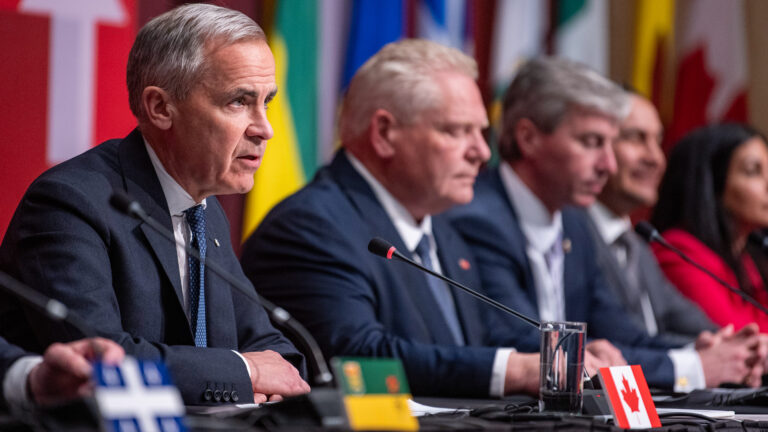
As the national convener, the federal government can set the table and invite the guests. The federal level can convene the First Ministers and encourage negotiation between provinces. This work began with a rare First Ministers in-person meeting in March 2025, appropriately held at the Canadian War Museum. At that meeting, First Ministers committed to work together to reduce internal barriers to trade (First Ministers meeting, 2025). In addition, the federal level can continue to convene the provinces to keep momentum and focus for the necessary interprovincial negotiations. The federal level can also act as a convener for the creation of model laws and regulations — an important component for the harmonization of rules.
Further, the federal government can create incentives to compromise. Trade liberalization inevitably creates winners and losers; for example, local industries who benefit from trade protection. In liberalizing internal trade, provinces might lose important revenue sources (from alcohol licensing, for example). To make compromise more palatable for provinces, the federal level can leverage its considerable spending power to replace those revenue sources and compensate the losers.
It goes without saying that, for the finesse approach to work, this federal leadership must be based on full respect for provincial jurisdiction and autonomy. It cannot be the Trudeau-style “gunboat diplomacy” of the carbon tax negotiation. It cannot come with a threat or ultimatum. It must be leadership that empowers rather than steamrolls. It needs to be serious and sustained, respectful yet vigilant.
Federal involvement signals that the problem is national, indeed existential. While the solutions lie within provincial jurisdiction, this federal engagement in shoring up Canada’s economic union — and thus its economic resilience — is the very purpose of the federal government, and has been since Confederation.
Conclusion: The Rhymes of History
As the saying goes, “History doesn’t repeat itself but it often rhymes.” Canada was cobbled together as a response to a trade and security threat from the United States. At a moment when our North-South relationship had soured, the East-West economic and political union was essential to our survival. At that moment, federalism was the “expedient” and pragmatic solution. But this solution is also the cause of today’s persistent internal trade barriers.
In the Parliamentary debates on confederation in 1865, George Brown (Upper Canada Parliamentarian, owner of the Globe, and Father of Confederation) had this to say:
[O]ne of the best features of this union is that if in our commercial relations with the United States we are compelled by them to meet fire with fire – it will enable us to stop this improvidence and turn the current of our own trade into our own waters.[7]
Every crisis is an opportunity. This crisis is the opportunity for Canada to bring to fruition the project started 158 years ago — to bring strength and resilience to a diverse and bestrewn population. In the best Canadian tradition, this will only be done through the hard work of negotiation and compromise. But in 2025, compromise is not failure, nor is it a luxury. It is “expedient,” which is to say, existential.
In the decades since the failure of the Charlottetown Accord in 1992, and the Trudeau-era failure of multilateralism on climate change policy, First Ministers meetings have been few and far between. The federal government has preferred to deal one-on-one (i.e., bilaterally) with provinces, rather than convening the provinces together in multilateral talks. Over these decades, the federal leadership has neglected its convening power — perhaps out of fear that nothing good could be accomplished through multilateralism. Now, there is new impetus to start talking again. Canada will relearn the art of compromise and be stronger for it, or die trying.
Notes
[1] BNA Act, s. 94: “the Parliament of Canada may make Provision for the Uniformity of all or any of the Laws relative to Property and Civil Rights in Ontario, Nova Scotia, and New Brunswick, […]; but any Act of the Parliament of Canada making Provision for such Uniformity shall not have effect in any Province unless and until it is adopted and enacted as Law by the Legislature thereof.”
[2] In 1976, Eugene Forsey called this provision (s. 94) “one of the Cheshire Cats of our Constitution” (Forsey, 1976, p. 536).
[3] See, for instance, Standing Senate Committee on Banking, Trade and Commerce,2016.
[4] Direct-to-consumer sales to Alberta have recently been allowed: see https://aglc.ca/liquor/about-liquor-alberta/alberta-bc-direct-consumer-wine-program.
[5] Canadian Free Trade Agreement Dispute Resolution – Status of Disputes by Chapter, last updated April 14, 2025. Online: https://www.cfta-alec.ca/wp-content/uploads/2025/05/Status-of-Disputes-by-Chapter-CFTA-April-14-2025.pdf.
[6] A challenge was started in Federal Court, and Alberta’s Bill 12 (“Turn off the Taps” law) was stayed based on another constitutional provision, s. 92A(2) (that provincial laws in relation to natural resources cannot discriminate with respect to other provinces). The Federal Court (2019 FC 1195) granted British Columbia’s motion for an interlocutory injunction of the Alberta law. Appeal allowed: Alberta (Attorney General) v. British Columbia (Attorney General), 2021 FCA 84 – lifting the stay mere days before the legislation was set to expire (under a two-year sunset clause). Shortly after, a new version was introduced in 2021 but has not yet been used.
[7] George Brown, Legislative Assembly, 7 February 1865, Parliamentary Debates on the Subject of the Confederation of the British North American Provinces, 3rd session, 8th Provincial Parliament Canada (Quebec: Hunter, Rose & Co Parliamentary Printers, 1865); reproduced in Manucha (2022, p. 18, n. 74).
References
Primary and Legal Sources
Alberta (Attorney General) v. British Columbia (Attorney General), 2021 FCA 84
Canada Temperance Act, RSC (1906) c 152.
Canadian Charter of Rights and Freedoms, Part I of Constitution Act, 1982, Schedule B to the Canada Act 1982 (UK), 1982, c 11.
Constitution Act, 1867, 30 & 31 Vict, c 3.
First Ministers Meeting. (2025, March 21). First Ministers’ statement on strengthening the Canadian economy. https://www.pm.gc.ca/en/news/statements/2025/03/21/first-ministers-strengthening-canadian-economy.
Free Trade and Labour mobility in Canada Act (C-5)
Gold Seal Ltd. v Alberta (Attorney-General) (1921), 62 SCR 424.
Liquor Control Act, RSNB 1973, c L10.
R v Comeau, 2016 NBPC 3.
R v Comeau, 2018 SCC 15.
Re: Anti-Inflation Act, [1976] 2 SCR 373.
References re Greenhouse Gas Pollution Pricing Act, 2021 SCC 11.
Reference re Secession of Quebec, [1998] 2 SCR 217.
Report of Continuing Committee of Ministers on the Constitution. 1989. Powers over the economy: Options submitted for consideration by the Government of Canada to safeguard the Canadian economic union in the constitution. In A. F. Bayefsky (Ed.), Canada’s Constitution Act 1982 & amendments: A documentary history (Vol. 2, p. 621). McGraw-Hill Ryerson Ltd. (Original work published 1980).
Royal Commission on the Economic Union and Development Prospects for Canada (“Macdonald Commission”), 1985, Volume 3, p 10, 114-115, 136.
Steam Whistle Brewing Inc v Alberta Gaming and Liquor Commission, 2019 ABCA 468.
Secondary Sources
Forsey, E. (1976). In defence of Macdonald’s constitution. Dalhousie Law Journal, 3(2) 529-539.
Government of Ontario. (2025, July 7). Ontario and Alberta Working Together to Build New Energy and Trade Infrastructure. Press release. https://news.ontario.ca/en/release/1006158/ontario-and-alberta-working-together-to-build-new-energy-and-trade-infrastructure
Harris, K. (2016, October 3). Justin Trudeau gives provinces until 2018 to adopt carbon price plan. CBC News. https://www.cbc.ca/news/politics/canada-trudeau-climate-change-1.3788825
Major, D. (2024, May 14). Carney kills consumer carbon tax in first move as prime minister. CBC News. https://www.cbc.ca/news/politics/mark-carney-drops-carbon-tax-1.7484290
Manucha, R. (2022). Booze, cigarettes, and constitutional dust-ups: Canada’s quest for interprovincial free trade. McGill-Queen’s University Press.
Manucha, R. (2025a). Tangled in red tape: How Canada can free its internal trade market. C.D. Howe Institute. https://cdhowe.org/publication/tangled-in-red-tape-how-canada-can-free-its-internal-trade-market/
Manucha, R. (2025b). Nova Scotia leading the way on reducing interprovincial trade barriers: Ryan Manucha in National Newswatch. Macdonald-Laurier Institute. https://macdonaldlaurier.ca/nova-scotia-leading-the-way-on-reducing-interprovincial-trade-barriers-ryan-manucha-in-national-newswatch/
Schneiderman, D. (2018, April 26). Barriers for beer, but not oil, National Post.
Schwanen, D. (2025). Provinces need to play if internal trade barriers are to fall. C.D. Howe Institute. https://cdhowe.org/publication/provinces-need-to-play-if-internal-trade-barriers-are-to-fall/
Smith, J. (2025). Nova Scotia introduces ‘first of its kind’ bill to remove interprovincial trade barriers. The Logic. https://thelogic.co/briefing/nova-scotia-introduces-first-of-its-kind-bill-to-remove-interprovincial-trade-barriers/
Standing Senate Committee on Banking, Trade and Commerce. (2016). Tear down these walls: Dismantling Canada’s internal trade barriers. https://publications.gc.ca/site/eng/9.819431/publication.html.
Trew, S. & Lee, M. (2025). The premiers’ new clothes: A critical look at the race to remove interprovincial trade barriers. Canadian Centre for Policy Alternatives.
https://www.policyalternatives.ca/news-research/the-premiers-new-clothes-a-critical-look-at-the-race-to-remove-interprovincial-trade-barriers/.
Maître Marion Sandilands’ essay examines the federal constitutional system and the obstacles it poses to trade. Reviewing two important Supreme Court of Canada decisions on interprovincial trade — R. v. Comeau, 2012-2018, and Gold Seal v. Alberta, 1921 — Ms. Sandilands notes that there is still no clearly defined law governing interprovincial trade. This legal uncertainty is inherent in federalism. To remedy this, we need a solution that draws on “the best Canadian tradition”: that of negotiation and compromise. Although legislative solutions are primarily the responsibility of provincial governments, Ms. Sandilands calls for federal leadership to guide these negotiations. For interprovincial trade to be a truly viable long-term alternative to declining trade with the United States, it must be based on the very foundations of the federation, namely multilateralism, not bilateral agreements.
This essay was published as part of the series Barriers and Bridges: Rethinking Trade Within the Federation published under the direction of Valérie Lapointe by the Centre of Excellence on the Canadian Federation. Editorial co-ordination was done by Étienne Tremblay, proofreading by Zofia Laubitz and production and layout by Chantal Létourneau and Anne Tremblay.
A French translation of this essay is available on the Centre’s website under the title Une union « opportune » : Le leadership fédéral et l’impératif du commerce intérieur.
Marion Sandilands is a partner at Conway Litigation in Ottawa. She joined Conway in 2019 after serving as an adviser to the Chief Justice of the Federal Court. She has also worked as a law clerk at the Supreme Court of Canada and the Federal Court. In addition to her work as a lawyer, Marion Sandilands is a lecturer at the University of Ottawa, where she teaches federalism law, and has taught the legislative process at McGill University’s Faculty of Law.
To cite this document:
Sandilands, Marion. (2025). An “Expedient” Union: Federal Leadership and the Imperative of Internal Trade. Institute for Research on Public Policy.
The opinions expressed in this essay are those of the author and do not necessarily reflect the views of the IRPP or its Board of Directors.
If you have questions about our publications, please contact irpp@irpp.org. If you would like to subscribe to our newsletter, IRPP News, please go to our website at irpp.org.
Cover: Luc Melanson