Economic Insecurity is Increasingly Linked with Opposition to Immigration in Canada



 |
Canada’s Changing Immigration Landscape |
| Immigration policy is central to the future of the federation. This series explores recent challenges and opportunities, turning complex issues into clear, actionable insights. |
Public support for immigration in Canada has dropped sharply in recent years amid rising concerns about the cost of living and economic insecurity. Using Canadian election survey data dating from 1988, we find that people who feel economically insecure are more likely to hold negative views of immigration. This link has become stronger since 2019. Negative attitudes toward immigration also tend to align with support for right-leaning political parties. Since 2019, economic insecurity has amplified the connection between the two. The analysis suggests that, while Canada has historically been less divided over immigration than other countries, growing financial pressures are making such tensions harder to ignore.
Setting the stage
Until recently, Canada stood out in the West for sustaining strong support for immigration — politically, immigration was not an election issue. A large proportion of voters from all major political parties supported the country’s immigration policy (Banting & Soroka, 2020). Canadian conservative parties have remained in favour of immigration and multiculturalism, even as conservative parties elsewhere in the world have successfully made anti-immigration pitches to voters. However, since the period between 2019 and 2022, the percentage of Canadians who believe there is too much immigration has increased by 21 percentage points, according to the Environics Institute for Survey Research (2025). For the first time since 1999, more Canadian survey respondents agree that there is too much immigration than those who disagree (Environics Institute for Survey Research, 2025). Pollara Strategic Insights (2025) documents a 29 percentage point drop between 2002 and 2025 in the view of immigration’s benefits to Canada.
Hostility to immigration has been an essential part of the far right’s electoral success in advanced democracies. Voters faced with economic insecurity have been particularly receptive to these parties’ appeals. While it might be expected that economic insecurity could push voters to support left-wing parties and their redistributive social policies, the European and American experience has instead seen unemployment feed anti-immigration attitudes and right-wing voting (Cohen, 2018; Dehdari, 2021; Golder, 2016).
In Canada, the recent collapse in support for immigration invites questions as to whether economic insecurity and hostility to immigration might start to define the divide between left and right. If the drop in Canadian support for immigration is lasting, will we see the Conservative Party of Canada (or other parties) try to capitalize on this division by breaking from the recent pro-immigration consensus? Conservative Leader Pierre Poilievre’s 2025 comments on the need to have “more people leaving than coming” (Duch, 2025, para. 1) suggest that the cross-partisan consensus on immigration is eroding and raises the possibility that immigration may become a significant electoral issue.
Measuring economic insecurity
When the Environics Institute for Survey Research asked respondents in 2025 to explain why they were opposed to immigration, the top two reasons were economic in nature: people feared the impact of excessive immigration on housing prices and the labour market.
Measuring economic insecurity is difficult. Having a job is, for most people, significant to their sense of economic security, so social scientists often consider whether survey respondents have been unemployed for some period in the present or past. A further complication in today’s world is the fact that an individual’s vulnerability to job loss may not necessarily be predicted by past unemployment. Technological change or fiscal circumstances can disrupt previously stable sectors of the economy. More importantly, an individual’s personal financial situation may be harmed by developments unrelated to unemployment, such as a steep escalation in the cost of housing or other necessities, unforeseen emergencies like car repairs or a root canal, or changing family situations like divorce. Yet, in some cases, with the rise of the gig economy and short-term contracts, people may become accustomed to unemployment in ways that do not necessarily bring about fears or anxiety.
In other research, we asked people several subjective questions about the consequences of losing their jobs (Polacko et al., 2024). Now, in this note, we look at how people rate their own financial situations over the last year (worse compared to better or same) and examine whether this evaluation affects their feelings about immigrants. We also examine whether a correlation between these two elements makes them more likely to support conservative parties.1 We find some evidence that the relationships between voting patterns and evaluations of personal financial situations and immigration attitudes have changed in recent elections in a manner that opens a door to the politicization of immigration policy in elections.
Attitudes and voting, 1988 to 2021
Has economic insecurity become more associated with anti-immigrant sentiment? Recent media coverage often links the high intake of temporary immigrants (especially international students) with housing unaffordability and high youth unemployment rates.
Figure 1 displays the average support for levels of immigration by respondents’ evaluation of their personal financial situation from 1988 to 2021. We distinguished respondents who rated their personal financial situation as “worse” from those who said it was “the same” or “better.”
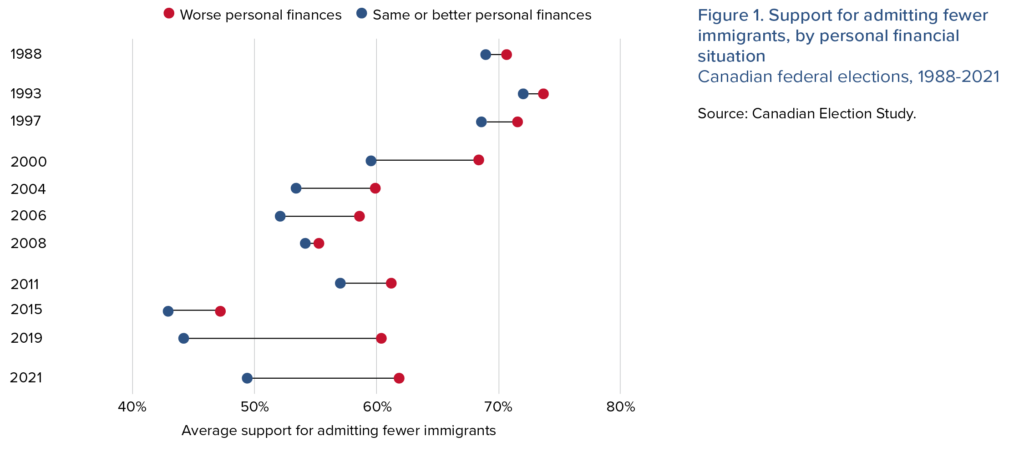
In every federal general election since 1988, respondents who rated their financial situation as worse were more opposed to increased immigration than those who rated their financial situation as same or better. However, there was little difference between these groups until 2000, when a roughly eight percentage point gap opened. This gap then narrowed a bit through to the 2015 election. The biggest change was seen in the 2019 and 2021 elections, when the gap widened significantly to roughly 16 and 13 percentage points, respectively. In the most recent elections, we find personal financial concerns have played a much more significant role in influencing Canadians’ attitudes to immigrants.
Does this recent change matter for voting in Canadian elections? To look at the relationship between personal financial evaluations and anti-immigrant sentiment with voter choice, we built a more complex model and used it to analyze elections grouped in the period between 1988 and 2015, and between 2019 and 2021. From this model, figure 2 displays the effect of personal financial evaluations on voting for right-wing parties by immigration sentiment from 1988-2015 (left) and 2019-2021 (right).2 It shows a positive, but limited, effect in the earlier period, but a negative and strong effect in the more recent period. In both periods, respondents with positive views of immigration did not vary much at all by financial evaluation in their level of support for the right. However, before 2019, respondents holding anti-immigrant sentiments were less likely to vote for the right if they viewed their financial situation as getting worse; post-2019, these respondents were significantly more likely to vote for the right. When moving from the most positive to most negative views of one’s financial situation, respondents were roughly seven percentage points more likely to support the right post-2019.

Therefore, in the 2019 and 2021 elections, an attitudinal relationship emerged that more tightly linked personal financial stress, hostility to admitting immigrants and support for right-wing parties.
Discussion and conclusions
This analysis underlines three points.
First, looking over time, we find that the effects of anti-immigrant sentiment have become much more correlated with how individuals view their personal financial situation. We also find that this correlation has become more influential in their voting. Anti-immigrant respondents who had a negative assessment of their personal financial situation used to move to the left, perhaps reflecting a material interest in a larger social safety net. However, in 2019 and 2021, these respondents moved to the right, perhaps reflecting the Conservatives’ positioning as the major party most concerned with controlling borders and immigration.
Second, the relationship between personal financial situation, immigration sentiment and voter choice was stronger in 2019 and 2021 than at any other time since 1988. Thus, these data could be seen as early warning signs of growing anti-immigrant sentiment since 2022. It is worth emphasizing the fact that the survey questions underlying this relationship are broad; they ask only about personal financial situation, whether that be a person’s income, labour market status or purchasing power. However, housing costs are also a significant factor in measuring personal financial security. Perhaps recent hostility to immigration is as much a function of concern about the effect of increased immigration on house prices and rents as it is on depressing wages or increasing competition for jobs.3
Third, our analyses show that economic hardship has recently started to feed anti-immigrant attitudes and might begin to form an electorate susceptible to embracing right-wing parties. This is happening at the same time the cross-partisan consensus behind Canada’s immigration policy is weakening, and the attitudinal profiles of parties’ supporters are becoming more distinct. An important factor in how this situation plays out is therefore the strategy adopted by the Conservative Party of Canada. Its decision to either activate or suppress anti-immigration appeals will play a significant role in determining whether Canada’s relatively unique immigration consensus persists.
Notes
1 Nous mesurons la situation financière au moyen de la question suivante : « Au cours de la dernière année, votre situation financière s’est-elle : améliorée, maintenue à peu près au même niveau détériorée ? » Le sentiment à l’égard de l’immigration est mesuré à l’aide de la question : « Pensez-vous que le Canada devrait admettre : plus d’immigrants, moins d’immigrants, à peu près le même nombre d’immigrants ? » Le vote est une variable binaire qui mesure le vote pour les partis de droite, soit le Parti conservateur du Canada (PCC) et le Parti populaire du Canada (PPC).
2 Dans le cadre de cette analyse, nous estimons des résultats électoraux groupés en tenant compte d’une interaction entre l’opinion à l’égard des immigrants et l’évaluation de la situation financière personnelle. Il n’est pas possible de présenter les tableaux contenant l’entièreté des données produites par ces modèles dans le présent document.
3 Il se peut aussi que le nouvel environnement médiatique ait fourni aux personnes dans une situation financière difficile un flux constant d’arguments attribuant la faute à l’immigration.
References
Banting, K., & Soroka, S. (2020). A distinctive culture? The sources of public support for immigration in Canada, 1980-2019. Canadian Journal of Political Science, 53(4), 821-838. https://www.jstor.org/stable/27080906
Cohen, D. (2018). When supply meets demand: Context-dependent mechanisms of radical right voting [Doctoral dissertation, Humboldt University of Berlin].
Dehdari, S. (2021). Economic distress and support for radical right parties — Evidence from Sweden. Comparative Political Studies, 55(2), 191-221.
https://doi.org/10.1177/00104140211024301
Duch, S. (2025, July 14). Poilievre says Canada needs “more people leaving than coming.” Global News. https://globalnews.ca/news/11288361/pierre-poilievre-population-growth/
Environics Institute for Survey Research. (2025, October 16). Canadian public opinion about immigration and refugees. https://environicsinstitute.org/canadian-public-opinion-about-immigration-and-refugees-2025/
Golder, M. (2016). Far right parties in Europe. Annual Review of Political Science, 19, 477-497. https://doi.org/10.1146/annurev-polisci-042814-012441
Polacko, M., Graefe, P., & Kiss, S. (2024). Subjective economic insecurity and attitudes toward immigration and feminists among voters on the right in Canada. Social Science Quarterly, 105(2), 281-295. https://doi.org/10.1111/ssqu.13336
Pollara Strategic Insights. (2025, June 18). Canadian views on immigration, 2002-2025.https://www.pollara.com/canadian-views-on-immigration-2002-2025/