

Canadians see improvements in their health-care systems, but remain divided on which government should lead reform


The issues of access to care, and the public’s assessment of the performance of their health-care system, continue to be central to Canadian politics. While currently overshadowed by economic issues relating to Canada-U.S. trade and the cost of living, health care is a perennial issue in both provincial elections and in the dynamics of federal-provincial relations. How has public opinion of health care evolved over the past year?
This bulletin shows that Canadians’ satisfaction with their health-care systems has improved, driven primarily by an improvement in their perception of access to care. As always, opinions about health care are related to views about the Canadian federation: we show that Canadians are split when we ask them which government should take the lead in health-care reform.
Is the health-care system working well?
Based on surveys asking the same question over almost four decades, overall satisfaction with the health-care system in Canada reached an all-time low in 2024. This deterioration was driven by declining confidence in getting treatment in a reasonable period of time. However, the latest Confederation of Tomorrow survey, conducted in the spring of 2025, shows an improvement in Canadians’ assessment of the system.
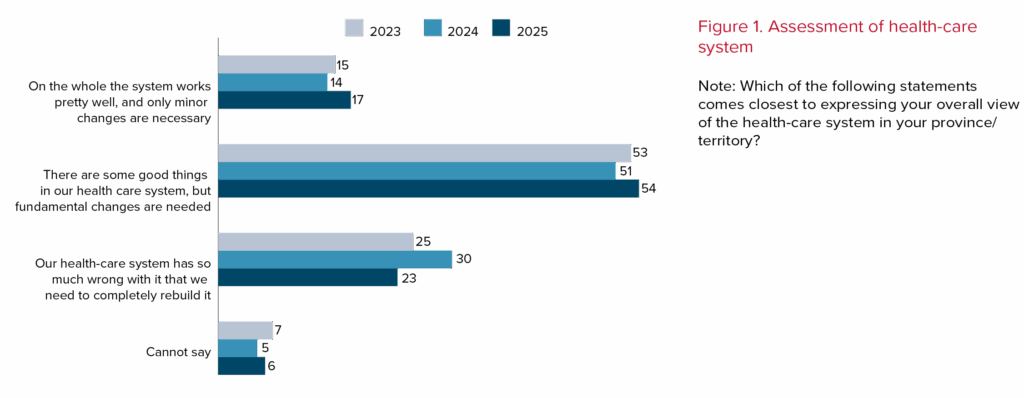
The proportion of Canadians who say that the health-care system in their province or territory has so much wrong with it that it needs to be completely rebuilt has declined by seven percentage points, from 30 to 23 per cent (see figure 1). At the same time, there have been small increases in the proportion of Canadians who say the system works well on the whole (up from 14 to 17 per cent) or that there are some good things in the system even if it needs fundamental change (up from 51 to 54 per cent).
This improvement since 2024 is evident in all provinces (but not in the North), as shown in figure 2. It is especially notable in the Maritime provinces, where the sense that the system needs to be completely rebuilt was previously much higher than average. Between 2024 and 2025, the proportion in the region holding this view dropped by 17 percentage points, from 45 to 28 per cent.

Access to treatment
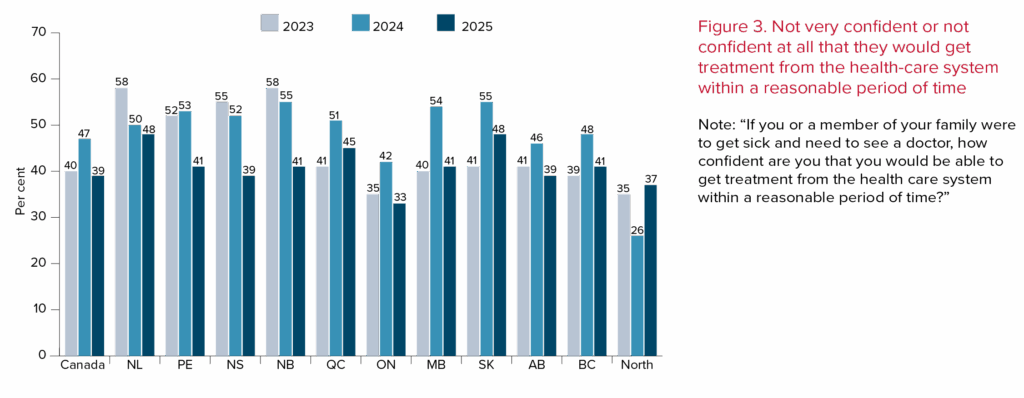
The main predictor of satisfaction with health care in Canada is perception of access to care.1 It follows, then, that the 2025 survey also shows an increase in the proportion of Canadians who are confident that they would get medical treatment in a reasonable period of time if they or a member of their family were to get sick. That proportion went from 51 per cent in 2024 to 58 per cent in 2025. The proportion that is not confident in accessing timely treatment has declined from 47 to 39 per cent overall, with a decline taking place in all provinces (but again, not in the territories). The Maritime provinces and Manitoba have seen the largest decrease in the proportion of respondents who are not confident in receiving timely access to care since 2024 (down by 13 percentage points in each case) (figure 3).
Trust in governments
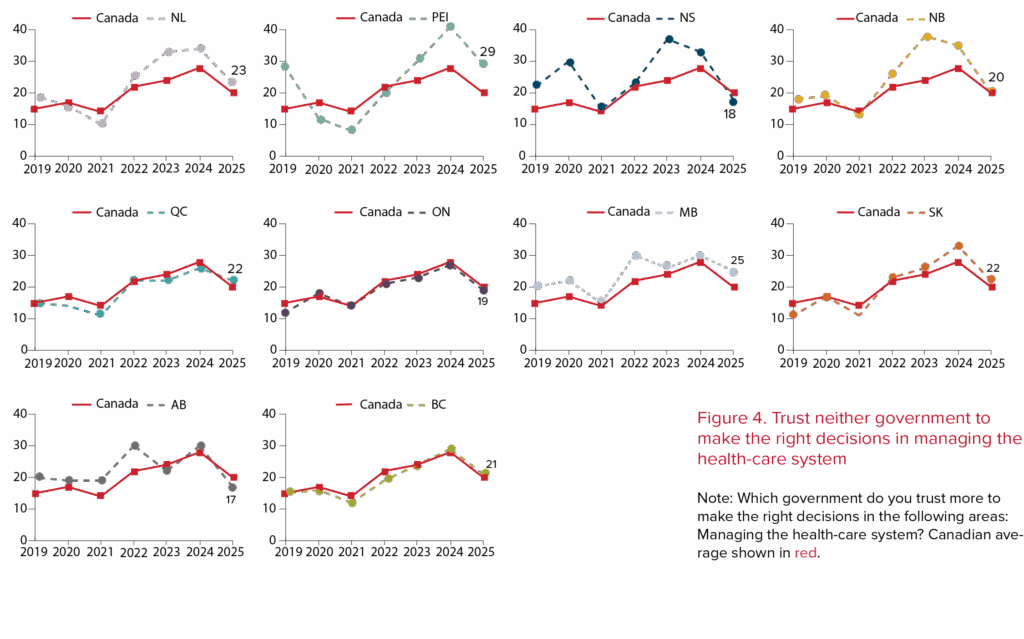
This overall improvement in the assessment of the health-care system is also reflected in the decline in the proportion of Canadians who trust neither their provincial government nor the federal government to manage the health-care system (figure 4). This proportion has fallen by eight percentage points since 2024 (from 28 to 20 per cent). Once again, this decline is seen in all provinces. It is greater than 10 percentage points in each of the four Atlantic provinces, as well as in Saskatchewan and Alberta.
It is hard to determine whether these changes reflect actual progress in access to treatment or just an improvement in perception. A cursory look at the Quebec government’s Tableau de bord2 on the performance of the health-care system shows an improvement in timely access to primary care from January 2024 (when the previous survey was conducted) to the spring of 2025 (when the most recent survey was conducted). Unfortunately, the Canadian Institute for Health Information does not provide recent data to verify if access to care improved in the last year in the rest of the country, but recent reports do not suggest any real improvement3 in access to care across Canada.
Moreover, the proportion of Canadians who trust neither government to deal with three other important issues — climate change, the economy and immigration — has also declined across the country since 2024.4 This suggests a general improvement in the political mood and in trust in government. Indeed, the 2024 survey was conducted as the Trudeau government was particularly unpopular, whereas the 2025 survey was conducted just after the election of the new Carney government, which was still in its “honeymoon” period.
The events following the return of U.S. President Donald Trump to the White House, including the imposition of tariffs and threats to Canada’s sovereignty, may have prompted some Canadians to feel more positively about their governments and the services they provide. The Confederation of Tomorrow survey finds there has been a modest increase in satisfaction with the direction of the country since 2024 (up from 36 to 41 per cent), as well as an increase in the proportion who think that the federal and provincial governments are working well together.
In any case, Canadians’ perception of their health-care system improved from 2024 to 2025, a finding that is also echoed in other surveys.5
Who should take the lead on health-care reform?
Because health care is inextricably linked to federalism in Canada, we included a new question in the 2025 survey asking which government should take the lead in reforming health care (figure 5). Overall, views in the country are split, as 42 per cent favour federal leadership, and 40 per cent look to their province (an additional 17 per cent do not take a position either way).

Ontarians (52 per cent) are by far the most likely to prefer the federal government to take the lead to ensure a national approach, whereas Quebecers (31 per cent) are the least likely to favour federal leadership. Along with Nova Scotians (52 per cent), Quebecers (48 per cent) are the most likely to prefer that the provincial governments take the lead in health care reforms (because the provinces actually run the health care system).
It is striking that opinions on this question have hardly shifted since it was last asked, almost 25 years ago. In 2001, 48 per cent of Canadians outside of Quebec preferred the federal government to take the lead on reforming health care to ensure a national approach; today that figure stands at 46 per cent. For Quebecers, federal leadership was favoured by only 32 per cent in 2001, identical to the 31 per cent today in the province who favour that option.6
Who wants their provincial governments to take the lead?
To dig deeper into the 2025 results, we determined which factors are most strongly associated with a preference for the provincial government taking the lead. The results are shown in figure 6.
Respondents who are not satisfied with health care, those who identify with their province more than with Canada, and those who resent the place of their province in the federation7 are more likely to want provinces to take the lead. In contrast, Liberal Party voters at the federal level are more likely to want the federal government to take the lead. Controlling for all these other variables, residents of Ontario, Newfoundland and Labrador, P.E.I. and Saskatchewan are less likely than Quebecers to support their provinces taking the lead on health care reform.
Figure 6 also shows that respondents who place themselves on the political right prefer that provinces take the lead, but our analysis reveals that this left-right divide is only relevant outside Quebec. Within Quebec, there is more left-right consensus in favour of provinces taking the lead. While voters on the political right outside Quebec are more likely than their left-wing counterparts to support provinces taking the lead, ideology is not a significant factor within Quebec. In fact, Quebecers on the political right are slightly less likely than those on the left to prefer provinces taking the lead.

This pattern is echoed on the question of which government is more trusted to manage the health-care system. Outside Quebec, those of the left (50 per cent) are more than twice as likely as those on the right (22 per cent) to place more trust in the federal government. Inside Quebec, there is no meaningful difference (25 per cent of Quebecers on the left and 27 per cent on the right trust the federal government more in this area).
These findings send a cautionary message to the federal NDP that it is unlikely to build support among the progressive electorate in Quebec if it continues to make federal expansion into health care one of its main campaign issues.
In brief, the 2025 Confederation of Tomorrow survey reveals a significant improvement in the public’s perception of the state of health care across the country, which is reflected in an increase in trust in the ability of governments to manage the system and in confidence in getting timely access to care. However, the country remains divided regarding which order of government should take the lead to implement the necessary reforms to improve the health-care system.
Notes
1 Jacques, O., & Perrot, M. (2024). Who’s to blame for the crisis of the healthcare system? Canadian Public Administration, 67(2), 249-265.
2 Gouvernement du Québec. (2025). Tableau de bord: Performance du réseau de la santé et des services sociaux.
3 Canadian Institute for Health Information. (2024). Better access to primary care key to improving health of Canadians.
4 Environics Institute. (2025). Working together in the Canadian Federation.
5 Institut économique de Montréal. (2025). La santé au Canada 2025. Rapport de recherche.
6 The 2001 data is from the Centre for Research and Information on Canada’s (CRIC’s) annual Portraits of Canada survey. The proportions outside and inside Quebec preferring provincial leadership have both declined slightly, as the proportions expressing no opinion have increased; this is likely a result of the switch of survey method from telephone to online.
7 Breton, C., Parkin, A., & Jacques, O. (2025, July 21). A less resentful federation? Findings from the 2025 Provincial Resentment Index. Bulletin No. 7. Centre of Excellence on the Canadian Federation.